Question
Consider a solid sphere of radius r and mass m that has a charge q distributed uniformly over its volume. The sphere is rotated about its diameter with an angular speed $\omega.$ Show that the magnetic moment $\mu$ and the angular momentum l of the sphere are related as $\mu=\frac{\text{q}}{2\text{m}}\text{l}.$
Answer


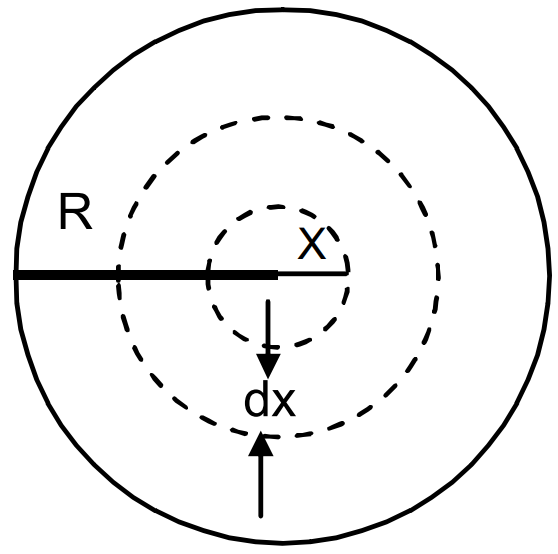
Considering a strip of width dx at a distance x from centre,
$\text{di}\frac{\text{dp}}{\text{dt}}=\frac{\text{q}4\pi\text{x}^2\text{dx}}{\Big(\frac{4}{3}\Big)\pi\text{R}^3\text{}}4\pi\text{x}^2\text{dx}$
$\text{di}=\frac{\text{dq}}{\text{dt}}=\frac{\text{q}4\pi\text{x}^2\text{dx}}{\Big(\frac{4}{3}\Big)\pi\text{R}^3\text{t}}=\frac{3\text{q}\text{x}^2\text{dx}\omega}{\text{R}^32\pi}$
$\text{d}\mu=\text{di}\times\text{A}=\frac{3\text{q}\text{x}^2\text{d}\text{x}\omega}{\text{R}^32\pi}\times4\pi\text{x}^{2\ =\ \frac{6\text{q}\omega}{\text{R}^3}\text{x}^4\text{dx}}$
$\mu=\int\limits_0^{\mu}\text{d}\mu\int\limits_0^{\text{R}}\frac{6\text{q}\omega}{\text{R}^3}\text{x}^4\text{dx}=\frac{6\text{q}\omega}{\text{R}^3}\Big[\frac{\text{x}^5}{5}\Big]_0$
$\text{R}=\frac{\text{6}\text{q}\omega\text{R}^5}{\text{R}^3}\frac{\text{R}^5}{5}=\frac{6}{5}\text{q}\omega\text{R}^2$

Need a full question paper?

Generate a complete, print-ready paper with questions like this in minutes — across 16+ boards, with answer keys.

Start Generating Free

Similar questions

  1. Estimate the speed with which electrons emitted from a heated emitter of an evacuated tube impinge on the collector maintained at a potential difference of 500 V with respect to the emitter. Ignore the small initial speeds of the electrons. The specific charge of the electron, i.e., its e/m is given to be $1.76 \times 10^{11}\ C\ kg^{–1}.$
  2. Use the same formula you employ in (a) to obtain electron speed for an collector potential of 10 MV. Do you see what is wrong? In what way is the formula to be modified?
The coil of an electric bulb takes 40 watts to start glowing. If more than 40W is supplied, 60% of the extra power is converted into light and the remaining into heat. The bulb consumes 100W at 220V. Find the percentage drop in the light intensity at a point if the supply voltage changes from 220V to 200V.
  1. Derive the mathematical relation between refractive indices $n_1$ and $n_2 $ of two radii and radius of curvature R for refraction at a convex spherical surface. Consider the object to be a point since lying on the principle axis in rarer medium of refractive index $n_1$ and a real image formed in the denser medium of refractive index $n_{2}$.Hence, derive lens maker's formula.
  2. Light from a point source in air falls on a convex spherical glass surface of refractive index 1.5 and radius of curvature 20 cm. The distance of light source from the glass surface is 100 cm. At what position is the image formed?
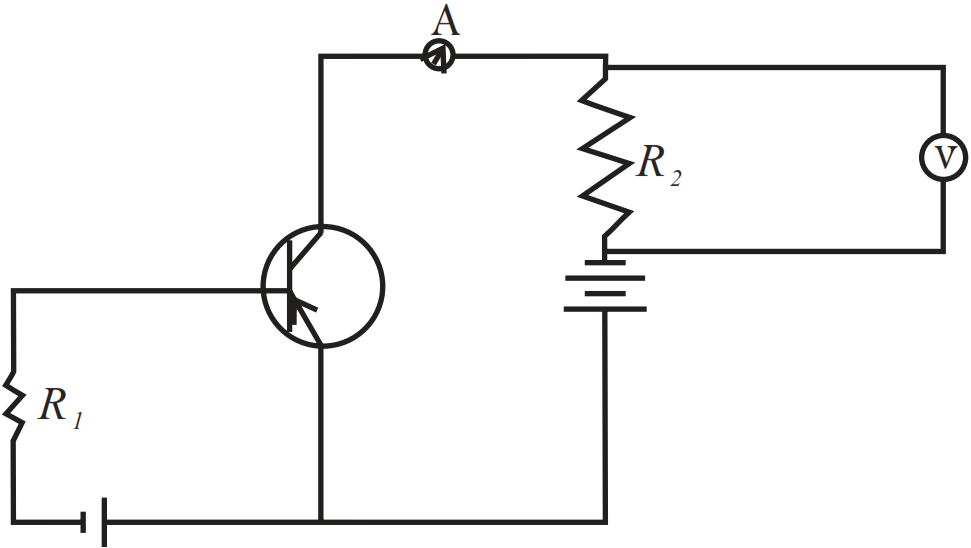
If the resistance $R_1$ is increased (Fig.), how will the readings of the ammeter and voltmeter change?
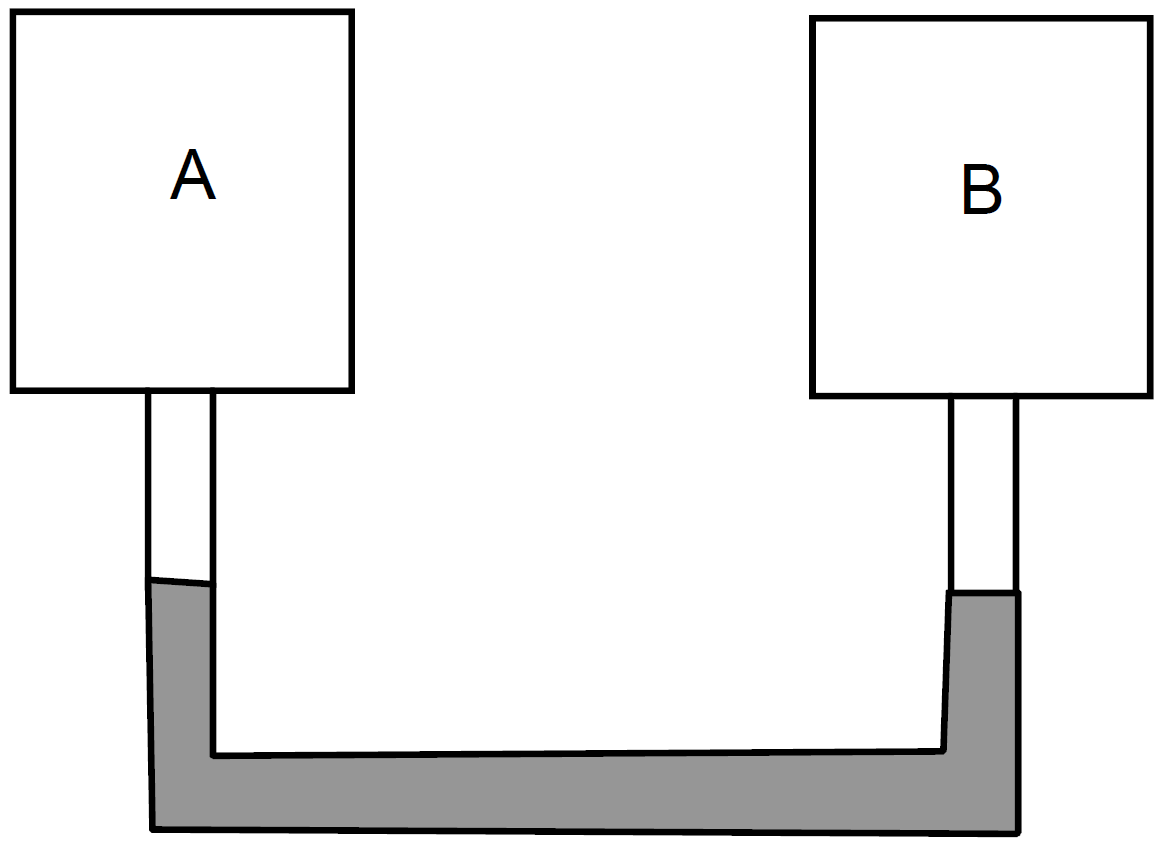
Figure shows two rigid vessels A and B, each of volume $200cm^3,$ containing an ideal gas $(C_v = 12.5JK^{-1}mol^{-1})$. The vessels are connected to a manometer tube containing mercury. The pressure in both the vessels is 75cm of mercury and the temperature is 300K.
  1. Find the number of moles of the gas in each vessel.
  2. 5.0J of heat is supplied to the gas in vessel A and 10J to the gas in vessel B. Assuming there's no appreciable transfer of heat from A to B, calculate the difference in the heights of mercury in the two sides of the manometer. Gas constant, $R = 8.3JK^{-1}mol^{-1}.$
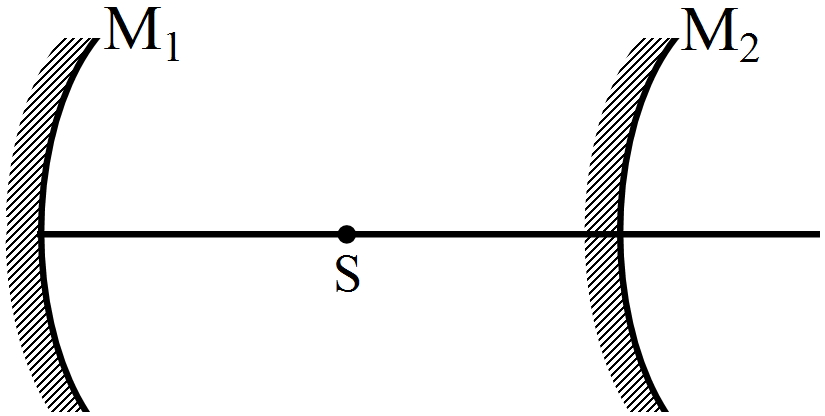
A converging mirror $M_1,$ a point source S and a diverging mirror $M_2$ are arranged as shown in figure. The source is placed at a distance of 30cm from $M_1$. The focal length of each of the mirrors is 20cm. Consider only the images formed by a maximum of two reflections. It is found that one image is formed on the source itself.
  1. Find the distance between the two mirrors.
  2. Find the location of the image formed by the single reflection from $M_2.$
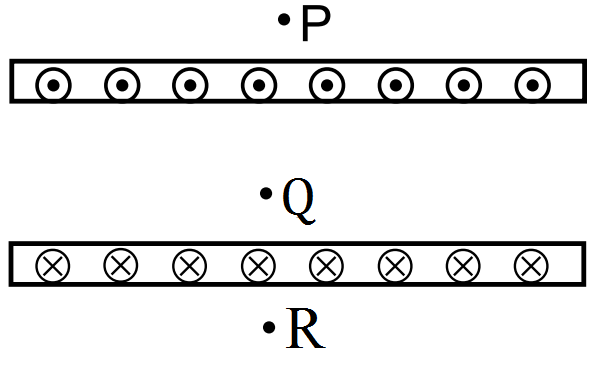
Two large metal sheets carry surface currents as shown in figure. The current through a strip of width dl is Kdl where K is a constant. Find the magnetic field at the points P, Q and R.
Consider a 20W bulb emitting light of wavelength $5000\mathring{\text{A}}$ and shining on a metal surface kept at a distance 2m. Assume that the metal surface has work function of 2eV and that each atom on the metal surface can be treated as a circular disk of radius $1.5\mathring{\text{A}}$.
  1. Estimate no. of photons emitted by the bulb per second. [Assume no other losses]
  2. Will there be photoelectric emission?
  3. How much time would be required by the atomc disk to receive energy equal to work function (2eV)?
  4. How many photons would atomic disk receive within time duration calculated in (iii) above?
  5. Can you explain how photoelectric effect was observed instantaneously?
Hint: Time calculated in part (iii) is from classical consideration and you may further take the target of surface area say $1cm^2$ and estimate what would happen?
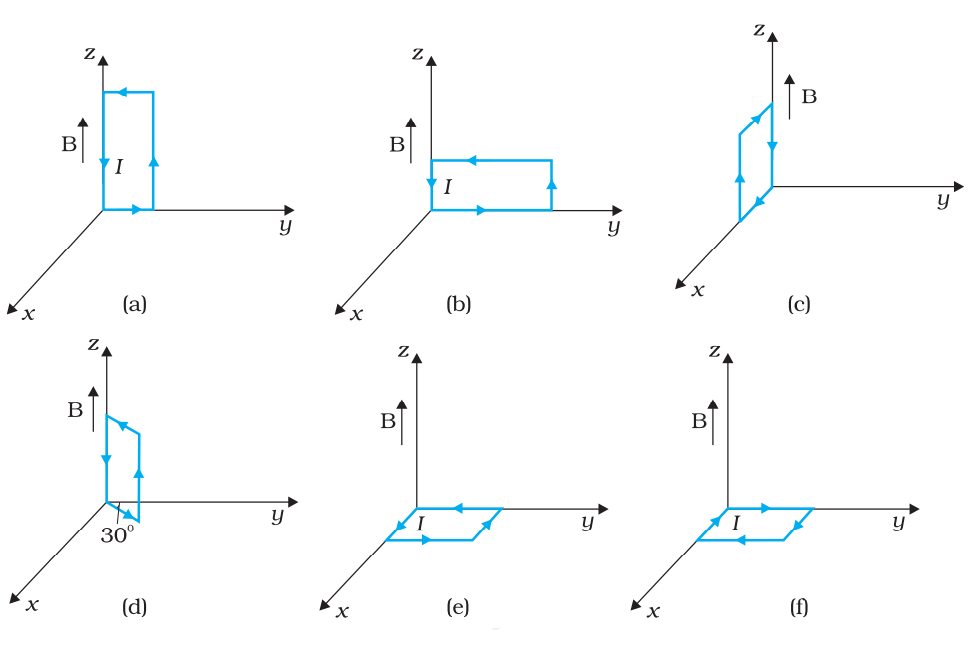
A uniform magnetic field of 3000 G is established along the positive z-direction. A rectangular loop of sides 10 cm and 5 cm carries a current of 12 A. What is the torque on the loop in the different cases shown in Fig.? What is the force on each case? Which case corresponds to stable equilibrium?
Two convex lenses, each of focal length 10cm, are placed at a separation of 15cm with their principal axes coinciding,
  1. Show that a light beam coming parallel to the principal axis diverges as it comes out of the lens system.
  2. Find the location of the virtual image formed by the lens system of an object placed far away.
  3. Find the focal length of the equivalent lens.
(Note that the sign of the focal length is positive although the lens system actually diverges a parallel beam incident on it).