Question
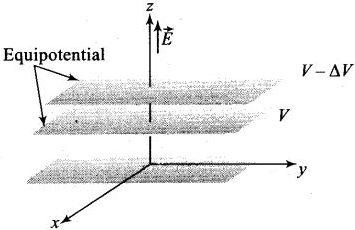
Consider a uniform electric field in the $\hat{\text{Z}}$ direction. The potential is a constant:

Answer

  1. For any x for a given z.
  2. For any y for a given z.
  3. On the x-y plane for a given z.
We know, the electric field intensity E and electric potential V are
$\text{E}=-\frac{\text{dV}}{\text{dr}}$

Electric potential decreases inf the direction of electric field. The direction of electric field is always perpendicular to one equipotential surface maintained at high electrostatic potential to other equipotential surface maintained at low electrostatic potential.
The electric field in z-direction suggest that equipotential surfaces are in x-y plane. Therefore the potential is a constant for any x for a given z, for any y for a given z and on the x-y plane for a given z.

Need a full question paper?

Generate a complete, print-ready paper with questions like this in minutes — across 16+ boards, with answer keys.
Start Generating Free

Similar questions

The rest mass of the photon is (a) 0(b) ∞(c) Between 0 and ∞(d) Equal to that of an electron
   
   
A proton $($or charged particle$)$ moving with velocity $v$ is acted upon by electric field $E$ and magnetic field $B.$ The proton will move undeflected if
If for a thermocouple $\mathrm{T}_{\mathrm{n}}$ is the neutral temperature, $\mathrm{T}_{\mathrm{c}}$ is the temperature of the cold junction and $\mathrm{T}_{\mathrm{i}}$ is the temperature of inversion, then
A man is 180 cm tall and his eyes are 10 cm  below the top of his head. In order to see his entire height right from toe to head, he uses a plane mirror kept at a distance of 1m from him. The minimum length of the plane mirror required is(a) 180 cm(b) 90 cm(c) 85 cm(d) 170 cm
       
Electroplating does not help in(a) Fine finish to the surface(b) Shining appearance(c) Metals to become hard(d) Protect metal against corrosion
   
   
The positive terminal of 12V battery is connected to the ground. Then the negative terminal will be at:
In the ideal double$-$slit experiment, when a glass$-$plate $($refractive index $1.5)$ of thickness $t$ is introduced in the path of one of the interfering beams $($wavelength $l),$ the intensity at the position where the central maximum occurred previously remains unchanged. The minimum thickness of the glass$-$plate is
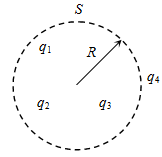
$q_1, q_2, q_3$ and $q_4$ are point charges located at points as shown in the figure and $S$ is a spherical Gaussian surface of radius $R$. Which of the following is true according to the Gauss’s law
The plate current in a diode is zero. It is possible that:
A charge of 5C  experiences a force of 5000 N when it is kept in a uniform electric field. What is the potential difference between two points separated by a distance of 1 cm (a) 10 V(b) 250 V (c) 1000 V (d) 2500 V