Question
  1. Write the expression for the force, $\overrightarrow{\text{F}}$, acting on a charged particle of charge 'q', moving with a velocity$\overrightarrow{\text{v}}$ in the presence of both electric field $\overrightarrow{\text{E}}$and magnetic field $\overrightarrow{\text{B}}.$ Obtain the condition under which the particle moves undeflected through the fields.
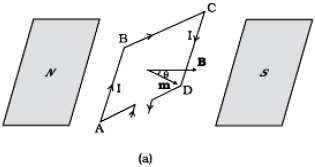
  2. A rectangular loop of size l x b carrying a steady current I is placed in a uniform magnetic field $\overrightarrow{\text{B}}.$ Prove that the torque$\overrightarrow{\tau}$ acting on the loop is given by $\overrightarrow{\tau} =\overrightarrow{\text{m}}\times\overrightarrow{\text{B},}$were $\overrightarrow{\text{m}}$is the magnetic moment of the loop.
Answer

  1. $\overrightarrow{\text{F}} = \text{q}[\overrightarrow{\text{E}} + (\overrightarrow{\nu}\times\overrightarrow{\text{B}})]$
Condition for undeflected motion
$\overrightarrow{\text{F}} - 0 $
$\rightarrow\text{q}[\overrightarrow{\text{E}} + (\overrightarrow{\nu}\times\overrightarrow{\text{B}})] = 0$
$\Rightarrow\overrightarrow{\text{E}} + \overrightarrow{\nu}\times\overrightarrow{\text{B}} = 0$
$\Rightarrow\overrightarrow{\text{E}} = - (\overrightarrow{\nu}\times\overrightarrow{\text{B}})$
or $\overrightarrow{\text{E}} - \overrightarrow{\text{E}}\times\overrightarrow{\nu}\text{ or }\text{ E} = \text{B } v \sin\theta$
$ =\text{B} \text{v}( \text{When }\theta = 90^{o})$
giving v = E/B when E, B and v are mutually perpendicular.
  1.  


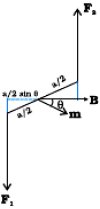
$F_1 = F_2 = IbB$
$\overrightarrow{\tau} = \text{F}_{1}\frac{\text{a}}{2}\sin\theta + \text{F}_{2}\frac{\text{a}}{2}\sin\theta$
$ = \text{I abB} \sin \theta$
$ = \text{I AB }\sin\theta$
But $\text{m} = \text{I A }$
$\therefore\tau = \text{mB}\sin\theta$
$\overrightarrow{\tau} = \overrightarrow{\text{m}}\times\overrightarrow{\text{B}}$
Hence, The sense of $\overrightarrow{\tau}$ is in the sense of $\overrightarrow{\text{m}}\times\overrightarrow{\text{B}}.$

Need a full question paper?

Generate a complete, print-ready paper with questions like this in minutes — across 16+ boards, with answer keys.

Start Generating Free

Similar questions

  1. Explain, giving reasons, the basic difference in converting a galvanometer into (i) a voltmeter and (ii) an ammeter.
  2. Two long straight parallel conductors carrying steady currents $I_1$ and $I_2$ are separated by a distance 'd'. Explain briefly, with the help of a suitable diagram, how the magnetic field due to one conductor acts on the other. Hence deduce the expression for the force acting between the two conductors. Mention the nature of this force.
An atom is in its excited state. Does the probability of its coming to ground state depend on whether the radiation is already present or not? If yes, does it also depend on the wavelength of the radiation present?
Write advantages and disadvantages of ac over dc and explain applied ac voltage over resistor.
Answer the following question:
It is necessary to use satellites for long distance TV transmission. Why?
An eye can distinguish between two points of an object if they are separated by more than 0.22mm when the object is placed at 25cm from the eye. The object is now seen by a compound microscope having a 20D objective and 10D eyepiece separated by a distance of 20cm. The final image is formed at 25cm from the eye. What is the minimum separation between two points of the object which can now be distinguished?
Define induction coefficient. Explain the phenomenon of mutual inductance with the help of an experiment. Obtain an expression for mutual inductance coefficient of two solenoids and prove that $M=\sqrt{L_1 L_2}$.
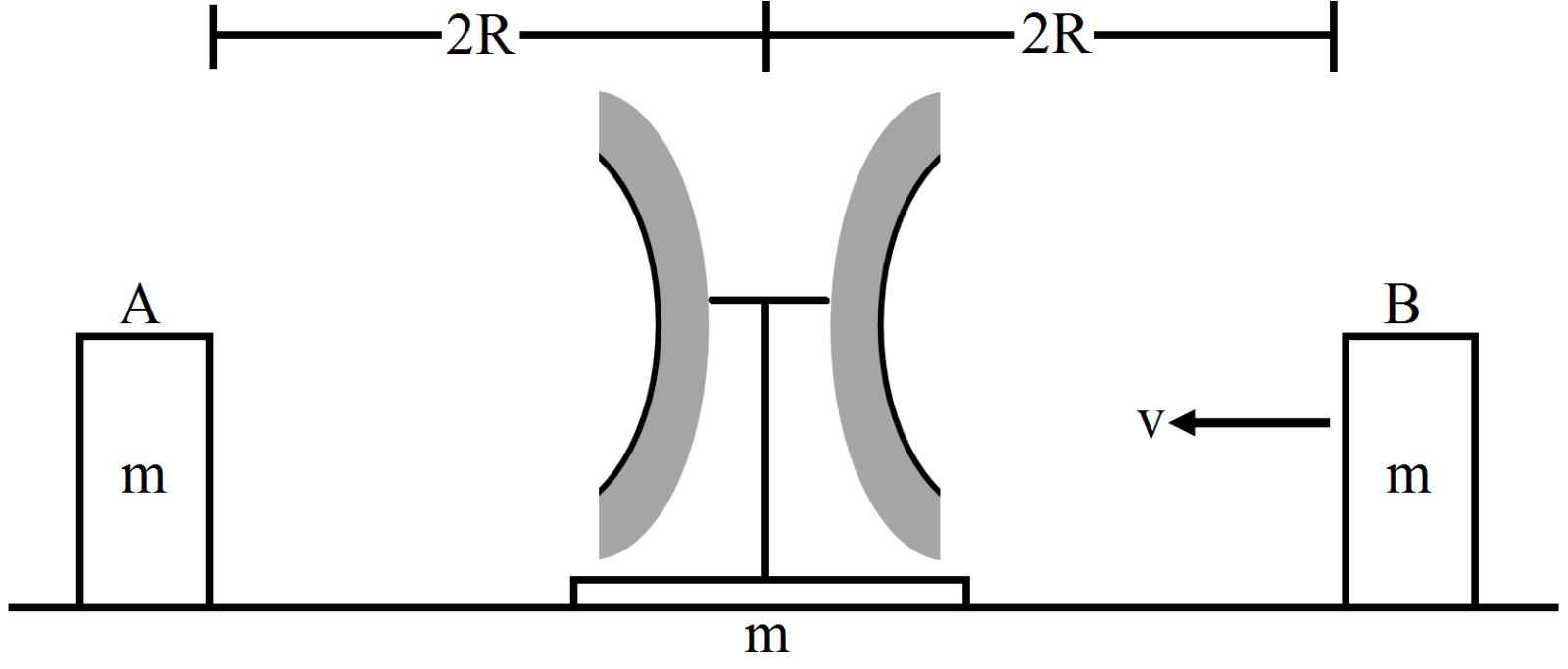
Two concave mirrors of equal radii of curvature R are fixed on a stand facing opposite directions. The whole system has a mass m and is kept on a frictionless horizontal table. Two blocks A and B, each of mass m, are placed on the two sides of the stand. At t = 0, the separation between A and the mirrors is 2 R and also the separation between B and the mirrors is 2 R. The block B moves towards the mirror at a speed v. All collisions which take place are elastic. Taking the original position of the mirrors-stand system to be x = 0 and X-axis along AB, find the position of the images of A and B at t =
  1. $\frac{\text{R}}{\text{v}}$
  2. $\frac{3\text{R}}{\text{v}}$
  3. $\frac{5\text{R}}{\text{v}}$
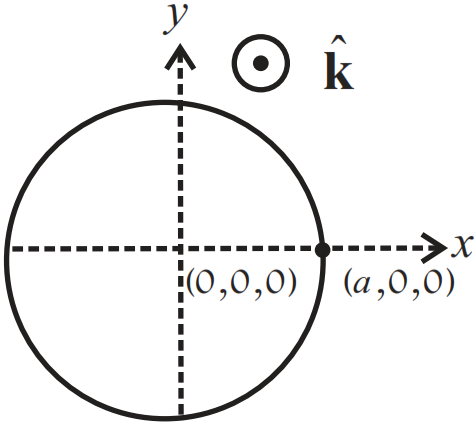
A magnetic field in a certain region is given by $\text{B}=\text{B}_0\cos(\omega\text{t})\hat{\text{k}}$ and a coil of radius a with resistance R is placed in the x-y plane with its centre at the origin in the magnetic field (see Fig). Find the magnitude and the direction of the current at (a, 0, 0) at $\text{t}=\frac{\pi}{2\omega},\text{t}=\frac{\pi}{\omega} \text{ and }\text{t}=\frac{3\pi}{2\omega}$.
A car accelerates on a horizontal road due to the force exerted by:
  1. The engine of the car.
  2. The driver of the car.
  3. The earth.
  4. The road.
When a Coolidge tube is operated for some time it becomes hot. Where does the heat come from?