Question
Consider an npn transitor with its base-emitter junction forward biased and collector base junction reverse biased. Which of the following statements are true?

Answer

  1. Electrons crossover from emitter to collector.
  1. Electrons move from emitter to base.
Solution:
Key concept: Transistor:
A junction transistor is formed by sandwiching a thin layer of P-type semiconductor between two N-type semiconductors or by sandwiching a thin layer of N-type semiconductor between two p-type semiconductors.
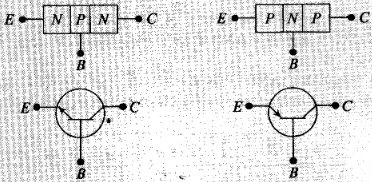
E - Emitter (emits majority charge carriers)
C - Collects majority charge carries
B - base (provide proper interaction between E and C)
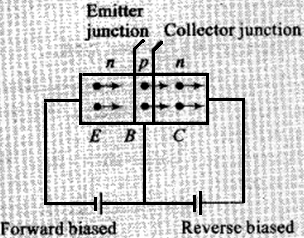
In normal operation base-emitter is forward biased, i.e., the positive pole of emitter base battery is connected to base and its negative pole is connected to the emitter. And collector base junction is reverse biased, i.e., the positive pole of the collector base battery is connected to collector and negative pole to base. Thus, electron moves from emitter to base and crossover from emitter to collector.

Need a full question paper?

Generate a complete, print-ready paper with questions like this in minutes — across 16+ boards, with answer keys.

Start Generating Free

Similar questions

Material A has critical angle $\mathrm{i}_{\mathrm{A}}$,  and material B has critical angle $i_B\left(i_B>i_A\right)$. Then which of the following is true
$(i)$ Light can be totally internally reflected when it passes from $B$ to $A$
$(ii)$ Light can be totally internally reflected when it passes from $A$ to $B$
$(iii)$ Critical angle for total internal reflection is $i_B-i_A$ 
$(iv)$ Critical angle between $A$ and $B$ is $\sin ^{-1}\left(\frac{\sin i_A}{\sin i_B}\right)$
Two wires of same size whose resistivities$\rho_1$ are $\rho_2$ and are joined in series. The equivalent resistivity of the combination will be:
An experiment is performed to find the refractive index of glass using a travelling microscope. In this experiment distances are measured by:
Two identical parallel plate capacitors are connected in series to a battery of 100 V. A dielectric slab of dielectric constant 4.0 is inserted between the plates of second capacitor.  The potential difference across the capacitors will now be respectively(a) 50 V, 50 V(b) 80 V, 20 V(c) 20 V, 80 V(d) 75 V, 25 V
       
An AC source rated 100V (rms) supplies a current of 10A (rms) to a circuit. The average power delivered by the source:
  1. Must be 1000W.
  2. May be 1000W.
  3. May be greater than 1000W.
  4. May be less than 1000W.
The magnetic moment of a current carrying loop is $2.1 \times 10^{-25} \ce{amp \times m ^2}$. The magnetic field at a point on its axis at a distance of $1 \mathring A$  is
A charged particle would continue to move with a constant velocity in a region wherein:
When cathode rays strike a metal target of high melting point with very high velocity, then(a) X-rays are produced(b) Ealpha-rays are produced(c) TV waves are produced(d) Ultrasonic waves are produced
   
   
The formula of kinetic mass of a photon is :
As compared to $^{12}C$ atom $,^{14}C$ atom has: