A wire of resistance $x$ ohm is drawn out, so that its length is increased to twice its original length, and its new resistance becomes $20 \,\Omega$, then $x$ will be ........ $\Omega$
Easy


Download our appand get started for free
Experience the future of education. Simply download our apps or reach out to us for more information. Let's shape the future of learning together!No signup needed.*
Similar Questions
- 1A rod of length $l$ with thermally insulated lateral surface is made of a material whose thermal conductivity $K$ varies as $K = C/T$ , where $C$ is a constant. The ends are at temperatures $T_1$ and $T_2$ . The heat current density isView Solution
- 2A wire $50\, cm$ long and $1\;mm^2$ in cross -section carries a current of $4\; A$ when connected to a $2\; V$ battery. The resistivity of the wire isView Solution
- 3A potentiometer is an accurate and versatile device to make electrical measurements of $EMF$ because the method involvesView Solution
- 4Two wires $A$ and $B$ of the same material, having radii in the ratio $1: 2$ carry currents in the ratio $4: 1$. The ratio of drift speed of electrons in $A$ and $B$ is .......View Solution
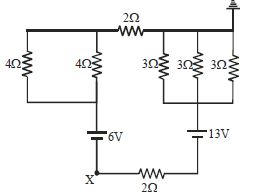
- 5Find potential at point $'x'$ in given circuit ............... $V$View Solution
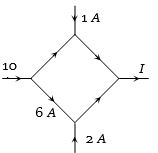
- 6The figure shows a network of currents. The magnitude of currents is shown here. The current $I$ will be ........... $A$View Solution
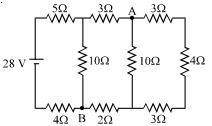
- 7View SolutionConsider the circuit shown in the figure
- 8A cell of internal resistance $r$ drives current through an external resistance $R$ . The power delivered by the cell to the external resistance will be maximum when:View Solution
- 9The supply voltage to room is $120\ V$. The resistance of the lead wires is $6\,\Omega$ . A $60\ W$ bulb is already switched on. What is the decrease of voltage across the bulb, when a $240\ W$ heater is switched on in parallel to the bulb? ............. $V$View Solution
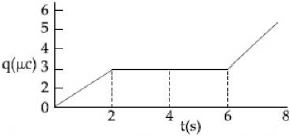
- 10The charge on a capacitor plate in a circuit, as a function of time, is shown in the figureView Solution
What is the value of current at $t = 4\,s$ ? ............... $\mu A$