MCQ
Consider the circuit shown in the figure. The current $I_3$ is equal to
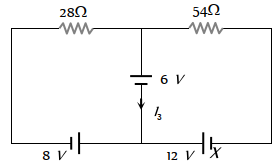
Image
  • $5 \mathrm{amp}$
  • B
    $3 \mathrm{amp}$
  • C
    $-3 \mathrm{amp}$
  • D
    $-5 / 6 a m p$

Answer

Correct option: A.
$5 \mathrm{amp}$
For same material and same length$\frac{R_2}{R_1}=\frac{A_1}{A_2}=\frac{3}{2}$
$\Rightarrow R_2=3 R_1$
Resistance of thick wire $R_1=10 \Omega$
$\therefore$ Resistance of thin wire $R_2=30 \Omega$
Total resistance in series $=10+30=40 \Omega$

Need a full question paper?

Generate a complete, print-ready paper with questions like this in minutes — across 16+ boards, with answer keys.

Start Generating Free

Similar questions

Ray optics is valid, when characteristic dimensions are
A wire of length $50 cm$ and cross sectional area of $1 sq . mm$ is extended by $1 mm$. The required work will be $\left(Y=2 \times 10^{10} Nm ^{-2}\right)$
A very small magnet is placed in the magnetic meridian with its south pole pointing north. The null point is obtained $20 \mathrm{~cm}$ away from the centre of the magnet. If the earth's magnetic field (horizontal component) at this point be $0.3$ gauss, the magnetic moment of the magnet is
The frequencies of two sound sources are $256 \mathrm{~Hz}$ and $260 \mathrm{~Hz}$. At $t$ $=0$, the intensity of sound is maximum. Then the phase difference at the time $t=1 / 16\  \mathrm{sec}$ will be
Refractive index of glass is $\frac{3}{2}$ and refractive index of water is $\frac{4}{3}$. If the speed of light in glass is $2.00 \times 10^8 \mathrm{~m} / \mathrm{s}$, the speed in water will be
In a forward biased $P N$-ju nction diode, the potential barrier in the depletion region is of the form ...
Photoelectric emission is observed from a metallic surface for frequencies $v_1$ and $v_2$ of the incident light rays $\left(v_1>v_2\right)$. If the maximum values of kinetic energy of the photoelectrons emitted in the two cases are in the ratio of $1: k$, then the threshold frequency of the metallic surface is
Pick out the statement which is not true
A lorry and a car moving with the same K.E. are brought to rest by applying the same retarding force, then
If heat given to a system is $6 \mathrm{kcal}$ and work done is $6 \mathrm{~kJ}$. Then change in internal energy is