MCQ
Consider the following statement: When jumping from some height, you should bend your knees as you come to rest, instead of keeping your legs stiff. Which of the following relations can be useful in explaining the statement
  • A
    $\Delta \overrightarrow {{P_1}} = - \Delta \overrightarrow {{P_2}} $
  • B
    $\Delta E = - \Delta (PE + KE) = 0$
  • $\overrightarrow F \Delta t = m\Delta \overrightarrow v $
  • D
    $\Delta \overrightarrow x \propto \Delta \overrightarrow F $
Answer

Correct option: C.
$\overrightarrow F \Delta t = m\Delta \overrightarrow v $
c
(c)$\overrightarrow F \Delta t = m\Delta \overrightarrow v $  $⇒$  $F = \frac{{m\Delta \overrightarrow v }}{t}$

By doing so time of change in momentum increases and impulsive force on knees decreases.

Need a full question paper?

Generate a complete, print-ready paper with questions like this in minutes — across 16+ boards, with answer keys.

Start Generating Free

Similar questions

The maximum potential energy of a block executing simple harmonic motion is $25\,J$. A is amplitude of oscillation. At $A / 2$, the kinetic energy of the block is $...............$
A hydraulic automobile lift is designed to lift cars with a maximum mass of $3000\, kg$. The area of cross section a of piston carrying the load is $425\, cm ^{2}$. What is the maximum pressure () would smaller piston have to bear ?
Inside a uniform spherical shell:
  1. The gravitational potential is zero.
  2. The gravitational field is zero.
  3. The gravitational potential is same everywhere.
  4. The gravitational field is same everywhere.
An ideal heat engine exhausting heat at $27^\circ C$ is to have $25\%$ efficiency. It must take heat at:
The time taken by an object to slide down $45^{\circ}$ rough inclined plane is $n$ times as it takes to slide down a perfectly smooth $45^{\circ}$ incline plane. The coefficient of kinetic friction between the object and the incline plane is
$A$ smooth sphere is moving on a horizontal surface with a velocity vector $(\,2\,\hat i + 2\,\hat j\,)$ $m/s$ immediately before it hit a vertical wall. The wall is parallel to vector $\hat j$ and coefficient of restitution between the sphere and the wall is $e = 1/2$ . The velocity of the sphere after it hits the wall is
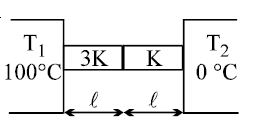
Two rods $A$ and $B$ of same cross-sectional are $A$ and length $l$ connected in series between a source $(T_1 = 100^o C)$ and a sink $(T_2 = 0^o C)$ as shown in figure. The rod is laterally insulated  If $G_A$ and $G_B$ are the temperature gradients across the rod $A$ and $B$, then 
If the $rms$ speed of oxygen molecules at $0^{\circ} {C}$ is $160\; {m} / {s}$, find the rms speed of hydrogen molecules at $0^{\circ} {C}$. (In ${m}/{s}$)
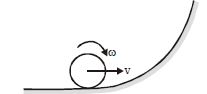
A solid sphere rolling without slipping on a horizontal rough surface and starts rising on inclined rough surface as shown in the figure assume pure rolling throughout the motion. Choose the $INCORRECT$ statement
A moving charge produces: