Question
Construct an isosceles triangle whose base is 8cm and altitude 4cm and then another triangle whose sides are $1\frac12\text{times}$ the corresponding sides of the isosceles triangle.
Answer


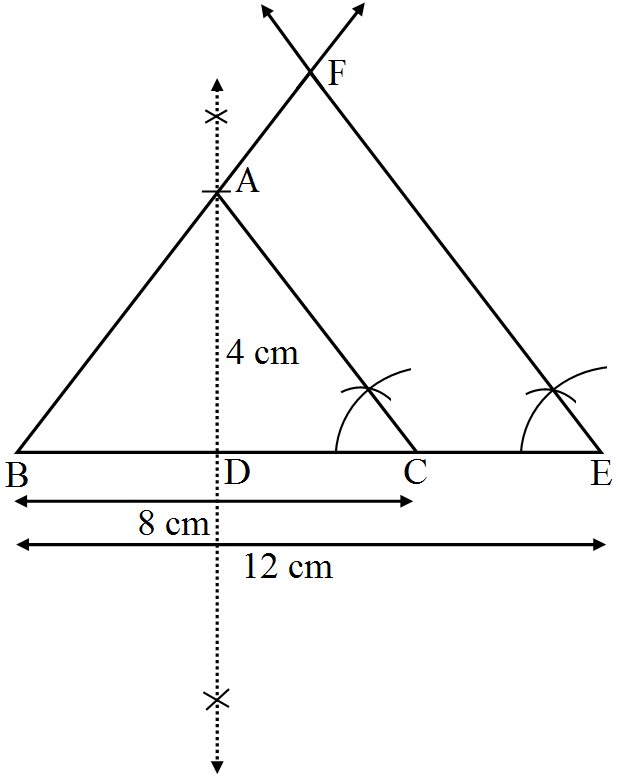
Steps of Construction:
Step 1. Draw a line segment BC = 8cm.
Step 2. Draw the perpendicular bisector XY of BC, cutting BC at D.
Step 3. With D as centre and radius 4cm, draw an arc cutting XY at A.
Step 4. Join AB and AC. Thus, an isosceles $\triangle\text{ABC}$ whose base is 8cm and altitude 4cm is obtained.
Step 5. Extend BC to E such that $\text{BE}=\frac{3}{2}\text{BC}=\frac32\times8\text{cm}=12\text{cm}.$
Step 6. Draw EF || CA, cutting BA produced in F.
Here, $\triangle\text{BEF}$ is the required triangle similar to $\triangle\text{ABC}$ such that each side of $\triangle\text{BEF}$ is $1\frac12$ or $\Big(\frac32\Big)\text{times}$ the corresponding side of $\triangle\text{ABC}.$

Need a full question paper?

Generate a complete, print-ready paper with questions like this in minutes — across 16+ boards, with answer keys.
Start Generating Free

Similar questions

Two dice are thrown together. Find the probability that the product of the numbers on the top of the dice is:
  1. 6
  2. 12
  3. 7
Solve the following system of equations by the method of cross-multiplication:
$\text{ax}+\text{by}=\frac{\text{a}+\text{b}}{2}$
$3\text{x}+5\text{y}=4$
From an external point P, two tangents, PA and PB are drawn to a circle with centre O. At one point E on the circle tangent is drawn which intersects PA and PB at C and D, respectively. If PA = 10cm, find the the perimeter of $\triangle\text{PCD}.$
If $a d \neq b c$ then prove that the equation $\left(a^2+b^2\right) x^2+2(a c+b d) x+\left(c^2+d^2\right)=0$ has no real roots.
A flag pole 18m high casts a shadow 9.6m long. Find the distance of the top of the pole from the far end of the shadow.
A kite is flying at a height of 75m from the level~round, a ched to a string inclined at 60° to the hori ontal. Find th length of the string, assuming that there is no slack in it.$\big[\text{Take}\sqrt{3}=1.732\big]$
In the given figure, $A B C$ and $D B C$ are two triangles on the same base $B C$. If $A D$ intersects $B C$ at $O$, show that $\frac{\operatorname{ar}(\triangle A B C)}{\operatorname{ar}(\triangle D B C)}=\frac{A O}{D O}$
Image
A leading library has a fixed charge for the first three days and an additional charge for each day thereafter Sarika paid $₹ 27$ for a book kept for seven days, while Sury paid $₹ 21$ for the book she kept for five days, find the fixed charge and the charge for each extra day
A wooden toy was made by scooping out a hemisphere of same radius from each end of a solid cylinder. If the height of the cylinder is 10cm and its base is of radius 3.5cm, then find the volume of wood in the toy.
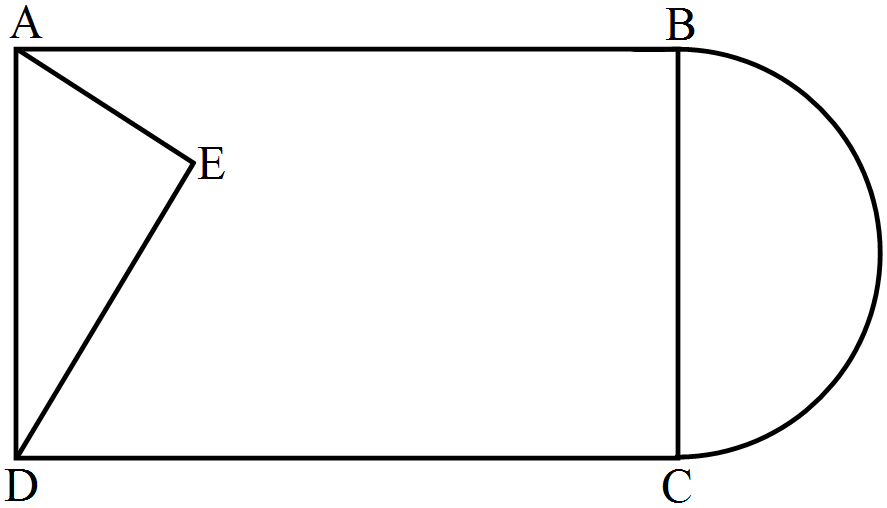
In the given figure, from a rectangular region ABCD with AB = 20cm, a right triangle AED with AE = 9cm and DE = 12cm, is cut off. On the other end, taking BC as diameter, a semicircle is added on outside the region. Find the area of the shaded region. $\big[\text{Use }\pi=3.14\big]$