Construction of submarines is based on
Easy
Download our app for free and get started
(a) construction of a submarine is based on Archimedes' principle.

Download our appand get started for free
Experience the future of education. Simply download our apps or reach out to us for more information. Let's shape the future of learning together!No signup needed.*
Similar Questions
- 1A cube of edge length $10 \,cm$ is just balanced at the interface of two liquids $A$ and $B$ as shown in figure. If $A$ and $B$ has specific gravity $0.6$ and $0.4$ respectively, then mass of cube is ................ $g$View Solution

- 2An air bubble of $1\, cm$ radius is rising at a steady rate of $2.00\, mm/sec$ through a liquid of density $1.5\, gm$ per $cm^3$. Neglect density of air. If $g$ is $1000\, cm/sec^2$, then the coefficient of viscosity of the liquid isView Solution
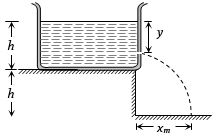
- 3A tank is filled upto a height $h$ with a liquid and is placed on a platform of height h from the ground. To get maximum range ${x_m}$ a small hole is punched at a distance of $y$ from the free surface of the liquid. ThenView Solution
- 4An empty balloon weighs $1\, g$. The balloon is filled with water to the neck and tied with a massless thread. The weight of balloon alongwith water is $101\, g$. The balloon filled with water is weighed when fully immersed. Then, its weight in water is ...... $g$View Solution
- 5A thin tube sealed at both ends is $100\, cm$ long. It lies horizontally, the middle $20\, cm$ containing mercury and two equal ends containing air at standard atmospheric pressure . If the tube is now turned to a vertical position, by what amount will the mercury be displaced ? (Given : cross-section of the tube can be assumed to be uniform) ........ $cm$View Solution

- 6During blood transfusion the needle is inserted in a vein where the gauge pressure is $2000 \;Pa$. At what height (in $m$) must the blood container be placed so that blood may just enter the vein ?View Solution
Density of whole blood, $\rho=1.06 \times 10^{3} \;kg m ^{-3}$
- 7A spherical solid ball of volume $V$ is made of a material of density $\rho_1$ . It is falling through a liquid of density $\rho_2 (\rho_2 < \rho_1 )$. Assume that the liquid applies a viscous force on the ball that is proportional to the square of its speed $v$, i.e., $F_{viscous}= -kv^2 (k >0 )$,The terminal speed of the ball isView Solution
- 8Consider a solid sphere of radius $\mathrm{R}$ and mass density $\rho(\mathrm{r})=\rho_{0}\left(1-\frac{\mathrm{r}^{2}}{\mathrm{R}^{2}}\right), 0<\mathrm{r} \leq \mathrm{R} .$ The minimum density of a liquid in which it will float isView Solution
- 9A train with cross-sectional area $S _{ t }$ is moving with speed $v_t$ inside a long tunnel of cross-sectional area $S _0\left( S _0=4 S _{ t }\right)$. Assume that almost all the air (density $\rho$ ) in front of the train flows back between its sides and the walls of the tunnel. Also, the air flow with respect to the train is steady and laminar. Take the ambient pressure and that inside the train to be $p _0$. If the pressure in the region between the sides of the train and the tunnel walls is $p$, then $p _0- p =\frac{7}{2 N } \rho v_{ t }^2$. The value of $N$ is. . . . .View Solution
- 10An air bubble of $1\, cm$ radius is rising at a steady rate of $2.00\, mm/sec$ through a liquid of density $1.5\, gm$ per $cm^3$. Neglect density of air. If $g$ is $1000\, cm/sec^2$, then the coefficient of viscosity of the liquid isView Solution