It takes $10$ minutes to cool a liquid from $61^oC$ to $59^oC$. If room temperature is $30^oC$ then time taken in cooling from $51^oC$ to $49^oC$ is ....... $\min$
Medium


Download our appand get started for free
Experience the future of education. Simply download our apps or reach out to us for more information. Let's shape the future of learning together!No signup needed.*
Similar Questions
- 1Spheres $P$ and $Q$ are uniformly constructed from the same material which is a good conductor of heat and the radius of $Q$ is thrice the radius of $P$. The rate of fall of temperature of $P$ is $x$ times that of $Q$ when both are at the same surface temperature. The value of $x$ is :View Solution
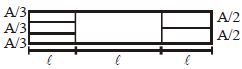
- 2For the shown figure, calculate the equivalent thermal resistance if the bricks made of the same material of conductivity $K$View Solution
- 3Two friends $A$ and $B$ are waiting for another friend for tea. $A$ took the tea in a cup and mixed the cold milk and then waits. $B$ took the tea in the cup and then mixed the cold milk when the friend comes. Then the tea will be hotter in the cup ofView Solution
- 4A spherical black body with a radius of $12\ cm$ radiates $450\ watt$ power at $500\ K$. If the radius were halved and the temperature doubled, the power radiated in watt would beView Solution
- 5View SolutionThe Wien’s displacement law express relation between
- 6If $\lambda_{ m }$ denotes the wavelength at which the radioactive emission from a black body at a temperature $T \;K$ is maximum, thenView Solution
- 7$Assertion :$ Woolen clothes keep the body warm in winterView Solution
$Reason :$ Air is a bad conductor of heat. - 8The radiant energy from the sun incident normally at the surface of earth is $20\, \frac{{k\;cal}}{{{m^2}\;min}}$. What would have been the radiant energy incident normally on the earth, if the sun had a temperature twice of the present one ....... $kcal/m ^2 \,min$View Solution
- 9The figure shows a system of two concentric spheres of radii $r_1$ and $r_2$ and kept at temperatures $T_1$ and $T_2$, respectively. The radial rate of flow of heat in a substance between the two concentric spheres is proportional toView Solution

- 10A liquid cools from $50^oC$ to $45^oC$ in 5 minutes and from $45 ^o C$ to $41.5 ^o C$ in the next $5$ minutes. The temperature of the surrounding is ...... $^oC$View Solution