MCQ
Cylindrical lenses are used to correct the eye defect called :
  • A
    Myopia
  • B
    Hypermetropia
  • Astigmatism
  • D
    Presbyopia

Answer

Correct option: C.
Astigmatism
C

Need a full question paper?

Generate a complete, print-ready paper with questions like this in minutes — across 16+ boards, with answer keys.

Start Generating Free

Similar questions

If $\lambda_1$ and $\lambda_2$ are the wavelengths of characteristic $X-$rays and gamma rays respectively, then the relation between them is
When a semiconductor is heated, its resistance(a) Decreases(b) Increases(c) Remains unchanged(d) Nothing is definite
       
A convex lens is made of a material having refractive index $1.2$. Both the surfaces of the lens are convex. If it is dipped into water $(\mu=1.33),$ it will behave like$:$
Let $i_E, i_C$ and $i_B$ represent the emitter current, the collector current and the base current respectively in a transistor. Then,
Phase difference between any two points of a wavefront is
The universal property among all substances is
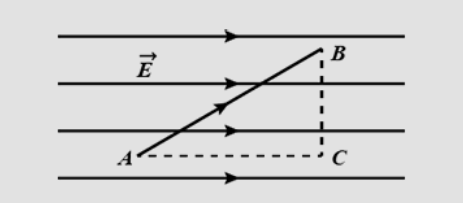
An electron is taken from point $A$ to point $B$ along the path $AB$ in a uniform electric field of intensity $E = 10Vm^{−1}.$ Side $AB = 5m,$ and side $BC = 3m.$ Then, the amount of work done on the electron by us is:
An electron $($mass $= 9.1 \times 10^{-19} \mathrm{~kg} ;$ charge $=1.6 \times 10^{-19} C)$ experiences no deflection if subjected to an electric field of $3.2 \times 10^5 \mathrm{V} / \mathrm{m},$ and a magnetic fields of $2.0 \times 10^{-3}\ \mathrm{Wb} / \mathrm{m}^2.$ Both the fields are normal to the path of electron and to each other. If the electric field is removed, then the electron will revolve in an orbit of radius
The absorption transitions between the first and the fourth energy states of hydrogen atom are 3. The emission transitions between these states will be     (a) 3 (b) 4(c) 5  (d) 6
       
Assertion   :   Inductance coil are made of copper.
Reason       : Induced current is more in wire having less resistance.(a) If both assertion and reason are true and the reason is the correct explanation of the assertion.(b) If both assertion and reason are true but reason is not the correct explanation of the assertion.(c) If assertion is true but reason is false.(d) If the assertion and reason both are false.