Questions

M.C.Q (1 Marks)

Take a timed test

43 questions · auto-graded multiple-choice test.
MCQ 11 Mark
In a white light spectrum produced by dispersion of light through a prism the ray that is deviated least is :
  • A
    yellow
  • B
    blue
  • C
    green
  • red
Answer
Correct option: D.
red
D
View full question & answer
MCQ 21 Mark
The resolving power of a telescope can be increased by increasing :
  • A
    Wavelength of light
  • Diameter of objective
  • C
    Length of the tube
  • D
    Focal length of eyepiece
Answer
Correct option: B.
Diameter of objective
B
View full question & answer
MCQ 31 Mark
A biconvex lens of glass having refractive index 1.47 is immersed in a liquid. It becomes invisible and behaves as a plane glass plate. The refractive index of the liquid is :
  • 1.47
  • B
    1.62
  • C
    1.33
  • D
    1.51
Answer
Correct option: A.
1.47
A
View full question & answer
MCQ 41 Mark
The colour of sky is blue due to :
  • A
    interference
  • scattering
  • C
    diffraction
  • D
    polarisation
Answer
Correct option: B.
scattering
B
View full question & answer
MCQ 51 Mark
Image formed in compound microscope is :
  • A
    real and erect
  • real and inverted
  • C
    virtual and inverted
  • D
    virtual and erect
Answer
Correct option: B.
real and inverted
B
View full question & answer
MCQ 61 Mark
The nature of electron beams moving with uniform velocity in the same direction will be :
  • A
    converging
  • diverging
  • C
    parallel
  • D
    none of these
Answer
Correct option: B.
diverging
B
View full question & answer
MCQ 71 Mark
Which causes the formation of rainbow ?
  • A
    Diffraction
  • B
    Scattering
  • C
    Refraction
  • Dispersion
Answer
Correct option: D.
Dispersion
D
View full question & answer
MCQ 81 Mark
Powers of two lenses kept in contact, are $P_{1}$ and $P_{2}.$ The power of equivalent lens will be :
  • A
    $\frac{P_{1}}{P_{2}}$
  • B
    $\frac{P_{2}}{P_{1}}$
  • C
    $P_{1}\times P_{2}$
  • $P_{1}+P_{2}$
Answer
Correct option: D.
$P_{1}+P_{2}$
D
View full question & answer
MCQ 91 Mark
Image of any object formed at the retina of human eye is :
  • real and inverted
  • B
    real and erect
  • C
    virtual and erect
  • D
    virtual and inverted
Answer
Correct option: A.
real and inverted
A
View full question & answer
MCQ 101 Mark
Convex lens is used in :
  • A
    short-sightedness
  • long-sightedness
  • C
    presbyopia
  • D
    astigmatism
Answer
Correct option: B.
long-sightedness
B
View full question & answer
MCQ 111 Mark
A large virtual image of object is formed by :
  • concave mirror
  • B
    convex mirror
  • C
    plane mirror
  • D
    concave lens
Answer
Correct option: A.
concave mirror
A
View full question & answer
MCQ 121 Mark
Optical path is equal to :
  • Refractive index $\times$ path-length
  • B
    Refractive index/path-length
  • C
    Path-length/refractive index
  • D
    Refractive index $\times \frac{\text { path-length }}{2}$
Answer
Correct option: A.
Refractive index $\times$ path-length
A
View full question & answer
MCQ 131 Mark
Which relation is correct for the power of compound microscope ?
  • $M=-\frac{L}{f_{0}}(1+\frac{D}{f_{e}})$
  • B
    $M=-\frac{f_{0}}{L}(1+\frac{D}{f_{e}})$
  • C
    $M=(1+\frac{D}{f_{e}})$
  • D
    $M=(1-\frac{D}{f_{e}})$
Answer
Correct option: A.
$M=-\frac{L}{f_{0}}(1+\frac{D}{f_{e}})$
A
View full question & answer
MCQ 171 Mark
A Convex lens $(n=1.5)$ is immersed in water $(n=1.33)$, then it will behave as a :
  • Converging lens
  • B
    Diverging lens
  • C
    Prism
  • D
    Concave mirror
Answer
Correct option: A.
Converging lens
A
View full question & answer
MCQ 191 Mark
Cylindrical lenses are used to correct the eye defect called :
  • A
    Myopia
  • B
    Hypermetropia
  • Astigmatism
  • D
    Presbyopia
Answer
Correct option: C.
Astigmatism
C
View full question & answer
MCQ 201 Mark
The magnifying power of an astronomical telescope in the position of normal adjustment is given by :
  • A
    $f_{o}+f_{e}$
  • B
    $f_{o}\times f_{e}$
  • $f_{o}/f_{e}$
  • D
    $f_{e}/f_{o}$
Answer
Correct option: C.
$f_{o}/f_{e}$
C
View full question & answer
MCQ 211 Mark
Which one of the following has maximum refractive index ?
  • A
    Glass
  • B
    Water
  • C
    Iron
  • Diamond
Answer
Correct option: D.
Diamond
D
View full question & answer
MCQ 221 Mark
The solar spectrums is :
  • A
    Continuous
  • Line spectrum
  • C
    Spectrum of black lines
  • D
    Spectrum of black bonds
Answer
Correct option: B.
Line spectrum
B
View full question & answer
MCQ 231 Mark
Two lenses of power $-15D$ and $+5D$ when are in contact then the focal length of the combination is :
  • A
    $-20$ cm
  • $-10$ cm
  • C
    $+10$ cm
  • D
    $+20$ cm
Answer
Correct option: B.
$-10$ cm
B
View full question & answer
MCQ 241 Mark
A thin lens is made up of a material of refractive index $\mu=1.51$. It is dipped into the water $(\mu=1.33)$. This lens will behave :
  • as a converging lens
  • B
    as a diverging lens
  • C
    as a rectangular glass slab
  • D
    as a prism
Answer
Correct option: A.
as a converging lens
A
View full question & answer
MCQ 251 Mark
A convex lens is dipped in a liquid, whose refractive index is equal to refractive index of material of lens. Then its focal length will :
  • A
    Become zero
  • Become infinite
  • C
    Decrease
  • D
    Increase
Answer
Correct option: B.
Become infinite
B
View full question & answer
MCQ 261 Mark
Critical angle for light moving in from medium I to medium II is $\theta$. The speed of light in medium I is v. Then speed in medium II is :
  • A
    $v(1-\cos \theta)$
  • $\frac{v}{\sin \theta}$
  • C
    $\frac{v}{\cos \theta}$
  • D
    $v (1 \sin 0)$
Answer
Correct option: B.
$\frac{v}{\sin \theta}$
B
View full question & answer
MCQ 271 Mark
The image formed by objective lens of a compound microscope is :
  • A
    Virtual and diminished
  • B
    Real and diminished
  • Real and large
  • D
    Virtual and large
Answer
Correct option: C.
Real and large
C
View full question & answer
MCQ 281 Mark
A magnifying glass is to be used at the fixed object distance of 1 inch. If it is to produce on erect image 5 items magnified, its focal length should be :
  • A
    0.2"
  • B
    0.8"
  • 1.25"
  • D
    5"
Answer
Correct option: C.
1.25"
C
View full question & answer
MCQ 291 Mark
To remove hyper-metropia lens used is :
  • Convex
  • B
    Concave
  • C
    Cylindrical
  • D
    Plano-Convex
Answer
Correct option: A.
Convex
A
View full question & answer
MCQ 301 Mark
A shortsighted person uses for clear vision :
  • A
    convex lens
  • concave lens
  • C
    cylindrical lens
  • D
    bifocal length
Answer
Correct option: B.
concave lens
B
View full question & answer
MCQ 311 Mark
The angle of minimum deviation for thin prism of refractive index $\mu$ is :
  • A
    $(1-\mu) A$
  • $(\mu-1) A$
  • C
    $(\mu+1) A$
  • D
    $(\mu+1) A^{2}$
Answer
Correct option: B.
$(\mu-1) A$
B
View full question & answer
MCQ 321 Mark
The critical angle of light passing from glass to air is minimum for :
  • A
    Red colour
  • B
    Green colour
  • C
    Yellow colour
  • Violet colour
Answer
Correct option: D.
Violet colour
D
View full question & answer
MCQ 331 Mark
The focal length of a lens $(n=1.5)$ in air is 20 cm. Its focal length in medium of refractive index 1.5 is :
  • A
    20 cm
  • B
    40 cm
  • C
    10 cm
  • $\infty$
Answer
Correct option: D.
$\infty$
D
View full question & answer
MCQ 341 Mark
When the length of a microscope tube is increased, its magnifying power :
  • increases
  • B
    decreases
  • C
    becomes zero
  • D
    remains unchanged
Answer
Correct option: A.
increases
(A) increases
[Hint : $M=-\left(\frac{L}{f_o}\right)\left(1+\frac{D}{f_e}\right)$
when final image is formed at least distance of distinct vision
$\Rightarrow \quad M=-\left(\frac{L}{f_o}\right)\left(\frac{D}{f_e}\right)$when final image is formed at infinity.
where $\quad L =$ length of microscope
$\Rightarrow \quad M \propto L$
Hence on increasing the length of microscope its magnifying power increases.
View full question & answer
MCQ 351 Mark
The optical fibre works on the principle of :
  • A
    scattering
  • B
    refraction
  • C
    dispersion
  • total internal reflection of light
Answer
Correct option: D.
total internal reflection of light
D
View full question & answer
MCQ 361 Mark
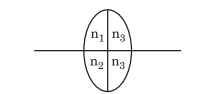
How many images are formed by the lens shown in adjacent figure if an object is kept on its axis ?
Image
  • A
    1
  • 2
  • C
    3
  • D
    7
Answer
Correct option: B.
2
B
View full question & answer
MCQ 371 Mark
When two converging lens of same focal length $f$ are placed in contact then the focal length of the combination is :
  • A
    $f$
  • B
    2$f$
  • $f/2$
  • D
    3$f$
Answer
Correct option: C.
$f/2$
C
View full question & answer
MCQ 381 Mark
A biconvex lens $(n=1.5)$ has equal radius of curvature each of 20 cm. The power of the lens is :
  • 5 D
  • B
    10 D
  • C
    2.5 D
  • D
    20 D
Answer
Correct option: A.
5 D
A
View full question & answer
MCQ 401 Mark
In angle of prism and angle of minimum deviation each is A then the refractive index of the material of the prism will be :
  • A
    $2 \sin (A/2)$
  • $2 \cos (A/2)$
  • C
    $2 \tan (A/2)$
  • D
    $2 \cot (A/2)$
View full question & answer
MCQ 411 Mark
Two thin lenses of $+2D$ and $-4D$ power are kept in contact. Focal length of the combination is :
  • A
    $+50$ m
  • $-50$ cm
  • C
    $-25$ cm
  • D
    $+25$ cm
Answer
Correct option: B.
$-50$ cm
B
View full question & answer
MCQ 421 Mark
When a lens is dipped into the water its focal length :
  • increases
  • B
    decreases
  • C
    remains the same
  • D
    none of these
Answer
Correct option: A.
increases
A
View full question & answer
MCQ 431 Mark
Out of the following which has its unit as diopter ?
  • A
    Focus of the lens
  • B
    Focal length of the lens
  • Power of the lens
  • D
    Magnifying power of the lens
Answer
Correct option: C.
Power of the lens
C
View full question & answer