Question
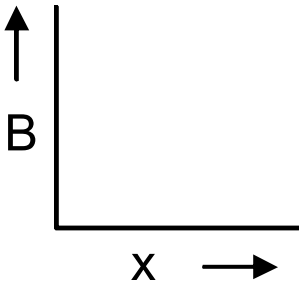
A solid wire of radius $10\ cm$ carries a current $5.0A$ distributed uniformly over its cross$-$section. Find the magnetic field $B$ at a point at a distance $(a)\ 2\ cm\  (b)\ 10\ cm$ and $(c)\ 20\ cm$ away from the axis. Sketch a graph of $B$ versus $x$ for $0 < x < 20\ cm.$

Answer

  1. $r = 10\ cm = 10 \times 10^{-2}m$
$x = 2 \times 10^{-2}m,$
$i = 5A$
$i$ in the region of radius $2\ cm$
$\frac{5}{\pi(10\times\times10^{-2})^2}\times\pi(2\times10^{-2})^2=0.2\text{A}$
$\text{B}\times\pi(2\times10^{-2})^2=\mu_0(0-2)$
$\Rightarrow\text{B}=\frac{4\pi\times10^{-7}\times0.2}{\pi\times4\times10^{-4}}=\frac{0.2\times10^{-7}}{10^{-4}}=2\times10^{-4}$
  1. $10\ cm$ radius
$\text{B}\times\pi(10\times10^{-2})^2=\mu_0\times5$
$\Rightarrow\text{B}=\frac{4\pi\times10^{-7}\times5}{\pi\times10^{-2}}=20\times10^{-5}$
  1. $x = 20\ cm$
$\text{B}\times\pi(20\times10^{-2})^2=\mu_0\times5$
$\Rightarrow\text{B}=\frac{\mu_0\times5}{\pi\times(20\times10^{-2})^2}=\frac{4\pi10^{-7}\times5}{\pi\times400\times10^{-4}}=5\times10^{-5}$

Need a full question paper?

Generate a complete, print-ready paper with questions like this in minutes — across 16+ boards, with answer keys.

Start Generating Free

Similar questions

A series L-C-R circuit is connected to an AC source. Using the phasor diagram, derive the expression for the impedance of the circuit. Plot a graph to show the variation of current with frequency of the source, explaining the nature of its variation.
Define electric flux. Find the expression for the electric field intensity due to the electric dipole at its axial point. Draw a diagram.
Two long, straight wires, each carrying a current of $5A,$ are placed along the $X$ and $Y-$ axes respectively. The currents point along the positive directions of the axes. Find the magnetic fields at the points $(a) (1m, 1m), (b) (-1m, 1m), (c) (-1m,-1m)$ and $(d) (1m, -1m),$
Solve the previous problem if the friction coefficient between the $2.0\ kg$ block and the plane below it is $0.5$ and the plane below the $4.0\ kg$ block is frictionless.
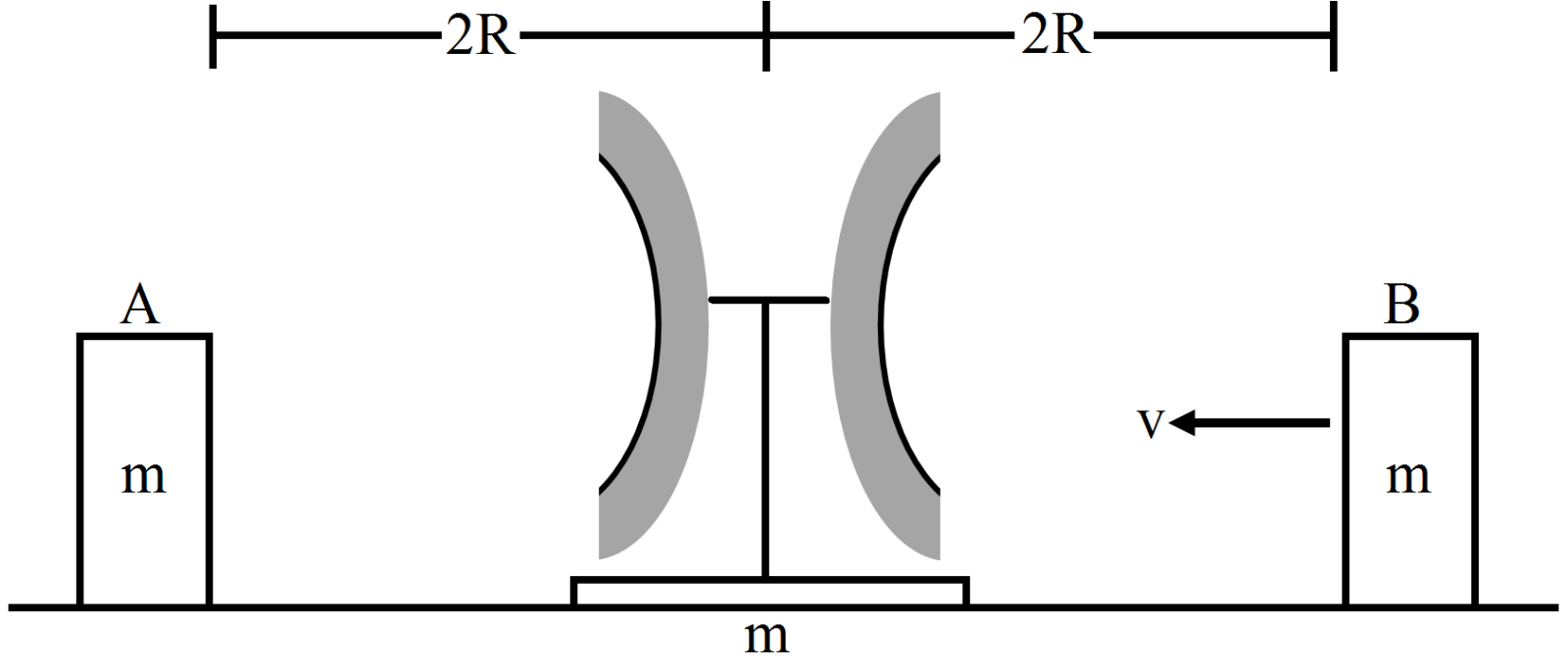
Two concave mirrors of equal radii of curvature R are fixed on a stand facing opposite directions. The whole system has a mass m and is kept on a frictionless horizontal table.

Two blocks A and B, each of mass m, are placed on the two sides of the stand. At t = 0, the separation between A and the mirrors is 2 R and also the separation between B and the mirrors is 2 R. The block B moves towards the mirror at a speed v. All collisions which take place are elastic. Taking the original position of the mirrors-stand system to be x = 0 and X-axis along AB, find the position of the images of A and B at t =
  1. $\frac{\text{R}}{\text{v}}$
  2. $\frac{3\text{R}}{\text{v}}$
  3. $\frac{5\text{R}}{\text{v}}$
A piano wire A vibrates at a fundamental frequency of 600Hz. A second identical wire B produces 6 beats per second with it when the tension in A is slightly increased. Find the ratio of the tension in A to the tension in B.
Explain the resolving power of an optical instrument. Write the formula for resolving power of telescope and microscope. Why is the resolving power of electron microscope more than that of optical microscope ?
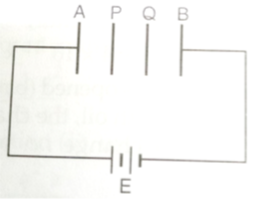
Two parallel metal plates P and Q are inserted at equal distances into a plane capacitor as shown in fig. Plates A and B of the capacitor are connected to a battery of e.m.f. V.
a. What are the potentials of the four plates?
Image
a. What are the potentials of the four plates?
b. How will the potentials of plates P and Q and the intensities of the fields in each of the three spaces change after plates P and Q have been connected by a wire?
c..What will happen to the charges on plates A and B, when plates P and Q are connected with a wire?
d. Will there be charges on the plates P and Q after connecting them with a wire?
A scooter company gives the following specifications about its product.
  • Weight of the scooter $- 95\ kg.$
  • Maximum speed $- 60\ km/h$.
  • Maximum engine power $- 3.5hp.$
  • Pick up time to get the maximum speed $ - 5s.$
  • Check the validity of these specifications.
A hydrogen atom moving at speed υ collides with another hydrogen atom kept at rest. Find the minimum value of υ for which one of the atoms may get ionized. The mass of a hydrogen atom $= 1.67 \times 10^{-27}kg.$