Question
Define degrees of freedom. How will you account for the five degrees of freedom in a diatomic molecule? Using the idea of equi-partition of energy, find the value of $\gamma$ for the same.

Answer

The number ofdegrees offreedom ofa dynamical system is defined as total number of coordinates required to describe comiletely the position and configuration of the syslem. The diatomic molecules have two atoms in it. The molecule is capable of translatory motion of its centre of mass and also it can rotate about its cenfie of mass. Therefore it has three translational degrees of freedom and two rotational degrees of freedom. So diatomic molecule has in all five degrees of freedom.$\text{U}=5\times\Big(\frac{1}{2}\text{K}_{\text{B}}\text{T}\Big)\times\text{N}_{\text{A}}=\frac{5}{2}\text{RT}$
$\text{C}_{\text{v}}=\Big(\frac{\text{dU}}{\text{dT}}\Big)$
$\text{C}_{\text{v}}=\frac{\text{d}}{\text{dT}}\Big(\frac{5}{2}\text{RT}\Big)=\frac{5}{2}\text{R}$
$\text{C}_{\text{v}}=4.96\text{ cal mol}^{-1}\text{K}^{-1}$
also, $\text{C}_{\text{P}}=\text{C}_{\text{v}}+\text{R}=\frac{5}{2}\text{R + R}=\frac{7}{2}\text{R}$$\text{C}_{\text{P}}=\frac{7}{2}\times1.985$
$\text{C}_{\text{P}}=6.95\text{ cal mol}^{-1}\text{ K}^{-1}$
$\gamma=\frac{\text{C}_\text{P}}{\text{C}_{\text{v}}}=\frac{\frac{7}{2}\text{R}}{\frac{5}{2}\text{R}}=1.4$

Need a full question paper?

Generate a complete, print-ready paper with questions like this in minutes — across 16+ boards, with answer keys.
Start Generating Free

Similar questions

A girl riding a bicycle with a speed of $5m/ s$ towards north direction, observes rain falling vertically down. If she increases her speed to $10m/ s$, rain appears to meet her at $45°$ to the vertical. What is the speed of the rain? In what direction does rain fall as observed by a ground based observer?
(Hint: Assume north to be $\hat{\text{i}}$ direction and vertically downward to be $-\hat{\text{j}}$. Let the rain velocity $\text{v}_\text{r}$ be $\text{a}\hat{\text{i}}+\text{b}\hat{\text{j}}.$ The velocity of rain as observed by the girl is always $V_r-V_{girl}$. Draw the vector diagram/s for the information given and find a and b. You may draw all vectors in the reference frame of ground based observer)
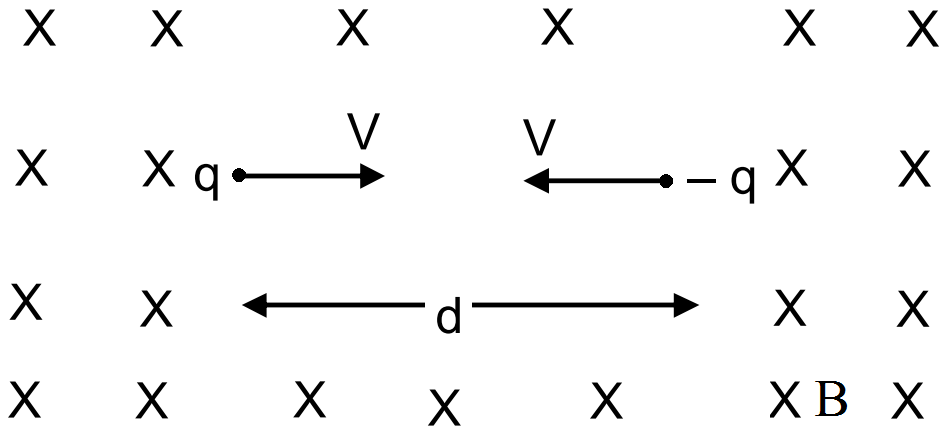
Two particles, each with mass m are placed at a separation d in a uniform magnetic field B, as shown in the figure. They have opposite charges of equal magnitude q. At time $t = 0$, the particles are projected towards each other, each with a speed v. Suppose the Coulomb force between the charges is switched off.
  1. Find the maximum value $v_m$ of the projection speed, so that the two particles do not collide.
  2. What would be the minimum and maximum separation between the particles if $\text{v}=\text{v}_{\text{m}}\sqrt{2}?$
  3. At what instant will a collision occur between the particles if $v = 2v_m$?
  4. Suppose $v = 2v_m$ and the collision between the particles is completely inelastic. Describe the motion after the collision.
A hollow sphere is released from the top of an inclined plane of inclination $\theta.$
  1. What should be the minimum coefficient of friction between the sphere and the plane to prevent sliding?
  2. Find the kinetic energy of the ball as it moves down a length 1 on the incline if the friction coefficient is half the value calculated in part (a).
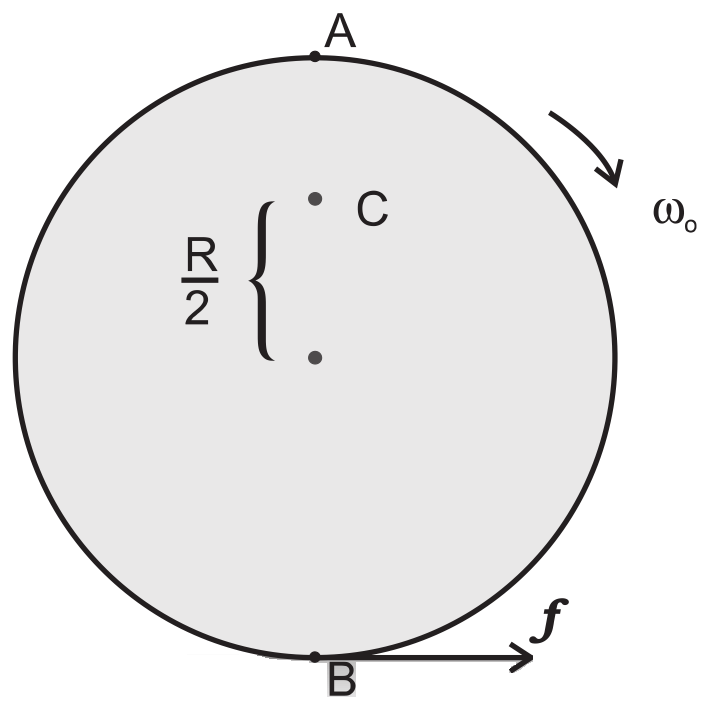
A disc rotating about its axis with angular speed $\omega_0$ is placed lightly (without any translational push) on a perfectly frictionless table. The radius of the disc is R. What are the linear velocities of the points A, B and C on the disc shown in will the disc roll in the direction indicated?
A ball is thrown vertically upwards with a velocity of $20 m s ^{-1}$ from the top of a multistorey building. The height of the point from where the ball is thrown is $25.0 m$ from the ground. (a) How high will the ball rlse? and (b) how long will it be before the ball hits the ground? Take $g =10 m s ^{-2}$.
In a Young's double slit experiment, the separation between the slits = $2.0mm$, the wavelength of the light = $600nm$ and the distance of the screen from the slits = $2.0m$. If the intensity at the centre of the central maximum is $0.20W/ m^2$, what will be the intensity at a point $0.5cm$ away from this centre along the width of the fringes?
Define co-efficient of linear expansion coefficient of areal expansion and coefficient of volume expansion and obtain mutual relation between them.
A cylindrical piece of cork of density of base area A and height h floats in a liquid of density $\rho_1.$ The cork is depressed slightly and then released. Show that the cork oscillates up and down simple harmonically with a period $\text{T}=2\pi\sqrt{\frac{\text{h}\rho}{\rho_1\text{g}}}$ where $\rho$ is the density of cork. (Ignore damping due to viscosity of the liquid).
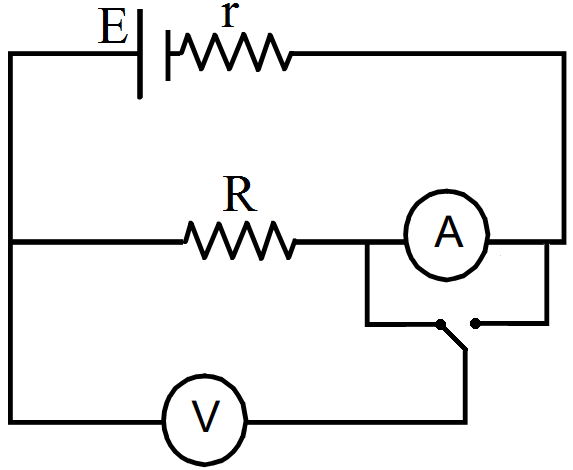
The emf $\in$ and the internal resistance r of the battery, shown in the figure. are 4.3V and $1.0\Omega$ respectively. The external resistance R is $50\Omega.$ The resistances of the ammeter and voltmeter are $2.0\Omega$ and $200\Omega$ respectively. (a) Find the readings of the two $200\Omega$ respectively. (a) Find the readings of the two meters. (b) The switch is thrown to the other side. What will be the readings of the two meters now?
Water stands at a depth H in a tank, whose side walls are vertical. A hole is made on one of the walls at a depth h below the water surface. Find at what distance from the foot of the wall does the emerging stream of water strike the floor and for what value of h this range is maximum.