Question
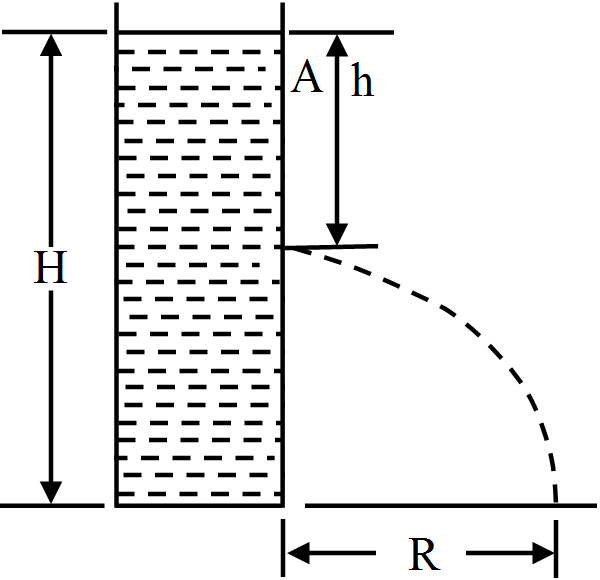
Water stands at a depth H in a tank, whose side walls are vertical. A hole is made on one of the walls at a depth h below the water surface. Find at what distance from the foot of the wall does the emerging stream of water strike the floor and for what value of h this range is maximum.
Answer


The situation is shown in fig. Here, we have,$\upsilon_\text{A}=\sqrt{2\text{gh}}\dots\text{(i)}$
$(\text{H}-\text{h})=\frac12\text{gt}^2\dots\text{(ii)} $
The distance R is given by$\text{R}=\upsilon_\text{A}\times\text{t}\dots\text{(iii)}$
From equation (ii) $\text{t}=\sqrt{\Big(\frac{2(\text{H}-\text{h})}{\text{g}}\Big)}\dots\text{(iv)}$ Substituting the value of $v_A$ from equation (1) and the value of t from equation (4) in equation (3), we get,$\text{R}=\sqrt{(2\text{gh})}\times\sqrt{\Big\{\frac{2(\text{H}-\text{h})}{\text{g}}\Big\}}$
$=\sqrt{\{\text{h}(\text{H}-\text{h}\}}.$
The range R will be maximum when$\frac{\text{dR}}{\text{dh}}=0$
$\therefore2\cdot\frac12\text{h}^{-\frac12}(\text{H}-\text{h})^{\frac12}\cdot\frac12(\text{H}-\text{h})^{-\frac12}=0$
Solving we get $\text{h}=\frac{\text{H}}2$

Need a full question paper?

Generate a complete, print-ready paper with questions like this in minutes — across 16+ boards, with answer keys.

Start Generating Free

Similar questions

The radius of atom is of the order of $\mathring{\text{A}}$ and radius of nucleus is of the order of fermi. How many magnitudes higher is the volume of atom as compared to the volume of nucleus?
A force $3\hat{\text{i}}+2\hat{\text{j}}$ displaces a 1kg mass from $\hat{\text{i}}+\hat{\text{j}}$ to $-\hat{\text{i}}+2\hat{\text{j}}$. Find the work done.
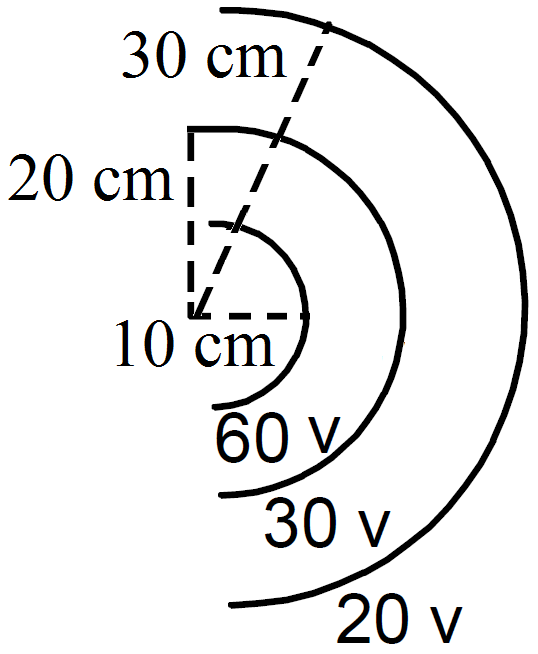
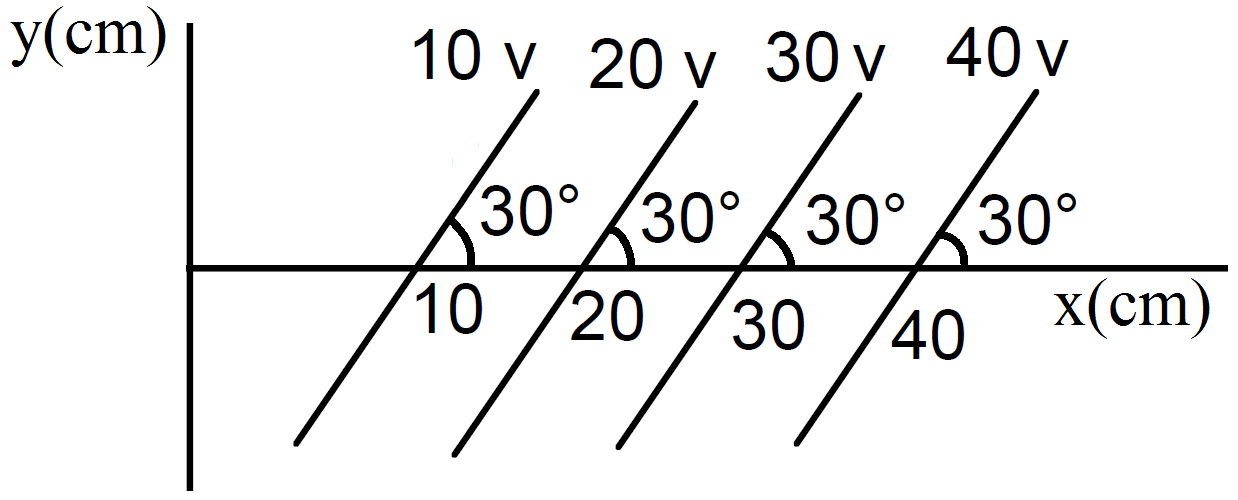
Some equipotential surfaces are shown in figure. What can you say about the magnitude and the direction of the electric field?

Mathematically describe the motion of a particle along a plane (or along a two-dimensional plane).
A ballon has $5.0g$ mole of helium at $7^\circ C$. Calculate.
  1. The number of atoms of helium in the balloon,
  2. The total internal energy of the system.
A capacitance C, a resistance R and an emf $\in$ are connected in series at t = 0. What is the maximum value of (a) the potential difference across the resistor (b) the current in the circuit (c) the potential difference across the capacitor (d) the energy stored in the capacitor (e) the power delivered by the battery and (f) the power converted into heat?
A block whose mass is $1 \ kg$ is fastened to a spring. The spring has a spring constant of $50 N m ^{-1}$. The block is pulled to a distance $x=10 \ cm$ from its equilibrium position at $x=0$ on a frictionless surface from rest at $t=0$. Calculate the kinetic, potential and total energies of the block when it is $5 \ cm$ away from the mean position.
A car starting from rest, accelerates uniformly with $5m/s^2$ for sometime and then decelerates to come to rest with $3m/s^2$. Find the maximum velocity attained during the motion and the distance covered in a total time of 6 seconds of the journey.
Define degrees of freedom. How will you account for the five degrees of freedom in a diatomic molecule? Using the idea of equi-partition of energy, find the value of $\gamma$ for the same.
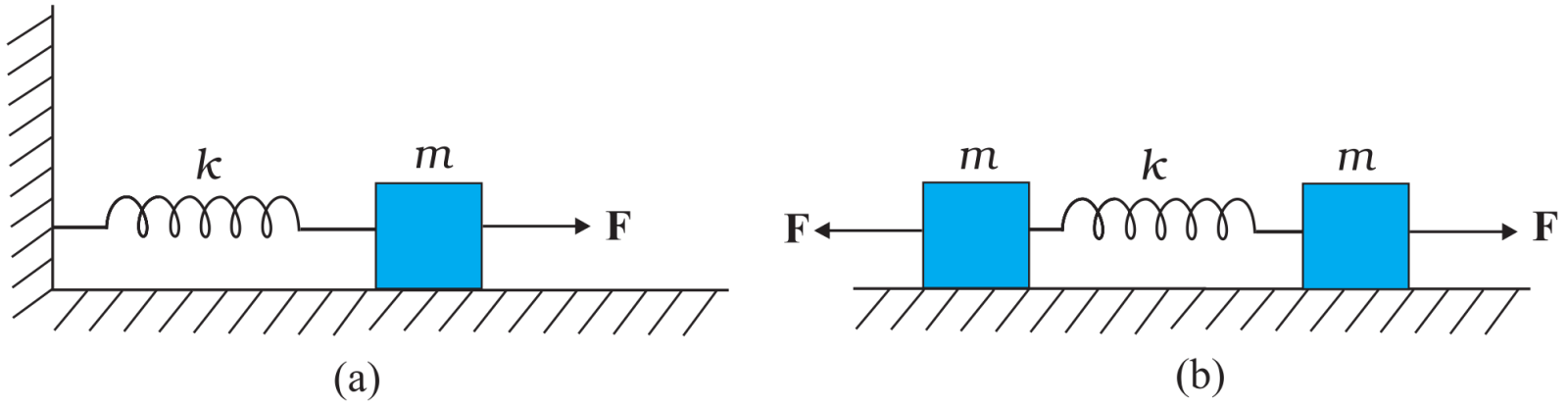
Figure (a) shows a spring of force constant k clamped rigidly at one end and a mass m attached to its free end. A force F applied at the free end stretches the spring. Figure (b) shows the same spring with both ends free and attached to a mass m at either end. Each end of the spring in Fig. (b) is stretched by the same force F.
If the mass in Fig. (a) and the two masses in Fig. (b) are released, what is the period of oscillation in each case?