Question
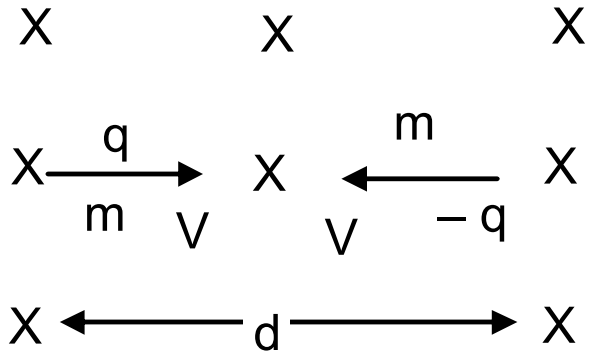
Two particles, each with mass m are placed at a separation d in a uniform magnetic field B, as shown in the figure. They have opposite charges of equal magnitude q. At time $t = 0$, the particles are projected towards each other, each with a speed v. Suppose the Coulomb force between the charges is switched off.
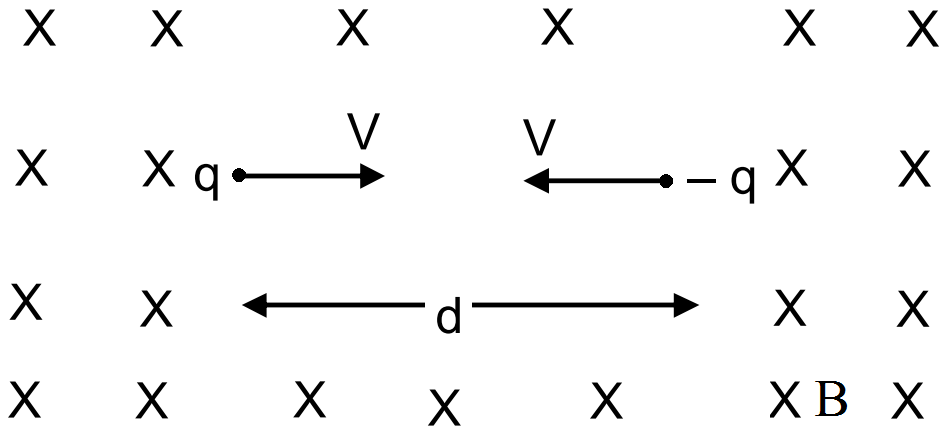
  1. Find the maximum value $v_m$ of the projection speed, so that the two particles do not collide.
  2. What would be the minimum and maximum separation between the particles if $\text{v}=\text{v}_{\text{m}}\sqrt{2}?$
  3. At what instant will a collision occur between the particles if $v = 2v_m$?
  4. Suppose $v = 2v_m$ and the collision between the particles is completely inelastic. Describe the motion after the collision.
Answer

  1. The particulars will not collide if,
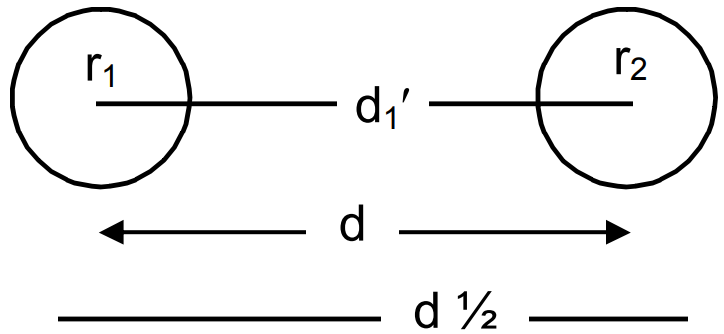
$\text{d}=\text{r}_1+\text{r}_2$

$\Rightarrow\text{d}=\frac{\text{mV}_\text{m}}{\text{qB}}+\frac{\text{mV}_\text{m}}{\text{qB}}$
$\Rightarrow\text{d}=\frac{2\text{mV}_\text{m}}{\text{qB}}$
$\text{V}_\text{m}=\frac{\text{qBd}}{2\text{m}}$
  1. $\text{V}=\frac{\text{V}_\text{m}}{2}$

$\text{d}_1'=\text{r}_1+\text{r}_2=\Big(\frac{\text{m}\times\text{qBd}}{2\times2\text{m}\times\text{qB}}\Big)=\frac{\text{d}}{2}$ (min. dist.)
Max. distance $\text{d}_2'=\text{d}+2\text{r}=\text{d}+\frac{\text{d}}{2}=\frac{3\text{d}}{2}$
  1. $\text{V}=2\text{V}_\text{m}$
$\text{r}_1'=\frac{\text{m}_2\text{V} _\text{m}}{\text{qB}}=\frac{\text{m}\times2\times\text{qBd}}{2\text{n}\times\text{qB}}$
$\text{r}_2=\text{d}$
$\therefore$ The arc is $\frac{1}{6}$
  1. $\text{V}_\text{m}=\frac{\text{qBd}}{2\text{m}}$

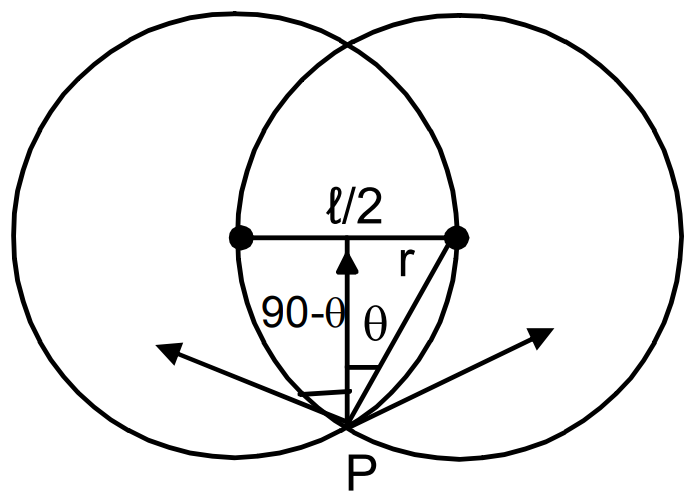
The particles will collide at point P. At point p, both the particles will have motion m in upward direction. Since the particles collide inelastically the stick together.
Distance l between centres $=\text{d},\sin\theta=\frac{1}{2\text{r}}$
Velocity upward $=\text{v}\cos90-\theta=\text{V}\sin\theta=\frac{\text{Vl}}{2\text{r}}$
$\frac{\text{mv}^2}{\text{r}}=\text{qvB}$
$\Rightarrow\text{r}=\frac{\text{mv}}{\text{qB}}$
$\text{V}\sin\theta=\frac{\text{vl}}{2\text{r}}=\frac{\text{vl}}{2\frac{\text{mv}}{\text{qb}}}=\frac{\text{qBd}}{2\text{m}}=\text{V}_\text{m}$
Hence the combined mass will move with velocity $V_m$.

Need a full question paper?

Generate a complete, print-ready paper with questions like this in minutes — across 16+ boards, with answer keys.

Start Generating Free

Similar questions

The linear momentum of a body is increased by 10%. What is the percentage change in kinetic energy?
A star like the sun has several bodies moving around it at different distances. Consider that all of them are moving in circular orbits. Let r be the distance of the body from the centre of the star and let its linear velocity be v, angular velocity $\omega$, kinetic energy K, gravitational potential energy U, total energy E and angular momentum l. As the radius r of the orbit increases, determine which of the above quantities increase and which ones decrease.
A particle is executing S.H.M. If $v_1$ and $v_2$ are the speeds of the particle at distance $x_1$ and $x_2$ from the equilibrium position, show that the frequency of oscillations is
$\text{f}=\frac{1}{2\pi}\bigg(\frac{\text{v}^2_1-\text{v}^2_2}{\text{x}^2_2-\text{x}^2_1}\bigg)^{\frac{1}{2}}$
State and explain Newton's law of cooling. Calculate the increase in the temperature of water which falls from a height of $100m$. Assume that $90\%$ of the energy due to fall is converted into heat and is retained by water. $J = 4.2J/ Cal^{-1}$.
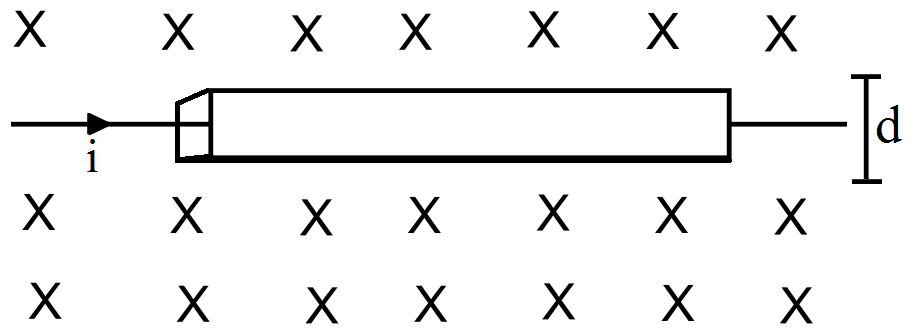
A current i is passed through a silver strip of width d and area of cross-section A. The number of free electrons per unit volume is n.
  1. Find the drift velocity v of the electrons.
  2. If a magnetic field B exists in the region, as shown in the figure, what is the average magnetic force on the free electrons?
  3. Due to the magnetic force, the free electrons get accumulated on one side of the conductor along its length. This produces a transverse electric field in the conductor, which opposes the magnetic force on the electrons. Find the magnitude of the electric field which will stop further accumulation of electrons.
  4. What will be the potential difference developed across the width of the conductor due to the electron-accumulation? The appearance of a transverse emf, when a current-carrying wire is placed in a magnetic field, is called Hall effect.
A 6.5m long ladder rests against a vertical wall reaching a height of 6.0m. A 60kg man stands half way up the ladder.
  1. Find the torque of the force exerted by the man on the ladder about the upper end of the ladder.
  2. Assuming the weight of the ladder to be negligible as compared to the man and assuming the wall to be smooth, find the force exerted by the ground on the ladder.
The triple points of neon and carbon dioxide are $24.57K$ and $216.55K$ respectively. Express these temperatures on the Celsius and Fahrenheit scales.
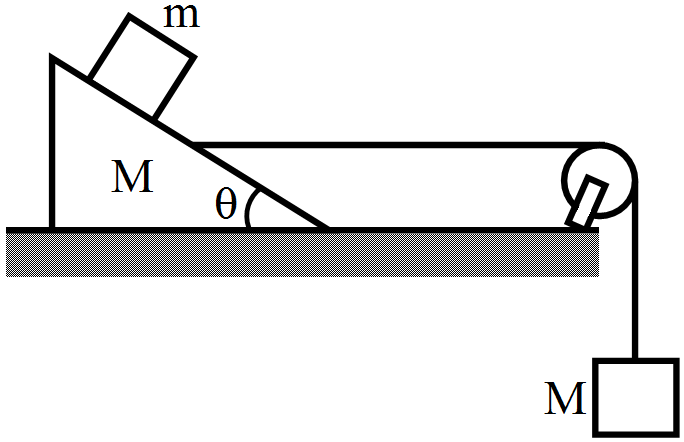
Find the mass M of the hanging block in figure which will prevent the smaller block from slipping over the triangular block. All the surfaces are frictionless and the strings and the pulleys are light.
A vector has both magnitude and direction. Does it mean that anything that has magnitude and direction is necessarily a vector? The rotation of a body can be specified by the direction of the axis of rotation, and the angle of rotation about the axis. Does that make any rotation a vector?
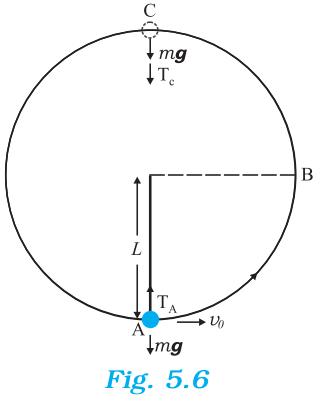
A bob of mass $m$ is suspended by a light string of length $L$. It is imparted a horizontal velocity $v_o$ at the lowest point $A$ such that it completes a semi$-$circular trajectory in the vertical plane with the string becoming slack only on reaching the topmost point, $C.$ This is shown in Fig. $5.6.$ Obtain an expression for $(i) v_o; (ii)$ the speeds at points $B$ and $C; (iii)$ the ratio of the kinetic energies $\left(K_B / K_C\right)$ at $B$ and $C.$ Comment on the nature of the trajectory of the bob after it reaches the point $C$.
Image