Question
Define electric flux. Write its SI unit.
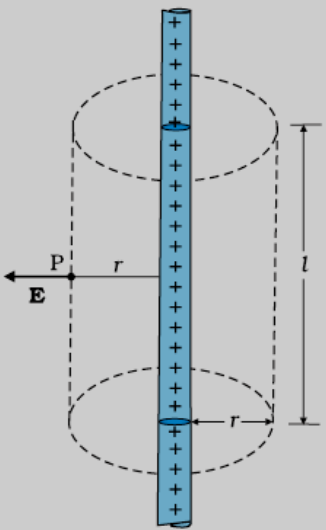
Using Gauss’s law, deduce an expression for electric field intensity due to an infinitely long straight uniformly charged wire.
Answer

The electric flux is defined as$\phi_E=\overrightarrow{E}.\overrightarrow{A}={EA}\cos\theta$
Its S.I unit is $(Nm^{2}C^{-1})$ The Gaussian surface is cylindrical and field is radial. At the cylindrical part of the surface, cylindrical part of the surface, $ \overrightarrow{E}$ is normal to the surface at every point and its magnitude is constant (since it depends only on r). By Gauss’s theorem : $ \oint \overrightarrow{E}.{d}\overrightarrow{S}=\frac{q}{\epsilon_0}$$\therefore(2\pi{rl})=\frac{\lambda{l}}{\epsilon_0}$ 
$\text{or}\text{ }\text{ } E=\frac{\lambda}{2\pi\epsilon_0r}$

Need a full question paper?

Generate a complete, print-ready paper with questions like this in minutes — across 16+ boards, with answer keys.

Start Generating Free

Similar questions

The radionuclide $^{11}C$ decays according to
$^{11}_{6}\text{C}\rightarrow^{11}_{5}\text{B}+\text{e}^{+}+\text{v}:\ \text{T}_{1/2}=20.3 \text{ min}$
The maximum energy of the emitted positron is $0.960 MeV$.
Given the mass values:
$\text{m}(^{11}_{6})=10=11.011434\text{u}$ and $\text{m}(^{11}_{6}\text{B})=11.009305\text {u}.$
calculate $Q$ and compare it with the maximum energy of the positron emitted.
State the underlying principle of a potentiometer. Write two factors by which current sensitivity of a potentiometer can be increased. Why is a potentiometer preferred over a voltmeter for measuring the emf of a cell?
Which of the following will describe the smallest circle when projected with the same velocity perpendicular to the magnetic field B (i) $\alpha$-particle and (ii) $\beta$-particle?
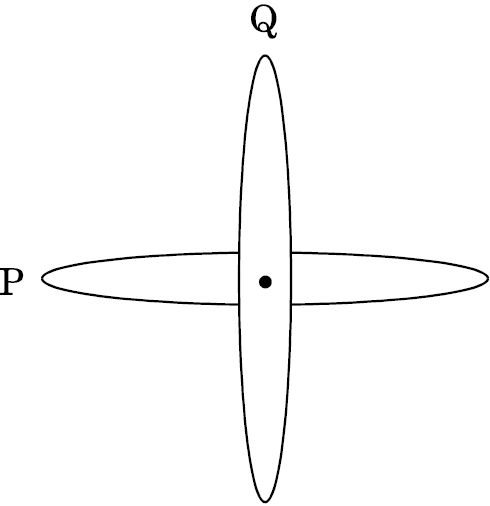
Two identical loops P and Q each of radius 5 cm are lying in perpendicular planes such that they have a common centre as shown in the figure. Find the magnitude and direction of the net magnetic field at the common centre of the two coils, if they carry currents equal to 3 A and 4 A respectively.
Two small bodies of masses $10\ kg$ and $20\ kg$ are kept a distance $1.0m$ apart and released, Assuming that only mutual gravitational forces are acting, find the speeds of the particles when the separation decreases to $0.5m$.
A short bar magnet has a magnetic moment of $0.48 JT ^{-1}$.Give the direction and magnitude of the magnetic field produced by the magnet at a distance of 10 cm from the centre of the magnet on (a) the axis, (b) the equatorial lines (normal bisector) of the magnet.
i. Will the earth's magnetic field induce current in an artificial satellite with a metal surface that is in orbit around the equator? Around the poles?
ii. If so how would these currents affect the motion of the satellite?
A potentiometer wire of length 1.0 m has a resistance of l5 $\Omega$. It is connected to a 5 V battery in series with a resistance of 5 $\Omega$ Determine the emf of the primary cell which gives a balance point at 60 cm.
Explain how radioactive nuclei can emit $\beta-$particles even though atomic nuclei do not contain these particles? Hence explain why the mass number of radioactive nuclide does not change during $\beta-$decay?
A storage battery of emf 8.0 V and internal resistance 0.5 Ω is being charged by a 120 V dc supply using a series resistor of 15.5 Ω. What is the terminal voltage of the battery during charging? What is the purpose of having a series resistor in the charging circuit?