Question
Define (i) Distance (ii) Displacement. Give two differences between displacement and distance.

Answer

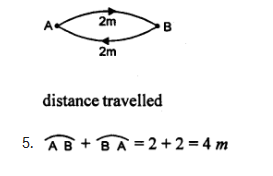
(i) Distance: The length of path travelled by a body in certain interval of time is called distance.
(ii) Displacement: of an object between two points is the shortest distance between these two points.
"It is the unique path which can take the body from its initial to final position."
Differences between displacement and distance.
Distance:
1. It is a scalar quantity.
2. Distance travelled is always positive.
3. The distance travelled by a moving body is the actual length of path.
Image
Displacement:
1. It is a vector quantity.
2. Displacement may be positive negative or zero.
3. The displacement of a body is the shortest distance between the initial and final positions of the body..
4. Displacement is always less than or equal to the distance travelled.
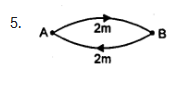
Displacement is zero.
Image

Need a full question paper?

Generate a complete, print-ready paper with questions like this in minutes — across 16+ boards, with answer keys.

Start Generating Free

Similar questions

Draw a neat and labelled diagram of a vernier callipers. Name its main parts and state their functions.
 A bullet of mass $50$ g moving with an initial velocity $100 m s ^{-1}$ strikes a wooden block and comes to rest after penetrating a distance $2$ cm in it. Calculate: (i) Initial momentum of the bullet, (ii) Final momentum of the bullet, (iii) Retardation caused by the wooden block and (iv) Resistive force exerted by the wooden block.
A train travels the first 30km of its journey at 30km/h. Find the speed it should travel the next 90km to have an average speed of 60km/h.
In each case (a) and (b), draw reflected rays for the given incident rays and mark focus by the symbol F.
What do you understand by the term acceleration due to gravity? What is its value in C.G.S. and S.I. systems?
The main scale of a vernier callipers is calibrated in mm and $19$ divisions of main scale are equal in length to $20$ divisions of the vernier scale. In measuring the diameter of a cylinder by this instrument, the main scale reads $35$ divisions and $4$th division of vernier scale coincides with a main scale division. Find
(i) Least count and (ii) Radius of a cylinder.
An object 5 cm high forms a virtual image of 1.25 cm high, when placed in front of a convex mirror at a distance of 24 cm . Calculate:
1. the position of the image
2. the focal length of the convex mirror.
Draw suitable diagrams to illustrate the action of (i) concave mirror and (ii) convex mirror on a beam of light incident parallel to the principal axis.
 A train travels with a speed of $60 km h ^{-1}$ from station $A$ to station $B$ and then comes back with a speed $80 km^{-1}$ from station $B$ to station A. Find -
i. The average speed
ii. The average velocity of the train.
Show that gravity decreases at higher altitudes.