Question
Define magnetic permeability and magnetic susceptibility. Prove that $\mu_{r} = (1+\chi)$.
Answer

Magnetic Permeability : It is the ability of a material to permit the passage of magnetic field lines through it. Hence it is the degree to which the magnetic field can penetrate the material.
For example, when a piece of iron is placed in a magnetising field, lines of force become much more concentrated in iron (where they become lines of induction) than in air. Thus iron is said to have greater permeability than air. The permeability of a medium may be defined as ratio of the lines of induction per unit normal area to the number of lines of force of the magnetising field per unit normal area. The former measures the magnetic induction B in the medium and the latter measures the strength of the magnetising field H. Hence permeability µ is defined as the ratio of the magnetising induction (B) in the specimen to the magnetising field (H). Thus $\mu=\frac{B}{H}$.
The ratio of magnetic permeability of the material $\mu$ and magnetic permeability of free space $\left(\mu_0\right)$ is called relative permeability of the substance denoted by $\mu_r$ i.e. $\mu_r=\mu / \mu_0$.
where $\mu_0 \times 4 \pi \times 10^{-7} Wb / Am$
Magnetic Susceptibility : For a large number of magnetic materials the intensity of magnetisation I is proportional to magnetising field strength, H. i.e.
$I \propto H$ or $I=\chi . H$
Where $\chi$ is a proportionality constant and is known as magnetic susceptibility of magnetic material.
Now $I =\chi H \Rightarrow \chi= I / H$
Hence the magnetisation per unit field strength is called the magnetic susceptibility.
Since I and H have the same dimensions the quantity $\chi$ is dimensionless i.e. it has no unit.
The magnetic susceptibility of a specimen of a magnetic material measures the ease with which the specimen can be magnetised. Since I is equal to the magnetic moment per unit volume, hence the susceptibility as defined above is also called volume susceptibility of the material.
Derivation of $\mu _r=(1+\chi)$ : When a magnetic material is placed in a magnetising field of magnetic intensity $\overrightarrow{ H }$, the material gets magnetised. In this state the total magnetic induction $\overrightarrow{ B }$ is the sum of the magnetic induction $\overrightarrow{ B }_0$ in vaccum produced by the magnetic intensity $\overrightarrow{ H }$ and magnetic induction $\overrightarrow{ B }_m$ due to magnetisation of the material i.e. intensity of magnetisation.
Hence $\overrightarrow{ B }=\overrightarrow{ B }_0+\overrightarrow{ B }_m$
but $\overrightarrow{ B }=\mu \overrightarrow{ H }, B _0=\mu_0 \overrightarrow{ H }$ and $\overrightarrow{ B }_m=\mu_0 \overrightarrow{ I }$
$\mu H =\mu_0( H + I )$
$\Rightarrow \quad \mu H =\mu_0 H \left(1+\frac{ I }{ H }\right)$
$\Rightarrow \quad \frac{\mu}{\mu_0}=\left(1+\frac{ I }{ H }\right)$. But $\mu / \mu_0=\mu_r$ and $I / H =\chi$
$\therefore \quad \mu_r=(1+\chi)$

Need a full question paper?

Generate a complete, print-ready paper with questions like this in minutes — across 16+ boards, with answer keys.

Start Generating Free

Similar questions

A copper wire of radius 0.1mm and resistance $1\text{k}\Omega$ is connected across a power supply of 20V.
(a) How many electrons are transferred per second between the supply and the wire at one end? (b) Write down the current density in the wire.
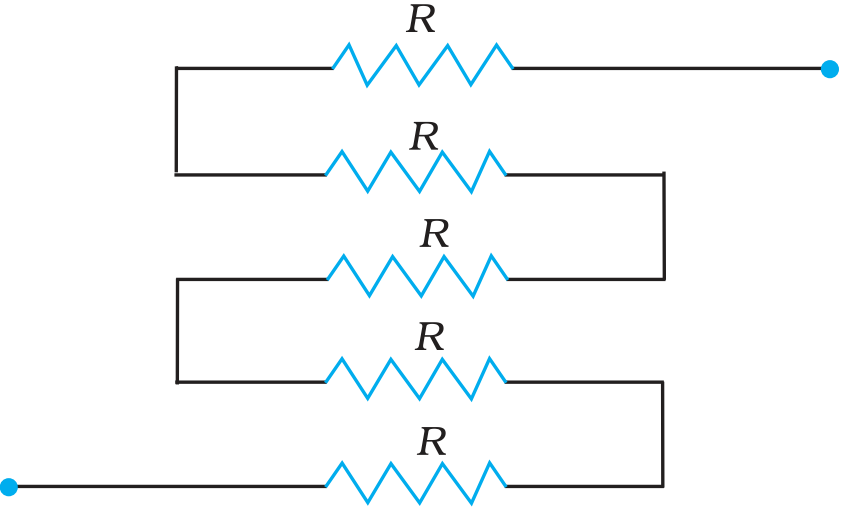
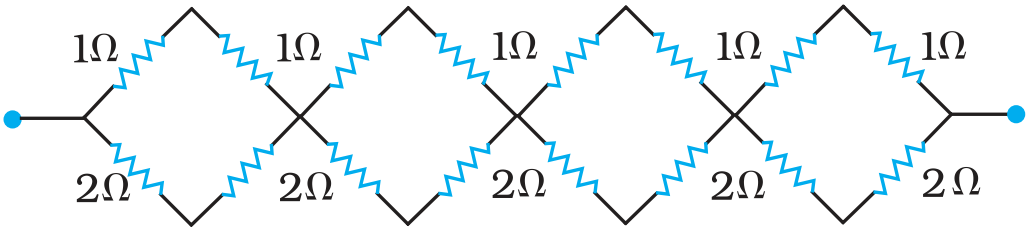
Determine the equivalent resistance of networks shown in Fig.

A person standing on the floor of an elevator drops a coin. The coin reaches the floor of the elevator in a time $t_1$ if the elevator is stationary and in time $t_2$ if it is moving uniformly. Then$:$
Two coils $A$ and $B$ have inductances $1.0H$ and $2.0H$ respectively. The resistance of each coil is $10\Omega.$ Each coil is connected to an ideal battery of emf $2.0V$ at $t = 0$ Let $i_A$ and $i_B$ be the currents in the two circuit at time $t$. Find the ratio $\frac{\text{i}_\text{A}}{\text{i}_\text{B}}$
  1. $t = 100ms$
  2. $t = 200ms$
  3. $t = 1s.$
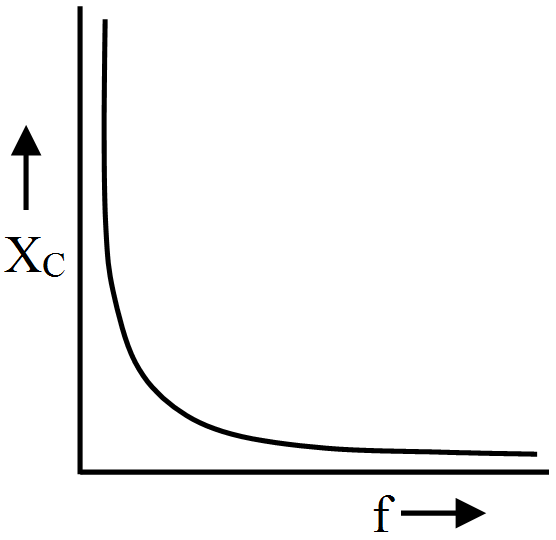
Define the term capacitive reactance. Show graphically the variation of capacitive reactance with frequency of applied alternating voltage. An ac voltage $\text{V = V}_0\sin\omega\text{t}$ is applied across a pure capacitor of capacitance $C.$ Find an expression for current flowing through it. Show mathematically the current flowing through it leads the applied voltage by angle $\frac{\pi}{2}.$
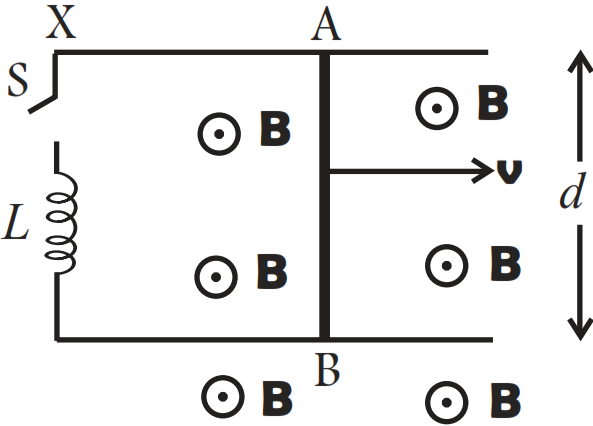
Find the current in the sliding rod AB (resistance = R) for the arrangement shown in Fig. B is constant and is out of the paper. Parallel wires have no resistance. v is constant. Switch S is closed at time t = 0.
$a.$ Use Huygen's geometrical construction to show how a plane wavefront at $t = 0$ propagates and produces a wavefront at a later time.
$b.$ Verify, using Huygen's principle, Snell's law of refraction of a plane wave propagating from a denser to a rarer medium.
$c.$ Illustrate with the help of diagrams the action of
$i.$ convex lens and
$ii.$ concave mirror, on a plane wavefront incident on it.
Define power and explain the following points (a) Instantaneous power (b) average power (c) power factor
A mica strip and a polysterene strip are fitted on the two slits of a double slit apparatus. The thickness of the strips is $0.50\ mm$ and the separation between the slits is $0.12\ cm$. The refractive index of mica and polysterene are $1.58$ and $1.55$ respectively for the light of wavelength $590\ nm$ which is used in the experiment. The interference is observed on a screen a distance one meter away.
  1. What would be the fringe-width?
  2. At what distance from the centre will the first maximum be located?
  1.  
  1. Draw a labelled ray diagram to show the formation of image in an astronomical telescope for a distant object.
  2. Write three distinct advantages of a reflecting type telescope over a refracting type telescope.
  1. A convex lens of focal length 10 cm is placed coaxially 5 cm away from a concave lens of focal length 10 cm. If an object is placed 30 cm in front of the convex lens, find the position of the final image formed by the combined system.