Question
  1. Define mutual inductance and write its $S.I$. unit.
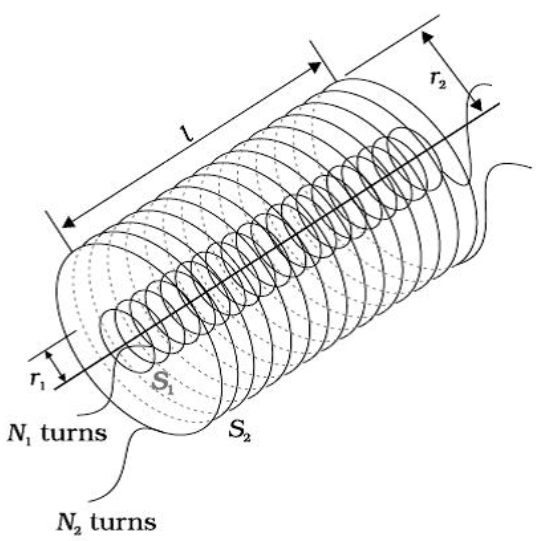
  2. Derive an expression for the mutual inductance of two long co $-$ axial solenoids of same length wound one over the other.
  3. In an experiment, two coils $c_1 $ and $c_2$ are placed close to each other. Find out the expression for the emf induced in the coil $c_1$ due to a change in the current through the coil $c_2$.
Answer

  1. $\phi = \text{MI}$
Mutual inductance of two coils is equal to the magnetic flux linked with one coil when a unit current is passed in the other coil.
Alternate Answer
$\text{e} = - \text{M}\frac{\text{dl}}{\text{dt}}$
Mutual inductance is equal to the induced emf set up in one coil when the rate of change of current flowing through the other coil is unity.
$SI$ unit: henry $\text{(weber ampere^{–1})/(volt second ampere^{–1})}$

Let a current $I_2$ flow through $S_2$.This sets up a magnetic flux $\phi_{1}$ through each turn of the coil $S_1$.
Total flux linked with $S_1$
$\text{N}_{1}\phi_{1} = \text{M}_{12}\text{I}_{2}......(i)$
where $M_{12}$ is the mutual inductance between the two solenoids Magnetic field due to the current $I_2$ in $S_2$ is $\text{S}_{2}\text{ is } \mu_{\circ}\text{n}_{2}\text{I}_{2}$
Therefore, resulting flux linked with $S_{1.}$
${\text{N}_{1}\phi_{1} = [ (\text{n}_{1}\ell)\pi\text{r}^{2}](\mu_0\text{n}_{2}\text{I}_{2})}_........(ii)$
Comparing $(i) (ii),$ we get
$M_{12 }I_2 =(\text{n}_{1}\ell)\pi\text{r}_{1}^{2}(\mu_{0}\text{n}_{2}\text{I}_{2})$
$\therefore\text{M}_{12} = \mu_{0}\text{n}_{1}\text{n}_{2}\pi\text{r}_{1}^{2}\ell$
  1. Let a magnetic flux be $(\phi_{1})$ linked with coil $C_1$ due to current $(I_2)$ in coil $C_{2;}$
We have:
$\Phi_{1}\propto\text{I}_{2}$
$ \Rightarrow \Phi_{1} = \text{MI}_{2}$
$\therefore\frac{\text{d}\Phi_{1}}{\text{dt}}= \text{M}\frac{\text{dI}_{2}}{\text{dt}}$
$\Rightarrow \text{e} = - \text{M}\frac{\text{dI}_{2}}{\text{dt}}$.

Need a full question paper?

Generate a complete, print-ready paper with questions like this in minutes — across 16+ boards, with answer keys.

Start Generating Free

Similar questions

Potassium$-40$ can decay in three modes. It can decay by $\beta^-$-emission, $\beta^+$-emission of electron capture.
  1. Write the equations showing the end products.
  2. Find the $Q-$values in each of the three cases. Atomic masses of $\text{ }^{40}_{18}\text{Ar},\text{ }^{40}_{19}\text{K}$ and $\text{ }^{40}_{20}\text{Ca}$ are $39.9624u,39.9640u$ and $39.9626u$ respectively.
Figure shows a long wire bent at the middle to form a right angle. Show that the magnitudes of the magnetic fields at the points $\text{P, Q, R}$ and $S$ are equal and find this magnitude.
A hollow sphere is released from the top of an inclined plane of inclination $\theta.$
  1. What should be the minimum coefficient of friction between the sphere and the plane to prevent sliding?
  2. Find the kinetic energy of the ball as it moves down a length 1 on the incline if the friction coefficient is half the value calculated in part (a).
A cylindrical vessel, whose diameter and height both are equal to 30cm, is placed on a horizontal surface and a small particle P is placed in it at a distance of 5.0cm from the centre. An eye is placed at a position such that the edge of the bottom is just visible. The particle P is in the plane of drawing. Up to what minimum height should water be poured in the vessel to make the particle P visible?
A particle of mass m and charge q is released from the origin in a region in which the electric field and magnetic field are given by
$\overrightarrow{\text{B}}=-\text{B}_0\overrightarrow{\text{j}}$ and $\overrightarrow{\text{E}}=\text{E}_0\overrightarrow{\text{k}}.$ Find the speed of the particle as a function of its z-coordinate.
The two blocks in an Atwood machine have masses $2.0\ kg$ and $3.0\ kg$. Find the work done by gravity during the fourth second after the system is released from rest.
Write the properties of charge. What is meant by charge conservation? Explain with example. What do you understand by charge quantization?
Consider the situation of the previous problem:
  1. Find the tension in the string in equilibrium.
  2. Suppose the ball is slightly pushed aside and released. Find the time period of the small oscillations.
A spherical tungsten piece of radius $1.0\ cm$ is suspended in an evacuated chamber maintained at $300K.$ The piece is maintained at $1000K$ by heating it electrically. Find the rate at which the electrical energy must be supplied. The emissivity of tungsten is $0.30$ and the Stefan constant $\sigma$ is $6.0 \times 10^{-8}Wm^{-2}K^{-4}.$
Suppose $a 'n\ ' -$ type wafer is created by doping $Si$ crystal having $5 \times 10^{28} \text{atoms/m^3}$ with $1 \text{ppm}$ concentration of As. On the surface $200 \text{ppm}$ Boron is added to create $'P\ '$ region in this wafer. Considering $n_i = 1.5 \times 10^{16}m^{-3}$.
  1. Calculate the densities of the charge carriers in the $n\ p$ regions.
  2. Comment which charge carriers would contribute largely for the reverse saturation current when diode is reverse biased.