Question
Define radioactivity.

Answer

Radioactivity : The phenomenon of spontaneous disintegration of atoms is called radioactivity. In 1896 AD , French scientist Becquerel discovered that some invisible rays automatically emitted from uranium and its salts, which have the ability to penetrate opaque materials and affect the photographic plate. These rays are called radioactive rays. The phenomenon of a substance emitting rays spontaneously is called 'radioactivity' and such a substance is called 'radioactive substance'. After the discovery of the property of radioactivity in uranium, it became known that not only uranium but other elements like thorium, polodium, actinium etc. are also radioactive.
Need a full question paper?

Generate a complete, print-ready paper with questions like this in minutes — across 16+ boards, with answer keys.

Start Generating Free

Similar questions

A double convex lens, made from a material of refractive index $\mu_1,$ is immersed in a liquid of refractive index $\mu_2$ where $\mu_1>\mu_2.$ What change, if any, would occur in the nature of the lens?
A straight horizontal wire of mass 10mg and length 1.0m carries a current of 2.0A. What minimum magnetic field B should be applied in the region, so that the magnetic force on the wire may balance its weight?
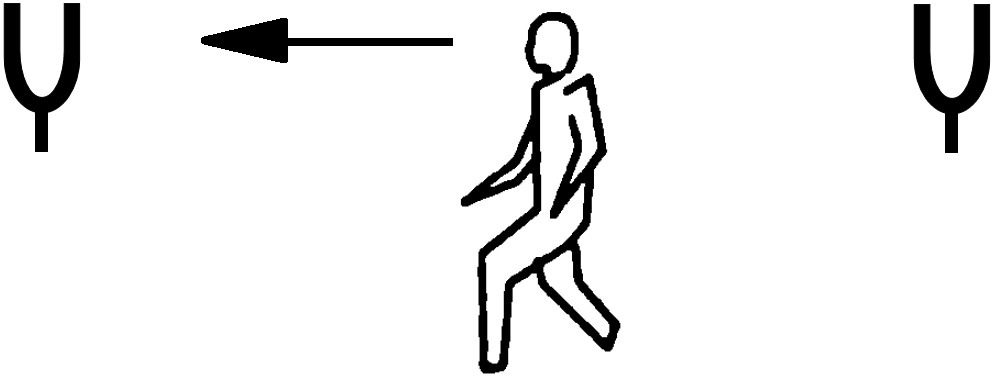
Two identical tuning forks vibrating at the same frequency $256\ Hz$ are kept fixed at some distance apart. $A$ listener runs between the forks at a speed of $3.0\ m/s$ so that he approaches one tuning fork and recedes from the other figure. Find the beat frequency observed by the listener. Speed of sound in air $= 332\ ms/s.$
A rod of mass m and length L, lying horizontally, is free to rotate about a vertical axis through its centre. A horizontal force of constant magnitude F acts on the rod at a distance of $\frac{\text{L}}{4}$ from the centre. The force is always perpendicular to the rod. Find the angle rotated by the rod during the time (t) after the motion starts.
Suppose the resistance of the coil in the preivous problem is $25\Omega.$ Assume that the coil moves with uniform velocity during its removal and restoration. Find the thermal energy developed in the coil during:
  1. Its removal.
  2. Its restoration.
  3. Its motion.
A rod is inserted as the core in the current-carrying solenoid of the previous problem.
  1. What is the magnetic intensity H at the centre?
  2. If the magnetization I of the core is found to be 0.12Nm, find the susceptibility of the material of the rod.
  3. Is the material paramagnetic, diamagnetic or ferromagnetic?
A parallel beam of light of wavelength $600 \ nm$ is incident normally on a slit of width $0.2 \ mm$. If the resulting diffraction pattern is observed on a screen $1 \ m$ away, find the distance of
$a$. first minimum, and
$b$. second maximum, from the central maximum.
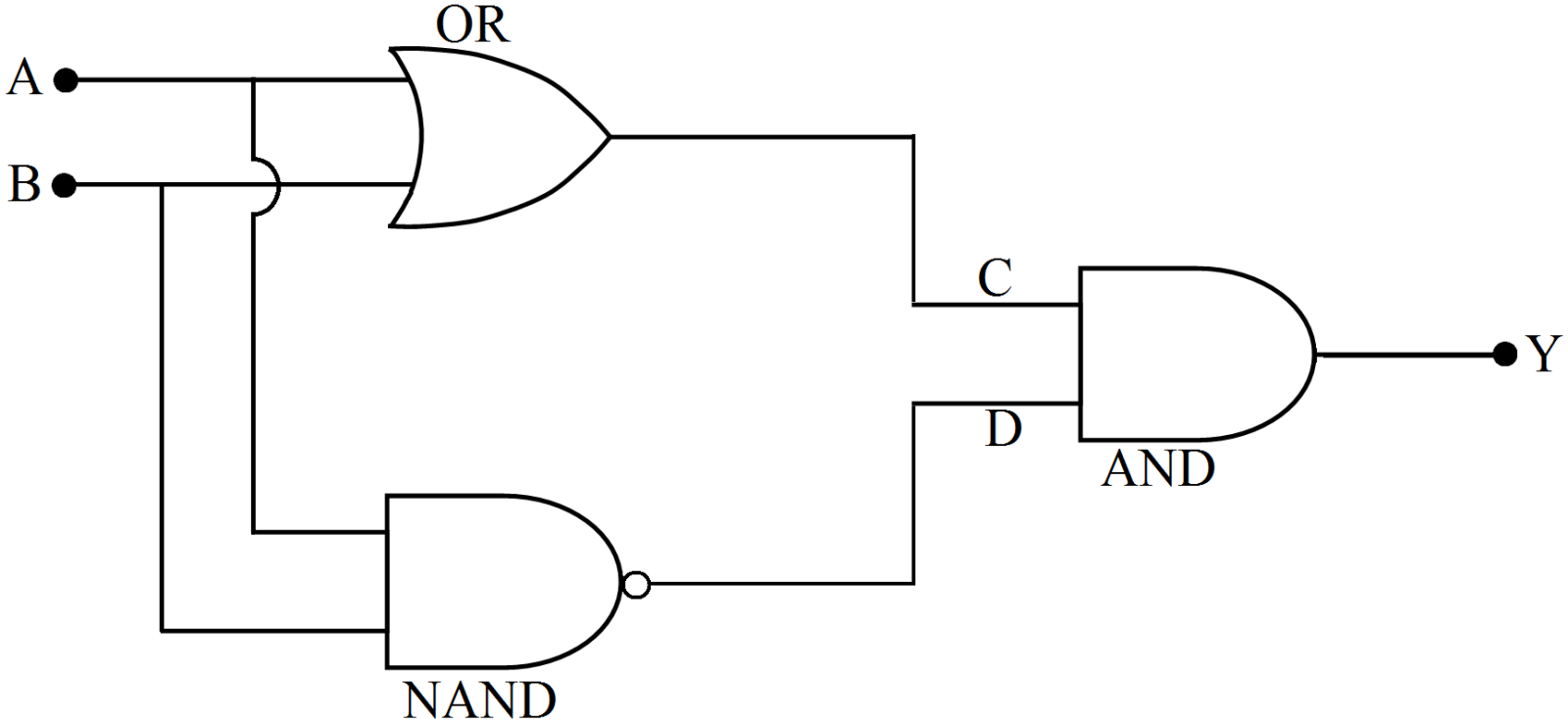
Identify the logic gate represented by the following circuit by writing its truth table:
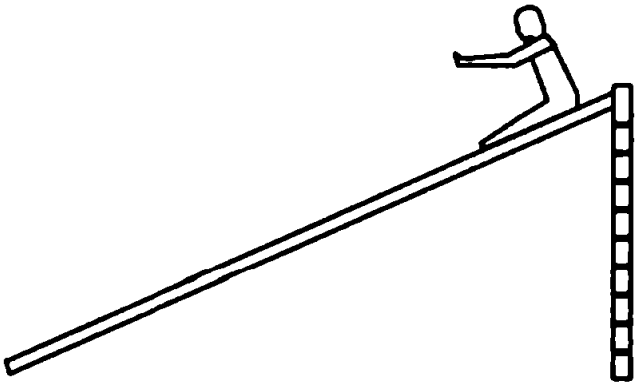
In a children's park, there is a slide which has a total length of 10m and a height of 8.0m (figure). Vertical ladder are provided to reach the top. A boy weighing 200N climbs up the ladder to the top of the slide and slides down to the ground. The average friction offered by the slide is three tenth of his weight. Find
  1. The work done by the ladder on the boy as he goes up.
  2. The work done by the slide on the boy as he comes down. Neglect any work done by forces inside the body of the boy.
A source emitting a sound of frequency v is placed at a large distance from an observer. The source starts moving towards the observer with a uniform acceleration a. Find the frequency heard by the observer corresponding to the wave emitted just after the source starts. The speed of sound in the medium is u.