Question
Define resolving power of a compound microscope. How does the resolving power of a compound microscope change when:
  1. Refractive index of medium between the object and objective lens increases.
  2. Wavelength of radiation used is increased?
Answer

Resolving Power of a Microscope:The resolving power of a microscope is defined as its ability to form separate images of two close objects placed near the microscope.
The minimum distance between close objects for which microscope can just form separate images of the objects is called the limit of resolution of microscope. Smaller the limit, larger the resolving power.
The angular resolving limit of microscope is $\text{d}\theta=\frac{\lambda}{2\text{n}\sin\theta},$
Where n is the refractive index of medium between object and objective.
Resolving power $\frac{1}{\text{d}\theta}=\frac{2\text{n}\sin\theta}{\lambda}$
  1. Resolving power $\alpha$ n; therefore resolving power of a compound microscope increases when refractive index (n) between the object and objective lens increases.
  2. Resolving power $\alpha \frac{1}{\lambda}$ ; therefore, resolving power of a compound microscope decreases with the increase of wavelength of light used.

Need a full question paper?

Generate a complete, print-ready paper with questions like this in minutes — across 16+ boards, with answer keys.

Start Generating Free

Similar questions

Figure shows two blocks $A$ and $B,$ each having a mass of $320g$ connected by a light string passing over a smooth light pulley. The horizontal surface on which the block $A$ can slide is smooth. The block $A$ is attached to a spring of spring constant $40N/m$ whose other end is fixed to a support $40\ cm$ above the horizontal surface. Initially, the spring is vertical and unstretched when the system is released to move. Find the velocity of the block $A$ at the instant it breaks off the surface below it. Take $g = 10m/s^2.$
Calculate potential on the axis of a ring due to charge Q uniformly distributed along the ring of radius R.
equiconvex lens $($of refractive index $1.50)$ in contact with a liquid layer on top of a plane mirror. A small needle with its tip on the principal axis is moved along the axis until its inverted image is found at the position of the needle. The distance of the needle from the lens is measured to be $45.0 \ cm.$ The liquid is removed and the experiment is repeated. The new distance is measured to be $30.0 \ cm.$ What is the refractive index of the liquid?
Two current-carrying wires may attract each other. In absence of other forces, the wires will move towards each other increasing the kinetic energy. Does it contradict the fact that the magnetic force cannot do any work and hence cannot increase the kinetic energy?
  1.  
  1. State the principle on which a potentiometer works. How can a given potentiometer be made more sensitive?
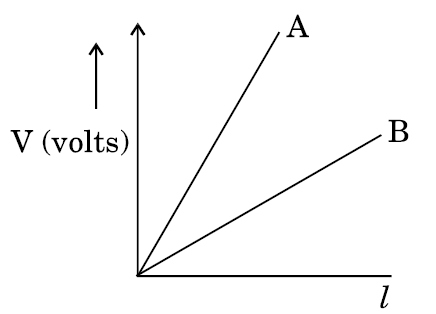
  2. In the graph shown below for two potentiometers, state with reason which of the two potentiometers$, A$ or $B,$ is more sensitive.
  1. Two metallic wires$, P_1$ and $P_2$ of the same material and same length but different cross$-$sectional areas$, A_1$ and $A_2$ are joined together and connected to a source of emf. Find the ratio of the drift velocities of free electrons in the two wires when they are connected $(i)$ in series, and $(ii)$ in parallel.
With the help of a diagram, explain the principle of a device which changes a low voltage into a high voltage but does not violate the law of conservation of energy. Give any one reason why the device may not be $100\%$ efficient.
A long, straight wire carries a current i. Let $B_1,$ be the magnetic field at a point Pat a distance d from the wire. Consider a section of length l of this wire such that the point $P$ lies on a perpendicular bisector of the section. Let $B_2$ be the magnetic field at this point due to this section only. Find the value of $\frac{\text{d}}{\text{l}}$ so that $B_2$ differs from $B_1,$ by $1\%.$
A sound wave of frequency 100Hz is travelling in air. The speed of sound in air is 350m/s.
  1. By how much is the phase changed at a given point in 2.5ms?
  2. What is the phase difference at a given instant between two points separated by a distance of 10.0cm along the direction of propagation?
Consider the situation of the previous problem. Consider the fastest electron emitted parallel to the large metal plate. Find the displacement of this electron parallel to its initial velocity before it strikes the large metal plate.
Find out magnetic force on parallel current carrying conductors and also state their special conditions.