Question
Define the principal focus of concave mirror.

Answer

Light rays that are parallel to the principal axis of a concave mirror converge at a specific point on its principal axis after
reflecting from the mirror. This point is known as the principal focus of the concave mirror
Principal focus (p.f.) is a point on principal axis of a concave mirror where the rays parallel to principal axis meet after reflection
from the mirror.
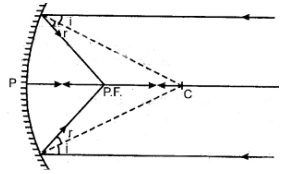
Image

Additional reading. For convex mirror, principal focus is a point on principal axis of a convex mirror where rays parallel to
principal axis appear to diverge from after reflection from the mirror.
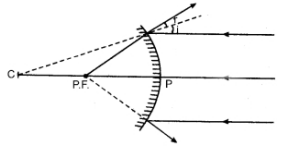
Image

Need a full question paper?

Generate a complete, print-ready paper with questions like this in minutes — across 16+ boards, with answer keys.

Start Generating Free

Similar questions

At which trophic level a person is feeding when he is eating:
  • Roasted chicken.
  • Bread.
  • Eggs.
  • Apple.
  • Fish.
Explain the significance of peristalsis.
Explain the principle of working of a thermal power plant. Draw a labelled diagram to illustrate your answer.
How will you infer with the help of an experiment that the same current flows through every part of the circuit containing three resistances in series connected to a battery?
  1. Define focal length of a spherical lens.
  2. A divergent lens has a focal length of 30 cm. At what distance should an object of height 5 cm from the optical centre of the lens be placed so that its image is formed 15 cm away from the lens? Find the size of the image also.
  3. Draw a ray diagram to show the formation of image in the above situation.
What happens when zinc granules are treated with dilute solution of $H _2 SO _4, HCl , HNO _3, NaCl$ and NaOH , also write the chemical equations if reaction occurs.
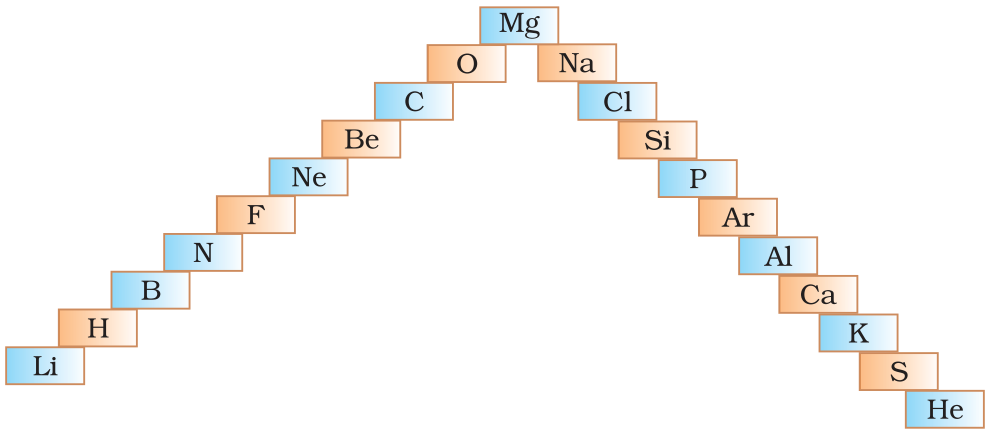
  1. In this ladder (Figure) symbols of elements are jumbled up. Rearrange these symbols of elements in the increasing order of their atomic number in the Periodic Table.
  1. Arrange them in the order of their group also.
i. Explain by giving one example each:
a. Unisexual flowers
b. Bisexual flowers
ii. Name the labelled parts A, B, C and D in the diagram given below.
Image
iii. Pollination may occur without fertilisation but fertilisation will not take place without pollination. Give reason to justify this statement.
Write the names and symbols of two very reactive metals belonging to group 1 of the periodic table. Explain by drawing electronic structure, how either one of the two metals reacts with a halogen. With which name is the bond formed between these elements known and what is the class of the compound so formed known? State any four physical properties of such compounds.
State one difference between artificial kidney and natural kidney?