Question
How will you infer with the help of an experiment that the same current flows through every part of the circuit containing three resistances in series connected to a battery?
Answer

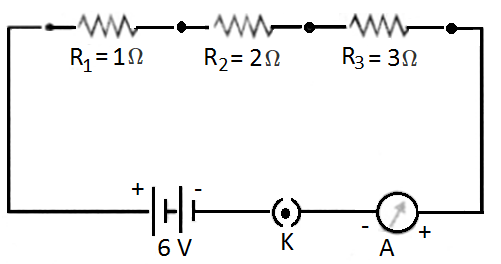
Perform an activity to show that in series combination of resistors, same current flows through each resistor.
  1. Connect three resistors of resistances $R_1=1 \Omega, R_2=2 \Omega$ and $R_3=3 \Omega$ in series.
  2. Connect the series combination of resistors with a battery of 6V, a plug key K and an ammeter A as shown in figure.
  1. Note the reading of ammeter after plugging the key. Let it be I.
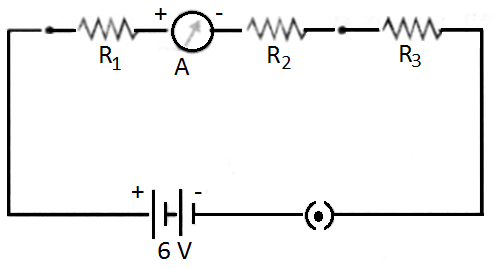
  2. Now disconnect ammeter and connect it in between the resistors $R_1$ and $R_2$ as shown in figure.
  1. Again plug the key and note the reading of ammeter. It is found that again it is I.
  2. Now disconnect the ammeter and connect it in between the resistors $R _2$ and $R _3$​​​​​​​.
  3. Plug the key and note the reading of ammeter. Again it is found to be I.

Need a full question paper?

Generate a complete, print-ready paper with questions like this in minutes — across 16+ boards, with answer keys.

Start Generating Free

Similar questions

A $10 cm$ long pencil is placed $5 cm$ in front of a concave mirror having a radius of curvature of $40 cm$.
(i) Determine the position of the image formed by this mirror.
(ii) What is the size of the image?
(iii) Draw a ray diagram to show the formation of the image as mentioned in the part (i).
The following is a food chain that ends with human:
plants → bee → human
  1. Explain how plants provide food for bees.
  2. How do bees provide food for humans?
  3. How does this food chain differ form a usual food chain involving human such as : plants → goat → human?
  4. Do you think that the food chain given in this question can really be regarded as a food chain? Explain your answer.
Explain the three pathways of breakdown in living organisms.
When a female child is born, her ovaries already contain thousands of immature eggs (or ova) contained in immature structures A. On maturing, A bursts open and an egg shoots out of the ovary in a process called B. The process B starts in the females at puberty and occurs again and again after a time period x. Before every occurrence of process B, the inner lining of uterus becomes thick and soft with lots of blood vessels in it. When the egg cell gets fertilised by a sperm, then an event C occurs in the life of mature human female which lasts for time period y leading to the birth of baby. If, however, the egg cell released by the ovary does not get a sperm to fuse with, then the thick and soft inner lining of uterus breaks down and comes out of the female's body in an event called D. The occurrence of event D is controlled by chemical substances E.
  1. What are A?
  2. What is process B?
  3. What is the time period x?
  4. Name the event C.
  5. How much is the time period y?
  6. What is the name of process D?
  7. Name the chemical substances E.
A water-insoluble substance X on reaction with dilute hydrochloric acid released a colourless and odourless gas accompanied by brisk effervescence. When the gas passed through water, the solution obtained turns blue litmus red.
On bubbling the gas through lime water, it initially became milky and milkiness disappeared when the gas was passed in excess. Identify the substance X. Write the chemical equation of the reaction involved.
Draw the electron-dot structures of the following compounds and state the type of bonding in each case:
i. $CO _2$
ii. MgO
iii. H,O
iv. HCl
v. $MgCl _2$
Draw the structure of a neuron and explain its function.
Classify the following into herbivores, carnivores and omnivores:
Lion, Man, Dog, Goat, Crow, Elephant, Snake, Hawk, Rabbit, Deer.
Define hydrotropism. Give one example of hydrotropism. State whether this example is of positive hydrotropism or negative hydrotropism. Illustrate your answer with the help of labelled diagram.
Draw a neat diagram of fate of pollen after landing on stigma. Also, label the following parts.
  1. Female germ cell.
  2. Pollen tube.
  3. Pollen grain.
  4. Male germ cell.