Question
  1. Define the term drift velocity.
  2. On the basis of electron drift, derive an expression for resistivity of a conductor in terms of number density of free electrons and relaxation time. On what factors does resistivity of a conductor depend?
  3. Why alloys like constantan and manganin are used for making standard resistors?

Answer

  1. Average velocity acquired by the electrons in the conductor in the presence of external electric field.

Alternate Answer

$[\text{V}_{d} =\frac{-eE\tau}{\text{m}}$ where $\tau$is the relaxation time.]

  1. $\text{V}_{d} =\frac{-eE\tau}{\text{m}}$ 

We have $\text{E} = - \frac{\text{V}}{\ell'}$

where V is potential difference across the length $\ell$

of the conductor

$\text{V}_{d} = \frac{\text{eV}\tau}{\text{m}\ell}$ Current flowing I = neAvd

I = neA$\text{V}_{d}\frac{\text{eV}\tau}{\text{ml}} = \frac{ne^{2}\text{AV}\tau}{\text{ml}}$

$\frac{\text{I}}{\text{V}} = \frac{\text{ne}^{2}A\tau}{ml} = \frac{1}{\text{R}}$ . . . . . (i)

Also,  $\text{R} = \rho\frac{\ell}{\text{A}}$ . . . . (ii) 

Comparing (i) and (ii)

$\rho = \frac{m}{ne^{2}\tau}$

Resistivity of the material of a conductor depends on the relaxation time, i.e., temperature and the number density of electrons.

  1. Because constantan and manganin show very weak dependence of resistivity on temperature.
Need a full question paper?

Generate a complete, print-ready paper with questions like this in minutes — across 16+ boards, with answer keys.

Start Generating Free

Similar questions

One morning an old man walked bare-foot to replace the fuse wire in kit kat fitted with the power supply mains for his house. Suddenly he screamed and collapsed on the floor. His wife cried loudly for help. His neighbour’s son Anil heard the cries and rushed to the place with shoes on. He took a wooden baton and used it to switch off the main supply.
Answer the following questions:
  1. What is the voltage and frequency of mains supply in India?
  2. These days most of the electrical devices we use require a.c. voltage. Why?
  3. Can a transformer be used to step up d.c.voltage?
  4. Write two qualities displayed by Anil by his action.
A pin of length 2.00cm is placed perpendicular to the principal axis of a converging lens. An inverted image of size 1.00cm is formed at a distance of 40.0cm from the pin. Find the focal length of the lens and its distance from the pin.
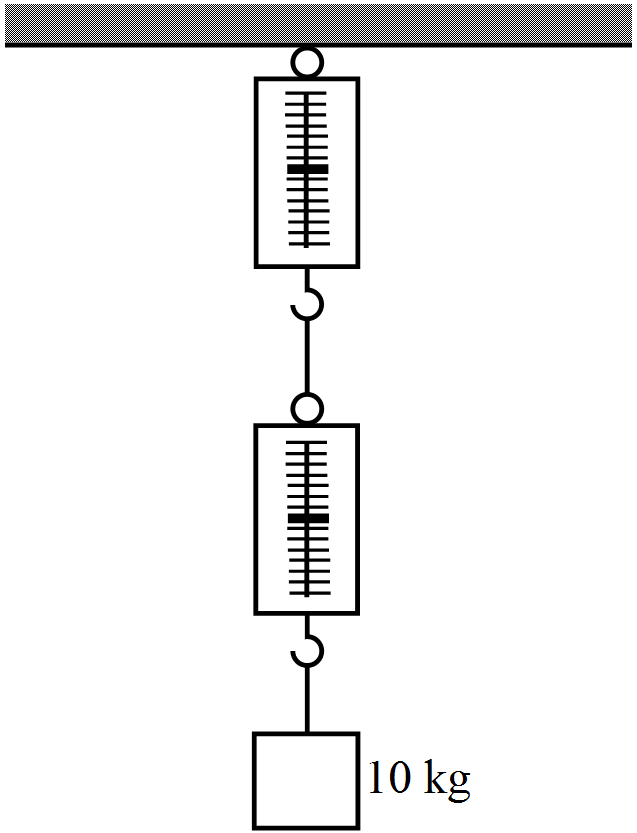
A block of mass 10kg is suspended through two light spring balances as shown in figure:

  1. Both the scales will read 10kg.
  2. Both the scales will read 5kg.
  3. The upper scale will read 10kg and the lower zero.
  4. The readings may be anything but their sum will he 10kg.
Suppose the space between the two inner shells of the previous problem is filled with a dielectric of dielectric coastant K. Find the capacitance of the system between A and B.
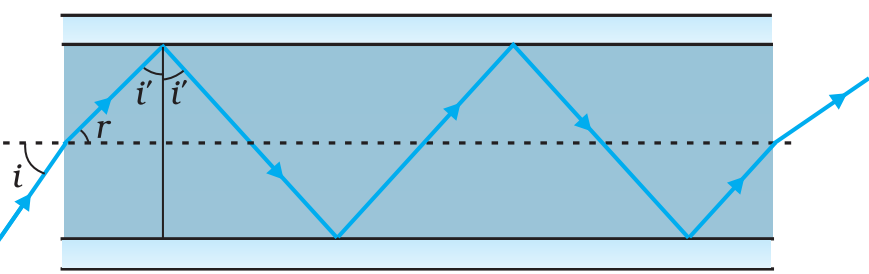
  1. a cross - section of a ‘light pipe’ made of a glass fibre of refractive. The outer covering of the pipe is made of a material of refractive. What is the range of the angles of the incident rays with the axis of the pipe for which total reflections inside the pipe take place, as shown in the figure.
  2. What is the answer if there is no outer covering of the pipe?

Answer the following questions:
(a) Are the equations of nuclear reactions (such as those given in Section 13.7) 'balanced' in the sense a chemical equation (e.g., $2 H _2+ O _2 \rightarrow 2 H _2 O$ ) is? If not, in what sense are they balanced on both sides?
(b) If both the number of protons and the number of neutrons are conserved in each nuclear reaction, in what way is mass converted into energy (or vice-versa) in a nuclear reaction?
(c) A general impression exists that mass-energy interconversion takes place only in nuclear reaction and never in chemical reaction. This is strictly speaking, incorrect. Explain.
The mixture a pure liquid and a solution in a long vertical column (i.e, horizontal dimensions < < vertical dimensions) produces diffusion of solute particles and hence a refractive index gradient along the vertical dimension. A ray of light entering the column at right angles to the vertical is deviated from its original path. Find the deviation in travelling a horizontal distance d < < h, the height of the column.
  1. Draw a ray diagram to show the image formation by a combination of two thin convex lenses in contact. Obtain the expression for the power of this combination in terms of the focal lengths of the lenses.
  2. A ray of light passing from air through an equilateral glass prism undergoes minimum deviation when the angle of incidence is $\frac{3}{4}$th of the angle of prism. Calculate the speed of light in the prism.
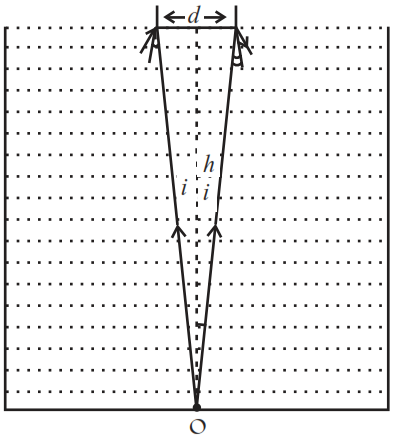
A jar of height h is filled with a transparent liquid of refractive index μ (Fig). At the centre of the jar on the bottom surface is a dot. Find the minimum diameter of a disc, such that when placed on the top surface symmetrically about the centre, the dot is invisible.

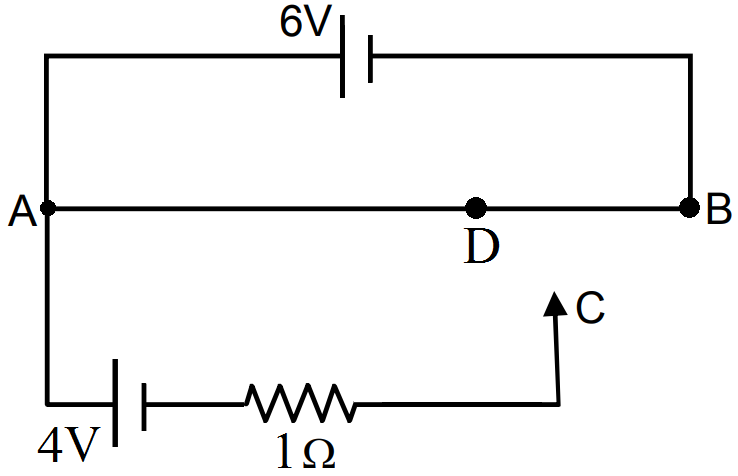
A 6 volt battery of negligible internal resistance is connected across a uniform wire AB of length 100cm. The positive terminal of another battery of emf 4V and internal resistance $1\Omega$ is joined to the point A, as shown in the figure. Take the potential at B to be zero. (a) What are the potentials at the points A and C? (b) At which point D of the wire AB, the potential is equal to the potential at C? (c) If the points C and D are connected by a wire, what will be the current through it? (d) If the 4V battery is replaced by a 7.5V battery, what would be the answers of parts (a) and (b)?