Question
Define the term magnetic moment of a current loop. Write the expression for the magnetic moment when an electron revolves at a speed v around an orbit of radius ‘r’ in hydrogen atom.

Answer

Magnetic moment of a current loop:

The torque on current loop is $\tau=\text{MB}\sin\theta$, where $\theta$ is angle between magnetic moment and magnetic field.

$\Rightarrow\text{M}=\frac{\tau}{\text{B}\sin\theta}$

If B or 1 T, $\sin\theta=1$ or $\theta=90^\circ$ then $\text{M}=\tau$.

That is the magnetic moment of a current loop is defined as the torque acting on the loop when placed in a magnetic field of 1 T such that the loop is oriented with its area vector normal to the magnetic field.

Also, M = IA

i.e., magnetic moment of a current loop is the product of current flowing in the loop and area of loop. Its direction is perpendicular to the plane of the loop and determined by using right hand thumb rule.

Magnetic moment of revolving electron,

$\text{M}=\frac{\text{evr}}{2}$

Need a full question paper?

Generate a complete, print-ready paper with questions like this in minutes — across 16+ boards, with answer keys.
Start Generating Free

Similar questions

A uniform magnetic field of 1.5 T exists in a cylindrical region of radius10.0 cm, its direction parallel to the axis along east to west. A wire carrying current of 7.0 A in the north to south direction passes through this region. What is the magnitude and direction of the force on the wire if,
  1. The wire intersects the axis,
  2. The wire is turned from N-S to northeast-northwest direction,
  3. The wire in the N-S direction is lowered from the axis by a distance of 6.0 cm?
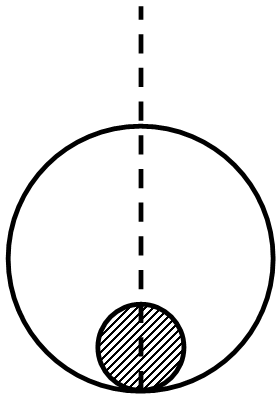
A solid sphere of mass m and radius r is placed inside a hollow thin spherical shell of mass M and radius R as shown in A particle of mass m' is placed on the line joining the two centres at a distance x from the point of contact of the sphere and the shell. Find the magnitude of the resultant gravitational force on this particle due to the sphere and the shell if,
  1. r < x < 2r.
  2. 2r < x < 2R.
  3. x > 2R.

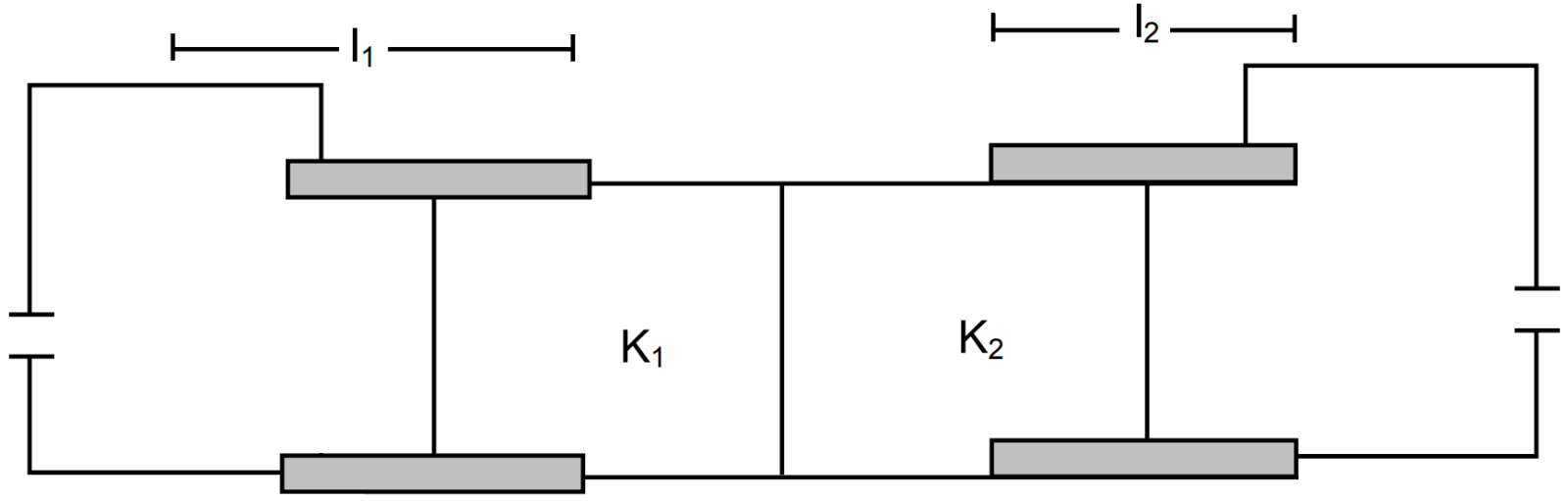
Figure shows two parallel plate capacitors with fixed plates and connected to two batteries. The separation between the plates is the same for the two capacitors. The plates are rectangular in shape with width b and lengths l1 and l2 The left half of the dielectric slab has a dielectric constant K1 and the right half K2. Neglecting any friction, find the ratio of the emf of the left. battery to that of the right battery for which the dielectric slab may remain in equilibrium.

Compare three magnetic substances on the basis of following properties :
(i) Behaviour in magnetic field
(ii) Main reason for magnet formation
(iii) Behaviour in non-uniform magnetic field
(iv) Behaviour on bringing magnetic pole near
(v) Magnitude of $\mu_r$
(vi) Number of field lines passing through substance in magnetic field
(vii) Direction of magnetisation.
The work function of a photoelectric material is 4.0eV.
  1. What is the threshold wavelength?
  2. Find the wavelength of light for which the stopping potential is 2.5V.
0.040g of He is kept in a closed container initially at 100.0°C. The container is now heated. Neglecting the expansion of the container, calculate the temperature at which the internal energy is increased by 12J.
An ammeter is to be constructed that can read currents up to 2.0A. If the coil has resistance of $25\Omega$ and takes 1mA for full-scale deflection, what should be the resistance of the shunt used?
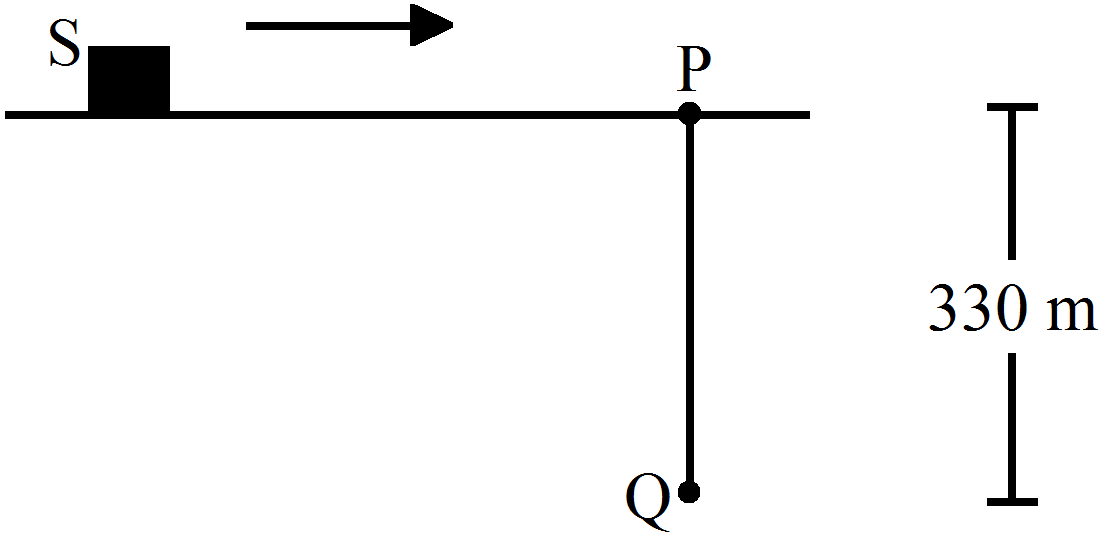
Figure, shows a source of sound moving along the X-axis at a speed of 22m/s continuously emitting a sound of frequency 2.0kHz which travels s in air at a speed of 330m/s. A listener Q stands on the Y-axis at a distance of 330 m from the origin. At t = 0, the source crosses the origin P.

  1. When does the sound emitted from the source at P reach the listener Q?
  2. What will be the frequency heard by the listener at this instant?
  3. Where will the source be at this instant?


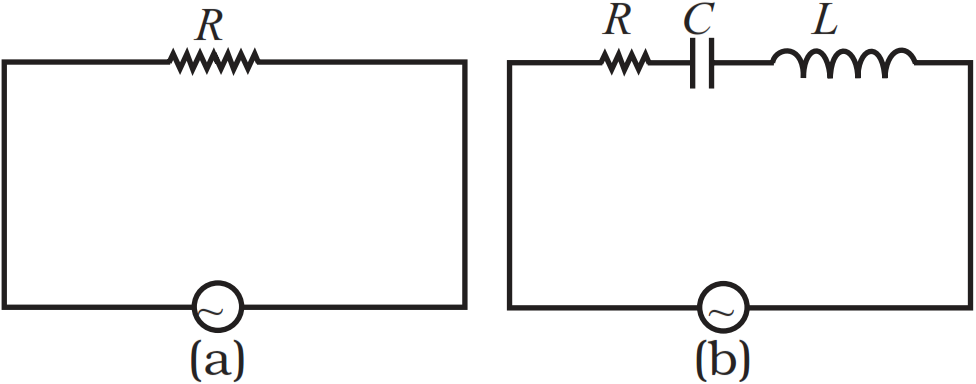
Study the circuits (a) and (b) shown in Fig. and answer the following questions.

  1. Under which conditions would the rms currents in the two circuits be the same?
  2. Can the rms current in circuit (b) be larger than that in (a)?
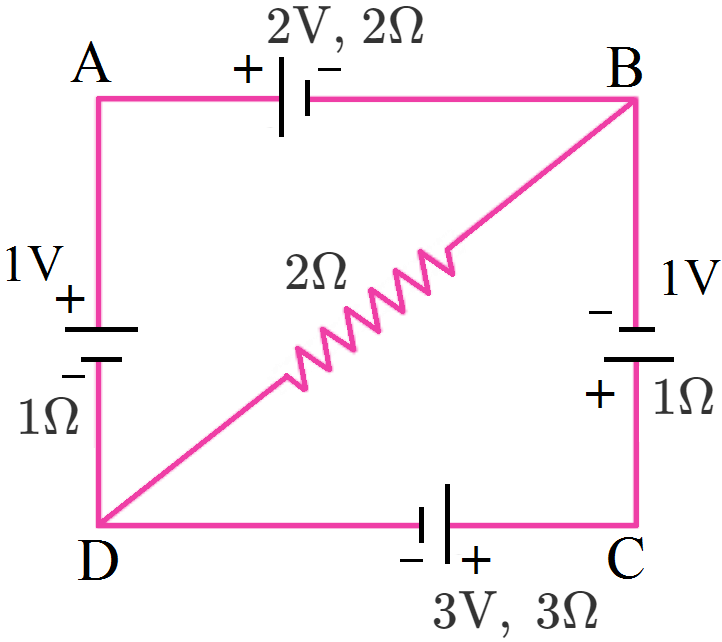
For the circuit shown here, calculate the potential difference between points B and D.