Question
  1. Define the term ‘volt’.
  2. State the relation between work, charge and potential difference for an electric circuit.
Calculate the potential difference between the two terminals of a battery if 100 joules of work is required to transfer 20 coulombs of charge from one terminal of the battery to the other.

Answer

  1. One volt is the potential difference between two points in a current carrying conductor when 1 joule of work is done to move a charge of 1 coulomb from one point to another.
  2. Work = charge x potential difference $(\text{OR }\text{W = Q} \times \text{V})$
$V = \frac{W}{Q}$

$V = \frac{\text{100 J}}{\text{20 C}}$

$\therefore V = \text{5 volt}$

Need a full question paper?

Generate a complete, print-ready paper with questions like this in minutes — across 16+ boards, with answer keys.
Start Generating Free

Similar questions

Draw a ray diagram showing the dispersion through a prism when a narrow beam of white light is incident on one of its refracting surfaces. Also indicate the order of the colours of the spectrum obtained.
How are the properties of an alloy different from those of the constitutent elements?
X, Y, and Z are three animals. The animal X can fly but animal Y can only run on ground or walls. The forelimbs of animals X and Y have the same basic design but they are used for different purposes such as flying and running respectively. The animal Z became extinct an long time ago. The study of fossils of Z tells us that it had some features like those of X and some like those of Y. In fact, Z is said to form a connecting link in the evolutionary chain of X and Y.
  1. What could the animals X, Y and Z be?
  2. What name is given to the forelimbs like those of X and Y which have the same basic design but different functions?
  3. Name one feature in which Z resembled X.
  4. Name one feature in which Z resembled Y.
  5. Which is the correct evolutionary chain involving X, Y and Z : X → Z → Y or Y → Z → X?
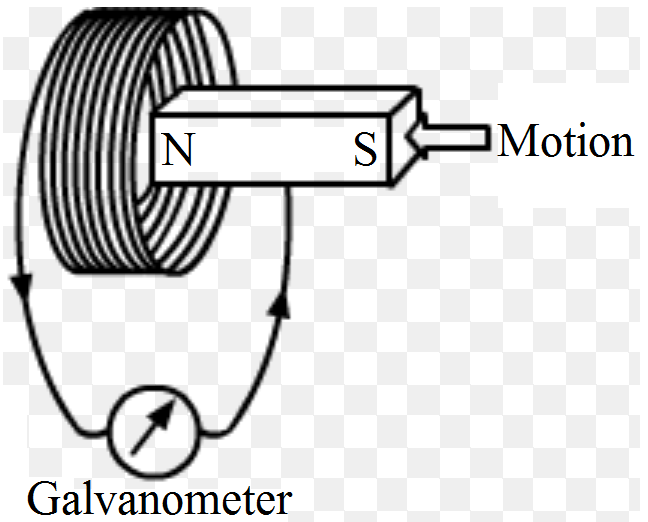
When the magnet shown in the diagram below is moving towards the coil, the galvanometer gives a reading to the right.
  1. What is the name of the effect being produced by the moving magnet?
  2. State what happens to the reading shown on the galvanometer when the magnet is moving away from the coil.
  3. The original experiment is repeated. This time the magnet is moved towards the coil at a great speed. State two changes you would notice in the reading on the galvanometer.
The atomic number of three elements A, B and C are 11, 14 and 17 respectively.
State the group to which these elements belong in the modern periodic table.
Calculate the focal length of a convex lens which produces a virtual image at a distance of 50cm of an object placed 20cm in front of it.
On adding a drop of barium chloride solution to an aqueous solution of sodium sulphite, white precipitate is obtained.
  1. Write a balanced chemical equation of the reaction involved.
  2. What other name can be given to this precipitation reaction?
  3. On adding dilute hydrochloric acid to the reaction mixture, white precipitate disappears. Why?
For which position of the object does a convex lens form a virtual and erect image? Explain with the help of a ray diagram.
Food does not pass through the digestive system by 'gravity'. This is clear from the fact that we can digest the food even if we are lying down. Explain the logic behind the passage of food through our digestive system.
What is 'Phototropism'? How does it occur in plants ? Describe an activity to demonstrate phototropism.