Question
  1. Define “Trade surplus”. How is it different from “Current account surplus”?
  2. “Indian Rupee (₹) plunged to all time low of ₹ 74.48 against the US Dollar ($)”. -The Economic Times

In the light of the above report, discuss the impact of the situation on Indian Imports.

Answer

  1. Trade surplus refers to the situation when exports of goods and services exceeds the import of goods and services.

Exports of Goods and Services > Imports of Goods and Service ⇒ Current Account Surplus

Trade surplus is different from "Current Account Surplus". This is because current account is the account which maintains the records of imports and exports of goods and services as well as the record of unilateral transfers.

Current Account Balance = Balance of Visible Trade + Balance of Invisible Trade + Balance of Unilateral Transfers

  1. Indian Rupee is depreciating against the US Dollar since it is given that "Indian Rupee (₹) plunged to all time low of ₹ 74.48 against the US Dollar ($)". A high exchange rate makes the imports more expensive. Consequently, a rise in the exchange rate implies a reduction in the demand for imports and vice-versa.

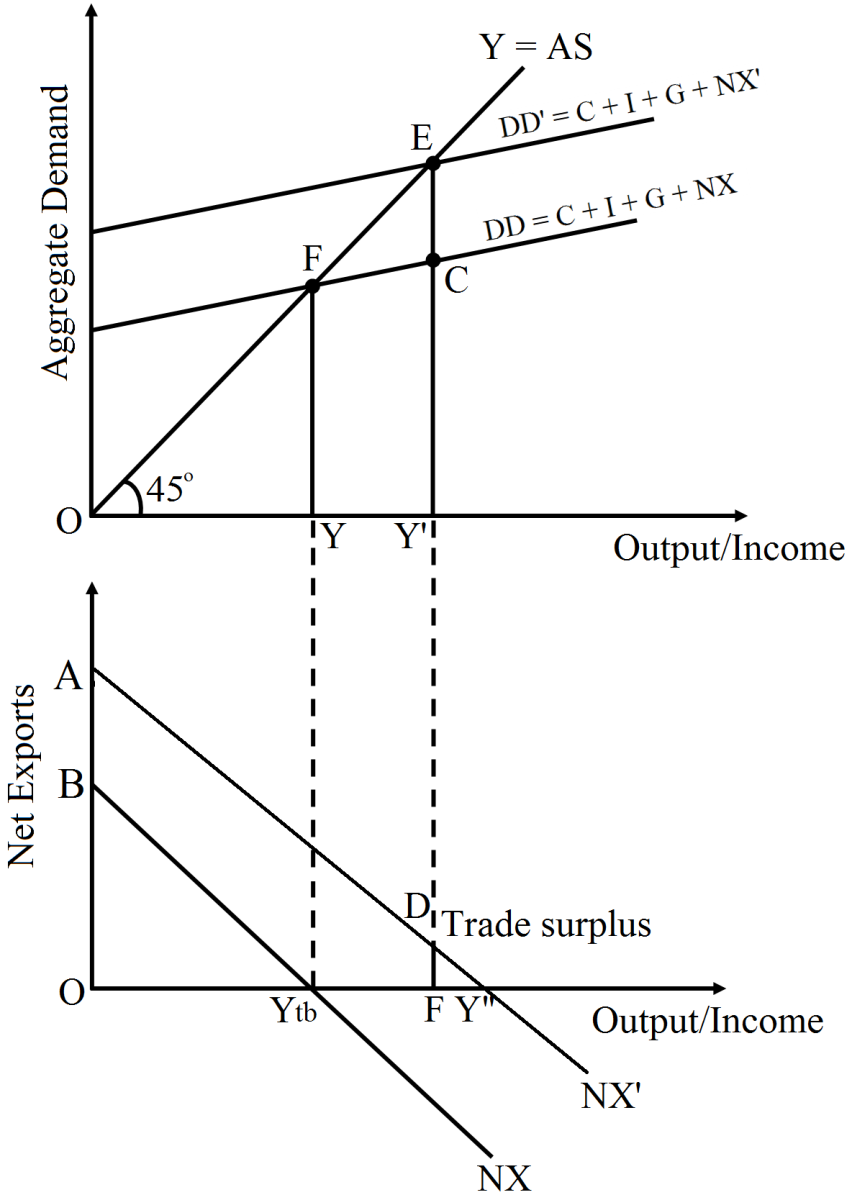
When imports falls, net exports (Exports-Imports) of a country rises. The given figure explains this process as follows:

Suppose the initial equilibrium income is given by Ye that corresponds to a trade balance equal to Ytb. With the rise in the net export demand, the aggregate demand curve DD shifts upwards to DD' such that the new equilibrium is established at point E' and the equilibrium income rises to Y'.

In the lower panel due to the fall in the imports, the net export rises and the net export curve shifts upwards from NX to NX'. At the new level of income, the net exports is represented by the vertical distance AE' which are necessarily positive (because the total demand curve DD' lies above the aggregate demand curve AD).

Thus, with a fall in the imports, there is a trade surplus. This trade surplus is represented in the lower panel by the vertical length DF.
Need a full question paper?

Generate a complete, print-ready paper with questions like this in minutes — across 16+ boards, with answer keys.

Start Generating Free

Similar questions

Distinguish between decrease in demand and decrease in quantity demanded.
Explain the distinction between "change in quantity supplied" and "change in supply". Use diagram.
Define price elasticity of demand. Explain its various degrees. Use diagrams.
What are revenue receipts? Explain the role of government budget in bringing stability in the economy.
At a given price of a commodity, there is excess demand. Is this price an equilibrium price? If not, how will the equilibrium price be reached?
The total fixed cost of a firm is ₹ 12. Given below is its marginal cost schedule. Calculate total cost and average variable cost for each given level of output.
Output
1
2
3
4
5
6
Marginal Cost ()
9
7
2
4
8
12
  1. In which sub-account and on which side of balance of payments account will foreign investments in India be recorded? Give reasons.
  2. What will be the effect of foreign investments in India on exchange rate? Explain.
While estimating national income, how will you treat the following? Give reasons for your answer.
  1. Imputed rent of self-occupied houses.
  2. Interest received on debentures.
  3. Financial help received by flood victims.
Explain the income method of estimating national income.
From the following data, calculate “national income” by (1) income method and(2) expenditure method:
    (Rs. in crores)
1 Interest. 150
2 Rent. 250
3 Government final consumption expenditure. 600
4 Private final consumption expenditure. 1200
5 Profits. 640
6 Compensation of employees. 1000
7 Net factor income to abroad. 30
8 Net indirect taxes. 60
9 Net exports. (-)40
10 Consumption of fixed capital. 50
11 Net domestic capital formation. 340