Question
Derive a mathematical expression for the force per unit length experienced by each of the two long current carrying conductors placed parallel to each other in air. Hence define one ampere of current.Explain why two parallel straight conductors carrying current in the opposite direction kept near each other in air repel?

Answer

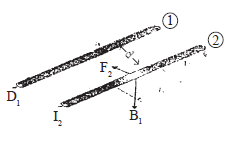
  1. Diagram:
  1. Magnetic field due to the current $\text{I}_{1}$ flowing in conductor 1 at a point on conductor 2 $\text{B}_{1} = \frac{\mu_\circ\text{I}_{1}}{2\pi\text{d}}$
$\therefore $ force on conductor 2 due to $\text{B}_{1}$ is
$\text{F}_{2} = \text{I}_{2} \big( \overrightarrow\ell{_2}\times\overrightarrow{\text{B}}_{1}\big)$
$=\text{I}_{2}\ell_{2}\times\text{B}_{1}$
$\therefore \frac{\text{F}_{2}}{\ell_2} = \frac{\mu_\circ\text{I}_{1}\text{I}_2}{2{\pi}\text{d}}$
  1. Ampere: The equal currents, flowing through two thin long straight parallel conductors said to be one ampere each if they interact with each other with a force of $2\times 10^{-7}$ N/m when kept one metre apart in vacuum.
  2. Direction of magnetic field, at the second conductor, due to current in the first conductor.
Direction of force on the second conductor, (carrying a parallel current) due to this magnetic field.

Need a full question paper?

Generate a complete, print-ready paper with questions like this in minutes — across 16+ boards, with answer keys.

Start Generating Free

Similar questions

Consider the situation of the previous problem. Consider the fastest electron emitted parallel to the large metal plate. Find the displacement of this electron parallel to its initial velocity before it strikes the large metal plate.
Figure shows a charge array known as an electric quadrupole. For a point on the axis of the quadrupole, obtain the dependence of potential on r for r/a >> 1, and contrast your results with thatdue to an electric dipole, and an electric monopole (i.e., a single charge).
A torsional pendulum consists of a solid disc connected to a thin wire$\Big(\alpha=2.4\times10^{-5}\ ^\circ\text{C}^{-1}\Big)$at its centre. Find the percentage change in the time period between peak winter $(5^\circ C)$ and peak summer $(45^\circ C)$.
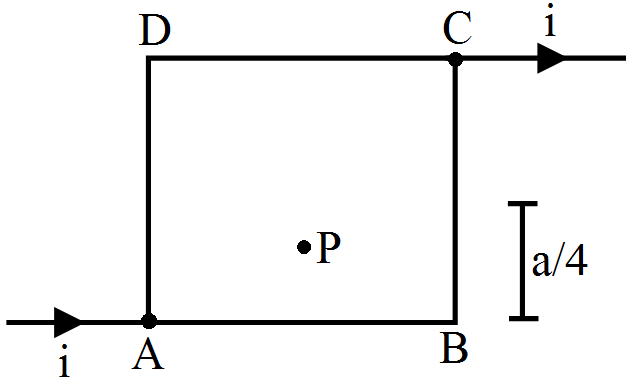
Figure shows a square loop of edge a made of a uniform wire. A current i enters the loop at the point A and leaves it at the point C. Find the magnetic field at the point P which is on the perpendicular bisector of AB at a distance $\frac{\text{a}}{4}$ from it.
An adiabatic cylindrical tube of cross-sectional area $1cm^2$ is closed at one end and fitted with a piston at the other end. The tube contains 0.03g of an ideal gas. At 1atm pressure and at the temperature of the surrounding, the length of the gas column is 40cm. The piston is suddenly pulled out to double the length of the column. The pressure of the gas falls to 0.355atm. Find the speed of sound in the gas at atmospheric temperature.
$4 \times 10^{23}$ tritium atoms are contained in a vessel. The half-life of decay tritium nuclei is 12.3y. Find:
  1. The activity of the sample.
  2. The number of decay in the next 10 hours.
  3. The number of decays in the next 6.15y.
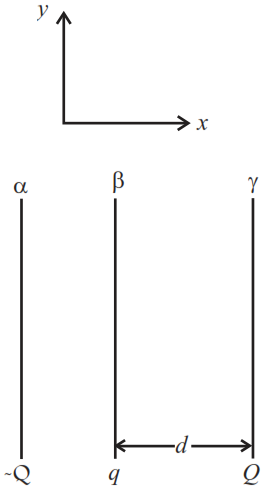
Two fixed, identical conducting plates $(\alpha\ \&\ \beta)$, each of surface area S are charged to -Q and q, respectively, where Q > q > 0. A third identical plate $(\gamma)$, free to move is located on the other side of the plate with charge q at a distance d (Fig.). The third plate is released and collides with the plate $\beta$. Assume the collision is elastic and the time of collision is sufficient to redistribute charge amongst $\beta\ \&\ \gamma$.

Find the electric field acting on the plate $\gamma$ before collision.
Three photo diodes D1, D2 and D3 are made of semiconductors having band gaps of 2.5eV, 2eV and 3eV, respectively. Which ones will be able to detect light of wavelength $6000\mathring{\text{A}}$?
Answer the following Questions.
  1. Find expressions for the force and torque on an electric dipole kept in a uniform electric field.
OR

An electric dipole is held in a uniform electric field. (i) Using suitable diagram show that it does not undergo any translatory motion, and (ii) derive an expression for torque acting on it and specify its direction.
  1. Derive an expression for the work done in rotating a dipole from the angle $\theta_0$ to $\theta_1$ in a uniform electric field E.
​​​​​​​OR
  1. Define torque acting on a dipole of dipole moment $\vec{\text{p}}$ placed in a uniform electric field $\vec{\text{E}}.$ Express it in the vector form and point out the direction along which it acts.
  2. What happens if the field is non-uniform?
  3. What would happen if the external field $\vec{\text{E}}$ is increasing (i) parallel to $\vec{\text{p}}$ and (ii) anti-parallel to $\vec{\text{p}}?$
A piano wire A vibrates at a fundamental frequency of 600Hz. A second identical wire B produces 6 beats per second with it when the tension in A is slightly increased. Find the ratio of the tension in A to the tension in B.