Motion of System of Particles and Rigid Bodies — Physics STD 11 — Question
Tamilnadu BoardEnglish MediumSTD 11PhysicsMotion of System of Particles and Rigid Bodies5 Marks
Question
Derive an expression for center of mass for distributed point masses.
✓
Answer
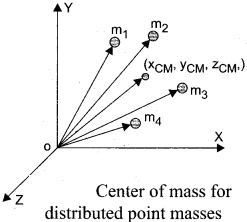
A point mass is a hypothetical point particle which has nonzero mass and no size or shape. To find the center of mass for a collection of $n$ point masses, say, $m_1, m_2, m_3 \ldots . . . m_n$ we have to first choose an origin and an appropriate coordinate system as shown in Figure. Let, $x _1, x _2, x _3 \ldots \ldots . . x _{ n }$ be the X -coordinates of the positions of these point masses in the X direction from the origin.
The equation for the X coordinate of the center of mass is,$
x_{ CM }=\frac{\sum m_i x}{\sum m_i}
$
where, $\sum mi$ is the total mass $M$ of all the particles. $\left(\sum mi = M \right)$. Hence,
$
x_{ CM }=\frac{\sum m_i x_i}{\sum M }
$
Similarly, we can also find $y$ and $z$ coordinates of the center of mass for these distributed point masses as indicated in figure.
$
\begin{aligned}
y_{ CM } & =\frac{\sum m_i y_i}{\sum M } \\
z_{ CM } & =\frac{\sum m_i z_i}{\sum M }
\end{aligned}
$
Hence, the position of center of mass of these point masses in a Cartesian coordinate system is $\left( x _{ CM }, y _{ CM } z _{ CM }\right)$. in general, the position of center of mass can be written in a vector form as, $\vec{r}_{ CM }=\sum_{ M }^{m_1 \vec{r}_i}$
where, is the position vector of the center of mass and $\vec{r}_i= x _{ i } \hat{j}+ y _{ i } \hat{j}+ z _{ i } \hat{k}$ is the position vector of the distributed point mass; where, $\hat{i}, \hat{j}$, and $\hat{j}$ are the unit vectors along $X , Y$ and $Z$-axis respectively.
Need a full question paper?
Generate a complete, print-ready paper with questions like this in minutes — across 16+ boards, with answer keys.