Question
Derive an expression for kinetic energy in rotation and establish the relation between rotational kinetic energy and angular momentum.
Answer

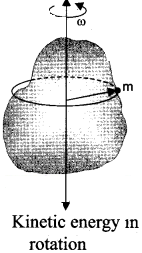
Let us consider a rigid body rotating with angular velocity $\omega$ about an axis as shown in figure.
Every particle of the body will have the same angular velocity $\omega$ and different tangential velocities $v$ based on its positions from the axis of rotation. Let us choose a particle of mass $m_i$ situated at distance $r_i$ from the axis of rotation. It has a tangential velocity $v_i$ given by the relation, $v _{ i }= r _{ i } \omega$. The kinetic energy $KE _{ i }$, of the particle is, $KE _{ i }=\frac{1}{2} m_i v_i^2$
Writing the expression with the angular velocity,
$KE =\frac{1}{2} m _{ i }\left( r _{ i } \omega\right)^2=\frac{1}{2} m_i r_i^2 \omega^2$
For the kinetic energy of the whole body, which is made up of large number of such particles, the equation is written with summation as,
$KE =\frac{1}{2}\left(\sum m_i r_i^2\right) \omega^2$
where, the term $\sum m_i r_i{ }^r$ is the moment of inertia l of the whole body. $\sum m_i r_i^r$
Hence, the expression for KE of the rigid body in rotational motion is -
$KE =\frac{1}{2} \mid \omega^2$
This is analogous to the expression for kinetic energy in transnational motion.
$KE =\frac{1}{2} Mv ^2$
Image
Relation between rotational kinetic energy and angular momentum
Let a rigid body of moment of inertia I rotate with angular velocity $\omega$.
The angular momentum of a rigid body is, $L=I \omega$
The rotational kinetic energy of the rigid body is, $KE =\frac{1}{2} l \omega^2$
By multiplying the numerator and denominator of the above equation with $I$, we get a relation between $L$ and $K E$ as,
$KE =\frac{1}{2} \frac{ I ^2 \omega^2}{ I }=\frac{1}{2} \frac{( I \omega)^2}{ I }$
$KE =\frac{ L ^2}{2 I }$

Need a full question paper?

Generate a complete, print-ready paper with questions like this in minutes — across 16+ boards, with answer keys.

Start Generating Free