Motion of System of Particles and Rigid Bodies — Physics STD 11 — Question
Tamilnadu BoardEnglish MediumSTD 11PhysicsMotion of System of Particles and Rigid Bodies5 Marks
Question
Derive an expression for kinetic energy in pure rolling.
✓
Answer
As pure is the combination of transnational and rotational motion, we can write the total kinetic energy ( KE ) as the sum of kinetic energy due to transnational motion ( $KE _{\text {TRANS }}$ ) and kinetic energy due to rotational motion ( $KE _{ ROT }$ ).
$K E=K E_{\text {TRANS }}+K E_{\text {ROT }}$
If the mass of the rolling object is M , the velocity of center of mass is $v _{ CM }$, its moment of inertia about center of mass is $I _{ CM }$ and angular velocity is ω, then
With center of mass as reference:
The moment of inertia $\left( I _{ CM }\right)$ of a rolling object about the center of mass is, $I _{ CM }=M K^2$ and $v _{ CM }=$ $R \omega$. Here, $K$ is radius of gyration.
$KE =\frac{1}{2} M v_{ CM }^2+\frac{1}{2}\left( MK ^2\right) \frac{v_{ CM }^2}{ R ^2}$
$KE =\frac{1}{2} M v_{ CM }^2+\frac{1}{2} M v_{ CM }^2\left(\frac{ K ^2}{ R ^2}\right)$
$KE =\frac{1}{2} M v_{ CM }^2\left(1+\frac{ K ^2}{ R ^2}\right) \quad \ldots(i v)$
With point of contact as reference:
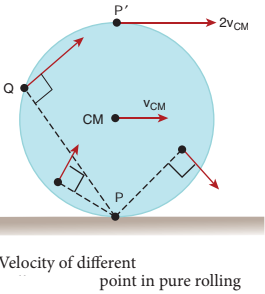
We can also arrive at the same expression by taking the momentary rotation happening with respect to the point of contact (another approach to rolling). If we take the point of contact as o, then,
$KE =\frac{1}{2} I _0 w ^2$
Here, $I _0$ is the moment of inertia of the object about the point of contact. By parallel axis theorem, $I_0=I_{C M}+M K^2$ Further we can write, $I_0 M K^2+M R^2$. With $v_{C M}=R \omega$ or $\omega=\frac{v CM }{ R }$
$KE =\frac{1}{2}\left( MK ^2+ MR ^2\right) \frac{ v _{ CM }^2}{ R ^2} \quad \ldots(v)$
$KE =\frac{1}{2} M v_{ CM }^2\left(1+\frac{ K ^2}{ R ^2}\right) \ldots(v i)$
As the two equations (v) and (vi) are the same, it is once again confirmed that the pure tolling problems could be solved by considering the motion as any one of the following two cases.
(i) The combination of transnational motion and rotational motion about the center of mass. (or)
(ii) The momentary rotational motion about the point of contact.
Need a full question paper?
Generate a complete, print-ready paper with questions like this in minutes — across 16+ boards, with answer keys.