Question
Derive the balance condition for Wheatstone Bridge.

Answer


Image
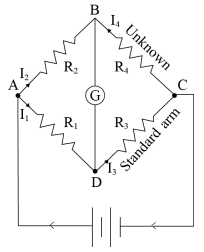
→ The circuit shown in the figure is called the wheatstone bridge. It uses four resistors $R_1, R_2, R_3$ and $R_4$ out of them three resistors are known and one is unknown, wheatstone bridge is used to find the value of unknown resistance.
→ As shown in the figure, across one pair of diagonally opposite points ( $A$ and $C$ in the figure) a source is connected hence $A C$ is called the battery arm.
→ Between the other two vertices, B and D , a galvanomenter G is connected hence BD is called the galvanometer arm.
→ When battery is connected, the currents flowing through the resistors $R_1, R_2, R_3$ and $R_4$ are $I_1, I_2, I_3$ and $I_4$ respectively.
→ Here, there resistors are chosen in such a way that current flowing through galvanometer is zero ( $I _g=0$ ).
→ When the current flowing through the galvanometer becomes zero, the bridge is said to be in balanced condition.
→ From the figure, in balanced condition
$
I_1=I_3 \text { and } I_2=I_4
$
→ Applying Kirchhoff's loop rule to closed loop A - D - B - A
$
\begin{array}{l}
-I_1 R_1+0+I_2 R_2=0 \\
\therefore I_1 R_1=I_2 R_2 \ldots(1)
\end{array}
$
→ Applying similarly, for closed loop $C - B - D - C$
$
\begin{array}{l}
I_4 R_4+0-I_3 R_3=0 \\
\therefore I_3 R_3=I_4 R_4 \ldots \text { (2) }
\end{array}
$
→ Taking ratio of equation (1) and (2)
$
\therefore \frac{I_1 R_1}{I_3 R_3}=\frac{I_2 R_2}{I_4 R_4}
$
But $I_1=I_3$ and $I_2=I_4$
$
\therefore \frac{R_1}{R_3}=\frac{R_2}{R_4} \text { OR } \frac{R_1}{R_2}=\frac{R_3}{R_4} \ldots(3)
$
→ which is a condition for the whetstone bridge to be in balanced condition.
→ If three resistors $R_1, R_2$ and $R_3$ are known then unknown resistence of $R_4$ is given by
$
R_4=R_3 \cdot \frac{R_2}{R_1} \ldots(4)
$
→ A practical device using this principle is called the meter bridge.

Need a full question paper?

Generate a complete, print-ready paper with questions like this in minutes — across 16+ boards, with answer keys.
Start Generating Free