Question
Derive the condition of floatation of a body.

Answer

When a body floats in a liquid with a part submerged in the liquid, the weight of the liquid displaced by the submerged part is always equal to the weight of the body. Let V = volume of the body$\sigma=$ density of its material
$\rho=$ density of the liquid in which the body floats such that its volume V' is outside the liquid.
Then volume of the body inside the liquid = V - V’ Weight of the displaced liquid $=(\text{V}-\text{V}')\rho\text{g}$ Also weight of the body $=\text{V}\sigma\text{ g}$ For the body to float, Weight of the liquid displaced by the sumberged part = weight of the body, i.e., $(\text{V}-\text{V}')\rho\text{g}=\text{V}\sigma\text{ g}$ or $\text{V}'=\frac{(\rho-\sigma)\text{V}}{\rho}$

Need a full question paper?

Generate a complete, print-ready paper with questions like this in minutes — across 16+ boards, with answer keys.
Start Generating Free

Similar questions

A gas thermometer measures the temperature from the variation of pressure of a sample of gas. If the pressure measured at the melting point of lead is 2.20 times the pressure measured at the triple point of water, find the melting point of lead.
A man, the surface area of whose skin is $2m^2$, is sitting in a room where area temperature is 20°C. If his skin temperature is 28°C and emissivity of his skin equals 0.97, find the rate at which his body loses heat $($Given $\sigma=5.67\times10^{-8}\text{w}/\ \text{m}^2/\ \text{T}^4).$
Is it true that the reaction of a gravitational force is always gravitational, of an electromagnetic force is always electromagnetic and so on?
Answer the following: An astronaut inside a small space ship orbiting around the earth cannot detect gravity. If the space station orbiting around the earth has a large size, can he hope to detect gravity?
The sum and difference of two vectors are perpendicular to each other. Prove that the ectors are equal in magnitude.
A current of 10A is established in a long wire along the positive z-axis. Find the magnetic field $\overrightarrow{\text{B}}$ at the point (1m, 0, 0).
Can there be a two dimensional motion even though acceleration is present in only one direction?
A, B and C are three non-collinear, non co-planar vectors. What can you say about direction of A × (B × C)?
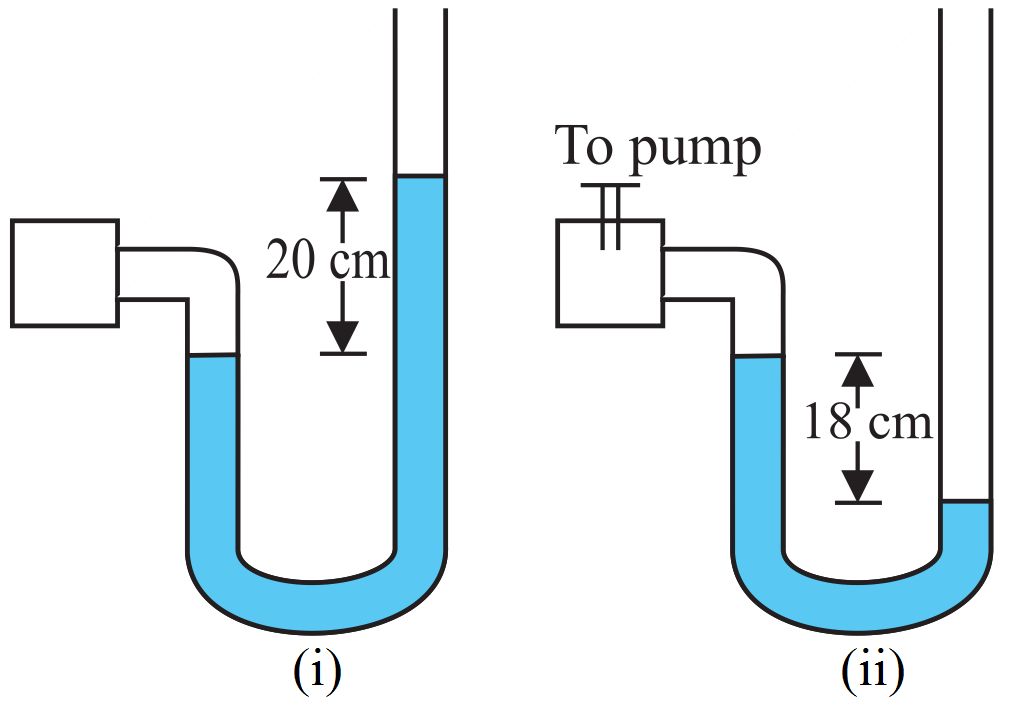
A manometer reads the pressure of a gas in an enclosure as shown in Fig.$(a)$ When a pump removes some of the gas, the manometer reads as in Fig. $(b)$ The liquid used in the manometers is mercury and the atmospheric pressure is $76\ cm$ of mercury. Give the absolute and gauge pressure of the gas in the enclosure for cases $(i)$ and $(ii)$ in units of cm of mercury. How would the levels change in case $(i)$ if $13.6\ cm$ of water $($immiscible with mercury$)$ are poured into the right limb of the manometer? $($Ignore the small change in volume of the gas.$)$
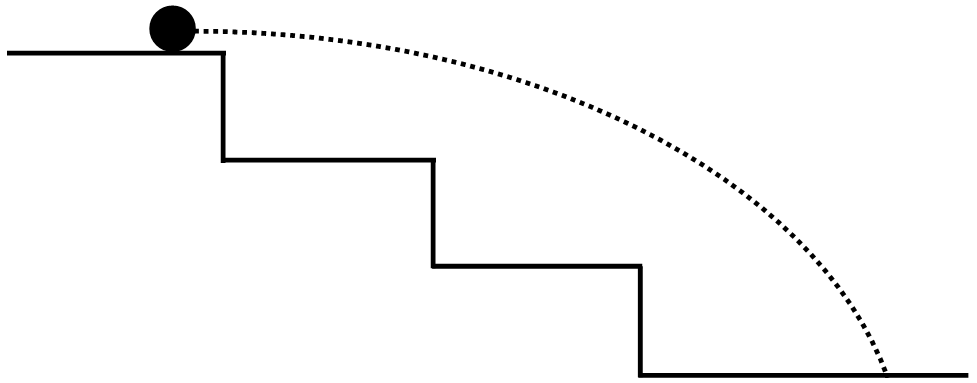
A staircase contains three steps each 10cm high and 20cm wide (figure). What should be the minimum horizontal velocity of a ball rolling off the uppermost plane so as to hit directly the lowest plane?