Question
Derive the expression for force per unit length between two long straight parallel current carrying conductors. Hence define one ampere.

Answer


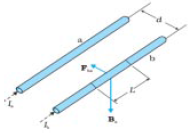
Figure shows two long parallel conductors $a$ and $b$ separated by $a$ distance $d$ and carrying $($parallel$)$ currents $I_a$ and $I _b,$ respectively.
The conductor $'a\ '$ produces, the same magnetic field $B$ a at all points along the conductor $'b\ '$.
The right-hand rule tells us that the direction of this field is downwards $($when the conductors are placed horizontally$)$. Its magnitude is given by
$\text{B}_{\alpha} = \frac{\mu_\circ\text{I}_{\alpha}}{2\pi\text{d}}$
The conductor $'b\ '$ carrying a current $I _b$ will experience a sideways force due to the field $B_a$.
The direction of this force is towards the conductor $'a\ '$.
We label this force as $F_{ba},$ the force on a segment $L$ of $'b\ '$ due to $'a\ '.$ The magnitude of this force is given by
$\int_{ba} = \text{I}_{b}\text{LB}_{a}$
$ = \frac{\mu_\circ\text{I}_{a}\text{I}_{b}}{2\pi\text{d}}\text{L}$
Let $\int_{ba}$ represent the magnitude of the force $\text{F}_{ba}$ per unit length.
$\int_{ba} = \frac{\mu_\circ\text{I}_{a}\text{I}_{b}}{2\pi\text{d}}$
One ampere: The ampere is the value of that steady current which, when maintained in each of the two very long, straight, parallel conductors of negligible cross $-$ section, and placed one metre apart in vacuum, would produce on each of these conductors a force equal to $2 \times 10^{–7}$ newton per metre of their length.

Need a full question paper?

Generate a complete, print-ready paper with questions like this in minutes — across 16+ boards, with answer keys.
Start Generating Free

Similar questions

  1. Write the expression for the speed of light in a material medium of relative permittivity $\varepsilon_\text{r}$ and relative magnetic permeability $\mu_\text{r}.$
  2. Write the wavelength range and name of the electromagnetic waves which are used in:
  1. Radar systems for aircraft navigation,
  2. Earth satellites to observe the growth of the crops.
  1. When an AC source is connected to an ideal capacitor, show that the average power supplied by the source over a complete cycle is zero.
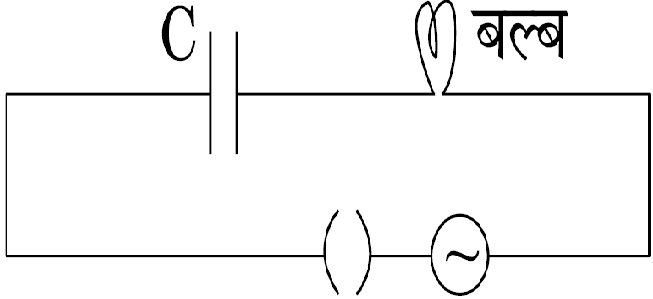
  2. A bulb is connected in series with a variable capacitor and an A.C. source as shown. What happens to the brightness of the bulb when the key is the capacitor is gradually reduced?
In a p-n junction, a potential barrier of 250meV exists across the junction. A hole with a kinetic energy of 300meV approaches the junction. Find the kinetic energy of the hole when it crosses the junction if the hole approached the junction.
  1. From the p-side.
  2. From the n-side.
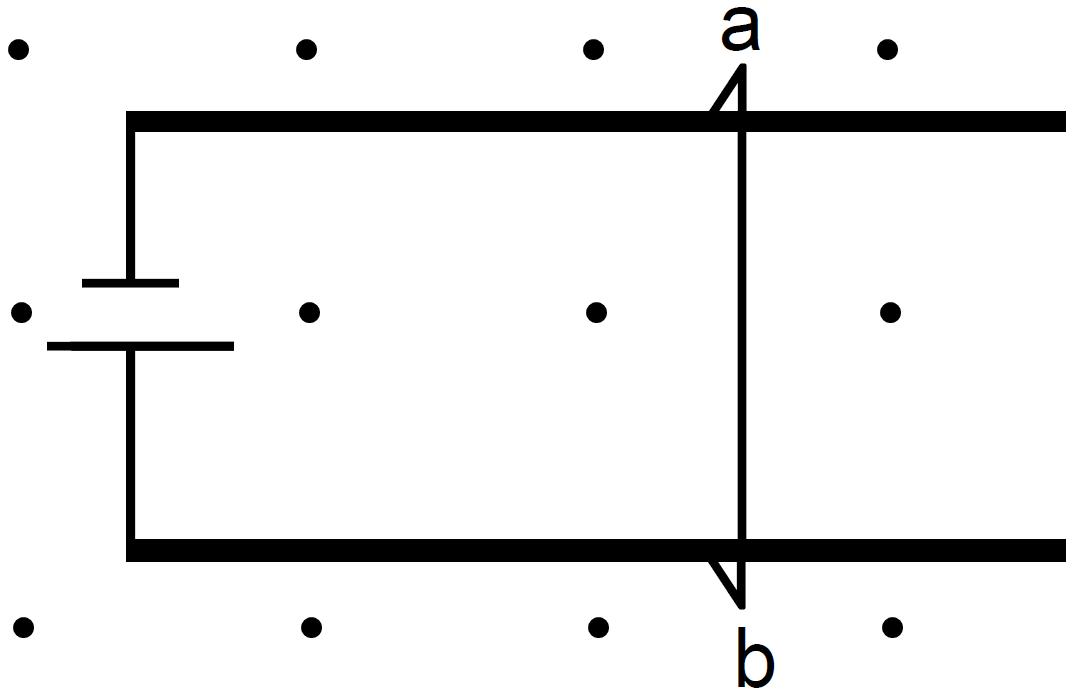
Figure shows a smooth pair of thick metallic rails connected across a battery of emf $\epsilon$ having a negligible internal resistance. A wire ab of length l and resistance r can slide smoothly on the rails. The entire system lies in a horizontal plane and is immersed in a uniform vertical magnetic field B. At an instant t, the wire is given a small velocity u towards right.
  1. Find the current in it at this instant. What is the direction of the current?
  2. What is the force acting on the wire at this instant?
  3. Show that after some time the wire ab will slide with a constant velocity. Find this velocity.
A uniform magnetic field of magnitude $0.20T$ exists in space from east to west. With what speed should a particle of mass $0.010g$ and with charge $1.0 \times 10^{-5}C$ be projected from south to north so that it moves with uniform velocity?
What length of a copper wire of cross$-$sectional area $0.01\ mm^2$ will be needed to prepare a resistance of $1\text{k}\Omega?$ Resistivity of copper $=1.7\times10^{-8}\Omega\text{-m}.$
The radius of innertmost orbit of hydrogen atom is $5.3 \times 10^{-11} m$. What is the radius of second excited state?
Accepting the relation $\frac{v_s}{v_p}=\frac{ N _s}{N_s}$ for ideal transformer, and using thé formula of power; derive $\frac{I_p}{I_s}=\frac{v_s}{v_p}=\frac{N_s}{ N _p}$ and from that explain the types of the transformers.
Power factor of a coil in an ac circuit at 60 hertz frequency is 0.707 . If frequency of ac source becomes 120 hertz, then what will be power factor?
The radionuclide $^{11}C$ decays according to
$^{11}_{6}\text{C}\rightarrow^{11}_{5}\text{B}+\text{e}^{+}+\text{v}:\ \text{T}_{1/2}=20.3 \text{ min}$
The maximum energy of the emitted positron is $0.960 MeV$.
Given the mass values:
$\text{m}(^{11}_{6})=10=11.011434\text{u}$ and $\text{m}(^{11}_{6}\text{B})=11.009305\text {u}.$
calculate $Q$ and compare it with the maximum energy of the positron emitted.