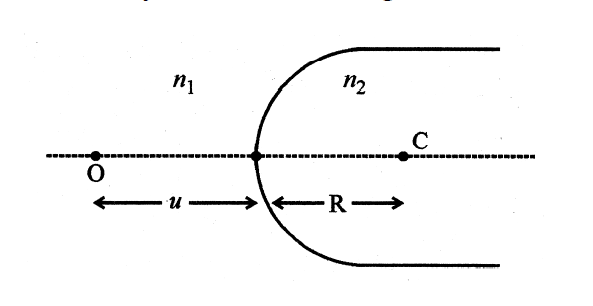
A point object 'O' is kept in a medium of refractive index $n_1$ in front of a convex spherical surface of radius of curvature R which separates the second medium of refractive index $n_2$ from the first one, as shown in the figure. Draw the ray diagram showing the image formation and deduce the relationship between the object distance and the image distance in terms of $n_1, n_2$ and R.
- hen the image formed above acts as a virtual object for concave spherical, surface separating the medium $n_2$ from $n_1 (n_2> n_1),$ draw this ray diagram and write the similar (similar to (a) relation. Hence obtain the expression for the lens maker's formula.
CBSE DELHI - SET 1 2015
Download our app for free and get started
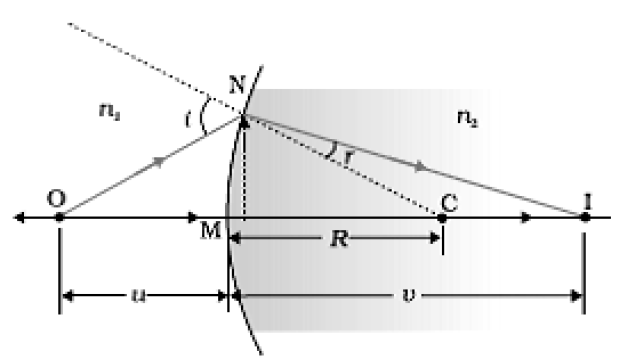
For small angles
$\angle\text{N0M}\cong\tan\angle \text{N0M} = \frac{\text{MN}}{\text{OM}}$
$\angle\text{NCM}\cong\tan\angle \text{NCM} = \frac{\text{MN}}{\text{MC}}$
$\angle\text{NIM}\cong\tan\angle \text{NIM} = \frac{\text{MN}}{\text{MI}}$
In $\Delta\text{NOC} , $ $\angle \text{i} = \angle\text{i}\angle\text{NOM} + \angle\text{NCM}$...........................(i)
$\therefore\angle\text{i} = \frac{\text{MN}}{\text{OM}} + \frac{\text{MN}}{\text{MC}}$
$\angle\text{r} = \angle \text{NCM} -\angle \text{NIM}$
$ =\frac{\text{MN}}{\text{MC}} -\frac{\text{MN}}{\text{MI}}$
Using Snell's Law
$n_1 \sin\ i. = n_2 \sin\ r$
For small angles $n_1 i = n_2 r$
Substituting for i and r, we get
$\frac{\text{n}_{1}}{\text{OM}} +\frac{\text{n}_{2}}{\text{MI}} = \frac{\text{n}_{2} -\text{n}_{1}}{\text{MC}}$
Here, $\text{OM} =\text{-u}, \text{MI} = + \text{v},\text{MC} = + \text{R}$
Substituting these, we get
$\Rightarrow\frac{\text{n}_{2}}{\text{v}} - \frac{\text{n}_{1}}{\text{u}} = \frac{\text{n}_{2} -\text{n}_{1}}{\text{R}}$
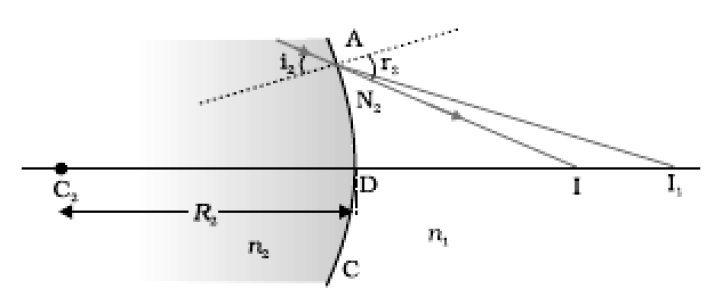
(Alternatively accept this Ray diagram)
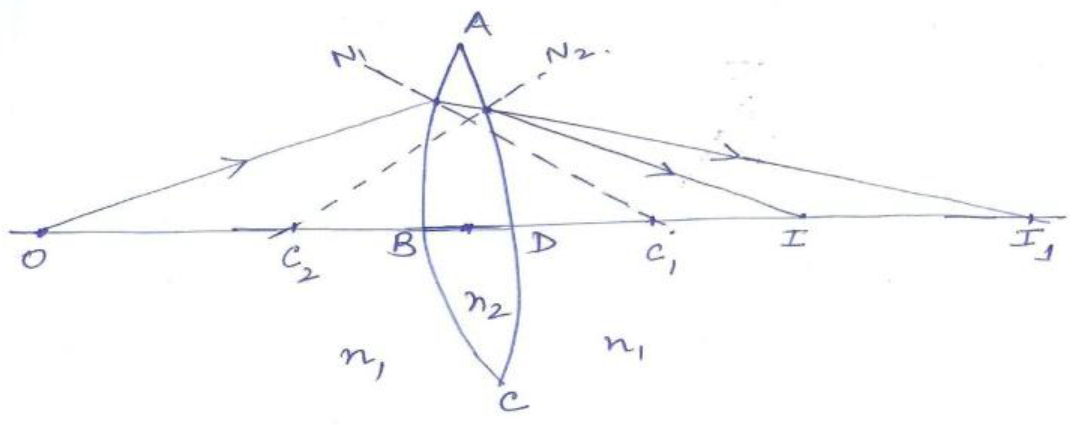
Similarly relation for the surface ADC.
$\frac{-\text{n}}{\text{DI}{1}} +\frac{\text{n}_{1}}{\text{DI}} = \frac{\text{n}_{2} - \text{n}_{1}}{\text{DC}_{2}}$................................(i)
Refraction at the first surface ABC of the lens.
$\frac{\text{n}_{1}}{\text{OB}} +\frac{\text{n}_{2}}{\text{BI}_{1}} = \frac{\text{n}_{2} -\text{n}_{2}}{\text{BC}_{1}}$..............................(ii)
Adding (i)and (ii), and taking $ BI_1\cong DI_1,$ we get
$\frac{\text{n}_{1}}{\text{OB}} +\frac{\text{n}_{1}}{\text{DI}} = (\text{n}_{2} -\text{n}_{1})\big(\frac{1}{\text{BC}_{1}} + \frac{1}{\text{DC}_{2}}\big)$
Here, $OB = – u$
$DI = + v$
$BC_1 = + R_1$
$DC_2 = – R_2$
$\Rightarrow = \frac{\text{n}_{1}}{\text{-u}} + \frac{\text{n}_{1}}{\text{v}} = (\text{n}_{2} -\text{n}_{1})\bigg(\frac{1}{\text{R}_{1}} +\frac{1}{\text{R}_{2}}\bigg)$
$\Rightarrow = \text{n}_{1}\bigg(\frac{1}{\text{v}} +\frac{1}{u}\bigg) (\text{n}_{2} -\text{n}_{1})\bigg(\frac{1}{\text{R}_{1}} +\frac{1}{\text{R}_{2}}\bigg)$
$\Rightarrow\frac{1}{\text{f}} =\bigg(\frac{\text{n}_{2}}{\text{n}_{1}} -1 \bigg)\bigg(\frac{1}{\text{R}_{1}} -\frac{1}{\text{R}_{2}}\bigg)$

Download our appand get started for free
Experience the future of education. Simply download our apps or reach out to us for more information. Let's shape the future of learning together!No signup needed.*
Similar Questions
- 1View SolutionMrs. Rashmi Singh broke her reading glasses. When she went to the shopkeeper to order new spects, he suggested that she should get spectacles with plastic lenses instead of glass lenses. On getting the new spectacles, she found that the new ones were thicker than the earlier ones. She asked this question to the shopkeeper but he could not offer satisfactory explanation for this. At home, Mrs. Singh raised the same question to her daughter Anuja who explained why plastic lenses were thicker.
- Write two qualities displayed each by Anuja and her mother.
- How do you explain this fact using lens maker's formula?
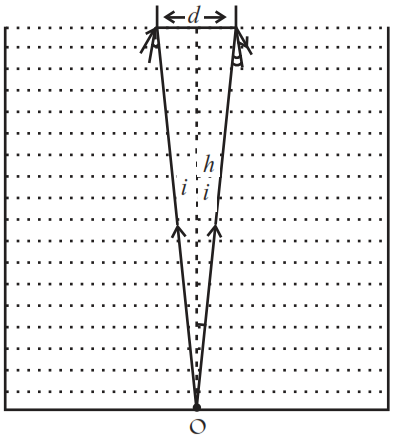
- 2View SolutionA jar of height h is filled with a transparent liquid of refractive index μ (Fig). At the centre of the jar on the bottom surface is a dot. Find the minimum diameter of a disc, such that when placed on the top surface symmetrically about the centre, the dot is invisible.
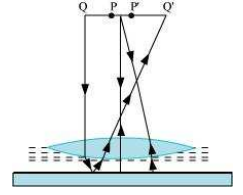
- 3View Solutionequiconvex lens (of refractive index 1.50) in contact with a liquid layer on top of a plane mirror. A small needle with its tip on the principal axis is moved along the axis until its inverted image is found at the position of the needle. The distance of the needle from the lens is measured to be 45.0 cm. The liquid is removed and the experiment is repeated. The new distance is measured to be 30.0 cm. What is the refractive index of the liquid?
- 4Two concave mirrors of equal radii of curvature R are fixed on a stand facing opposite directions. The whole system has a mass m and is kept on a frictionless horizontal table.View Solution
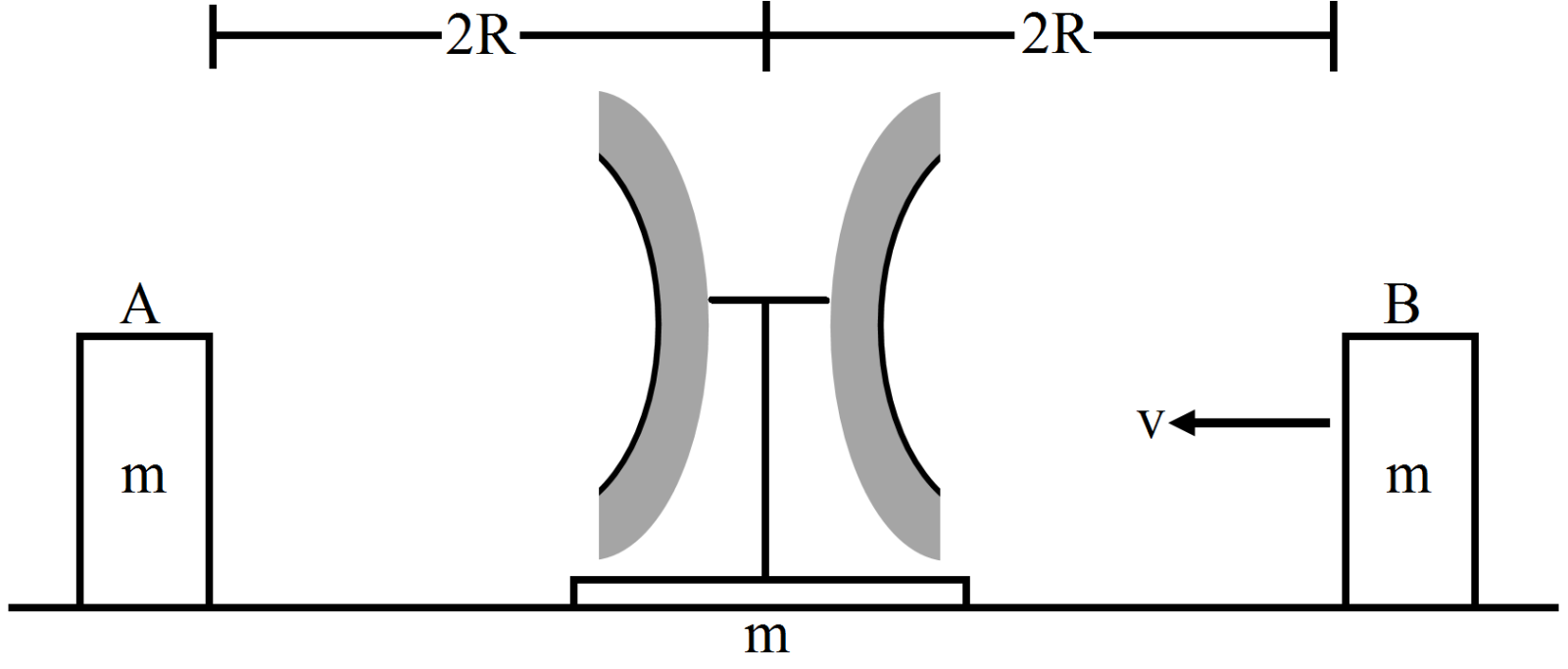
Two blocks A and B, each of mass m, are placed on the two sides of the stand. At t = 0, the separation between A and the mirrors is 2 R and also the separation between B and the mirrors is 2 R. The block B moves towards the mirror at a speed v. All collisions which take place are elastic. Taking the original position of the mirrors-stand system to be x = 0 and X-axis along AB, find the position of the images of A and B at t =- $\frac{\text{R}}{\text{v}}$
- $\frac{3\text{R}}{\text{v}}$
- $\frac{5\text{R}}{\text{v}}$
- 5A card sheet divided into squares each of size $1\ mm^2$ is being viewed at a distance of 9 cm through a magnifying glass (a converging lens of focal length 9 cm) held close to the eye.View Solution
- What is the magnification produced by the lens? How much is the area of each square in the virtual image?
- What is the angular magnification (magnifying power) of the lens?
- Is the magnification in (a) equal to the magnifying power in (b)? Explain.
- 6View SolutionA normal eye has retina 2cm behind the eye-lens. What is the power of the eye-lens when the eye is
- Fully relaxed,
- Most strained?
- 7A biconvex thick lens is constructed with glass $(\mu=1.50)$ Each of the surfaces has a radius of 10cm and the thickness at the middle is 5cm. Locate the image of an object placed far away from the lens.View Solution
- 8View Solution
- Draw a ray diagram to show refraction of a ray of monochromatic light passing through a glass prism.
- Explain briefly how the phenomenon of total internal reflection is used in fibre optics.
- 9View Solution
- Draw a ray diagram to show image formation when the concave mirror produces a real, inverted and magnified image of the object.
- Obtain the mirror formula and write the expression for the linear magnification.
- Explain two advantages of a reflecting telescope over a refracting telescope.
- 10The convex surface of a thin concavo-convex lens of glass of refractive index 1.5 has a radius of curvature 20cm. The concave surface has a radius of curvature 60cm. The convex side is silvered and placed on a horizontal surface as shown in figure.View Solution
- Where should a pin be placed on the axis so that its image is formed at the same place?
- If the concave part is filled with water $\Big(\mu=\frac{4}{3}\Big),$ find the distance through which the pin should be moved so that the image of the pin again coincides with the pin.