Question
  1. Derive the expression for the torque on a rectangular current carrying loop suspended in a uniform magnetic field.
  2. A proton and a deuteron having equal momenta enter in a region of uniform magnetic field at right angle to the direction of the field. Depict their trajectories in the field.
Answer

  1.  

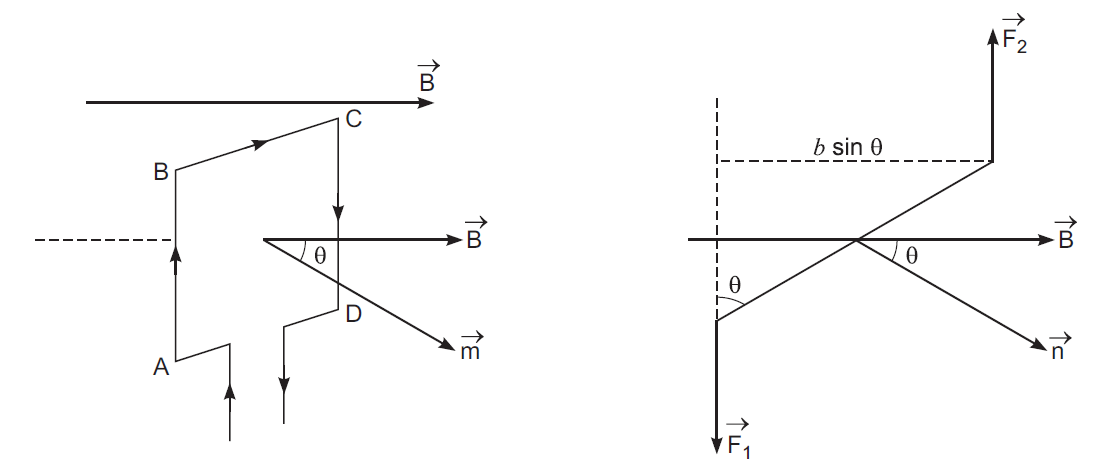
A rectangular loop $\text{ABCD}$ of dimensions $l$ and $b$, carrying a steady current is placed in uniform magnetic field as shown in fig; such that normal of the plane is at angle $q$ with the magnetic field lines.
The force $F_{BC}$ and $F_{AD}$ on arms $BC$ and $AD$ are equal, opposite and along the axis of the coil, so they cancel each other.
The forces $F_{AB}$ and $F_{CD}$ are also equal and opposite, but are not collinear, so they constitute a couple, and the magnitude of the torque can be given as
$\tau = \text{F}_{AB}.\frac{\text{b}}{2}\sin\theta + \text{F}_{CD}.\frac{\text{b}}{2}\sin\theta$
Since
$|\text{F}_{AB}| = |\text{F}_{CD}| =\text{BI}\ell$
$\tau = \text{BI}\ell\times\text{b}\times\sin\theta$
$ = \text{BI}(\ell\text{b})\sin\theta$
$= BI\ A \sin \theta$
$[\text{A} = \ell \text{b} = $ area of the rectangle
Since magnetic moment $m = I |A|$
$\tau = \text{mB} \sin \theta$
In vector from $\overrightarrow{\tau} = \overrightarrow{\text{m}}\times\overrightarrow{\text{B}}$
  1. If a charge particle enters right angle to the direction of magnetic field, it follows a circular trajectory, and radius can be given as
$\text{q}v\text{B} = \frac{\text{m}v^{2}}{\text{r}}$
$\Rightarrow\text{r} = \frac{\text{m}v}{\text{qB}} = \frac{\text{p}}{\text{qB}}$
Since momentum are equal, and they have equal charges.
So, $r_p : r_d = 1:1.$

Need a full question paper?

Generate a complete, print-ready paper with questions like this in minutes — across 16+ boards, with answer keys.

Start Generating Free

Similar questions

Determine the current in each branch of the network shown in Fig :
Four particles of equal masses M move along a circle of radius R under the action of their mutual gravitational attraction. Find the speed of each particle.
A hydrogen atom initially in the ground level absorbs a photon, which excites it to the $n = 4$ level. Determine the wavelength and frequency of photon.
A person travelling in a fast spaceship measures the distance between the earth and the moon. Is it the same, smaller or larger than the value quoted in this book?
Obtain the binding energy of the nuclei $^{56}_{26}\text{Fe }$ and $\ ^{209}_{83}\text{Bi}$ in units of $\text{MeV}$ from the following data:
$\text{m}(^{56}_{26}\text{Fe})=55.934939\text{ u }$ $\text{ m}(^{209}_{83}\text{Bi})=208.980388\text{ u}$
In Young’s double $-$ slit experiment using monochromatic light of wavelength $\lambda ,$ the intensity of light at a point on the screen where path difference is $\lambda ,$ is $K$ units. What is the intensity of light at a point where path difference is $\lambda /3$?
A $100$ turn closely wound circular coil of radius $10 \ cm$ carries a current of $3.2 A. \ (a)$ What is the field at the centre of the coil? $(b)$ What is the magnetic moment of this coil?
The coil is placed in a vertical plane and is free to rotate about a horizontal axis which coincides with its diameter. A uniform magnetic field of $2 T$ in the horizontal direction exists such that initially the axis of the coil is in the direction of the field. The coil rotates through an angle of $90^{\circ}$ under the influence of the magnetic field. $(c)$ What are the magnitudes of the torques on the coil in the initial and final position?
$(d)$ What is the angular speed acquired by the coil when it has rotated by $90^{\circ}$ ? The moment of inertia of the coil is $0.1 \ kg m ^2$.
A parallel plate capacitor is to be designed with a voltage rating $1kV,$ using a material of dielectric constant $3$ and dielectric strength about $10^7Vm^{–1}.\  ($Dielectric strength is the maximum electric field a material can tolerate without breakdown, i.e., without starting to conduct electricity through partial ionisation.$)$ For safety, we should like the field never to exceed, say $10\%$ of the dielectric strength. What minimum area of the plates is required to have a capacitance of $50pF$ ?
The $\text{K}_\beta\ X-$rays from certain elements are given below. Draw a Moseley-type plot of $\sqrt{\text{v}}$ versus $Z$ for $\text{K}_\beta$ radiation.
Element
$Ne$ $P$ $Ca$ $Mn$ $Zn$ $Br$
Energy $(keV)$
$0.858$ $2.14$ $4.02$ $6.51$ $9.57$ $13.3$
Propound Coulomb's law. On the basis of this rule, write the definition of Coulomb, the unit of charge. If there is a medium between the charges then how will the electric force change with the medium?