Question
Describe different type of vegetation found in India.

Answer

Tropical rain: Tropical forests occur in the areas which receive heavy rainfall. They are so dense that Sunlight doesn’t reach the ground. Many species of trees are found in these forests. The trees shed their leaves at different time of the year. These always appear green.

Mahogany, ebony and rosewood are trees found in these areas. Andaman and Nicobar Islands, parts of north-eastern states and a narrow strip of the western slope of the Western Ghats are home of these forests.

Tropical deciduous forests: These forests are found in a large part of our country. These forests are also called monsoon forests. They are less dense. They shed their leaves at a particular time of the year.

Important trees of these forests are sal, teak, peepal, neem and shisham. They are found in Madhya Pradesh, Uttar Pradesh, Bihar, Jharkhand, Chhattisgarh, Odisha, and in parts of Maharashtra.

Thorny bushes vegetation: These are found in dry areas of the country. The leaves are in the form of spines to reduce the loss of water. Cactus, khair, babool, keekar are important and are found in the States of Rajasthan, Punjab, Haryana, eastern slopes of Western Ghat and Gujarat.

Mountain vegetation: A wide range of Mountain vegetation is found in the mountains according to the variation in height. At a height between 1500 to 2500 metres. Most of the trees are conical in shape. These trees are called coniferous trees. Chir, Pine and Deodar are important trees of these forests.

Mangrove forests: These forests can survive in saline water. They are found mainly in Sunderbans in West Bengal and in the Andaman and Nicobar Islands. Sundari is a well-known species of trees in mangrove forests after which Sunderbans have been named.
Need a full question paper?

Generate a complete, print-ready paper with questions like this in minutes — across 16+ boards, with answer keys.

Start Generating Free

Similar questions

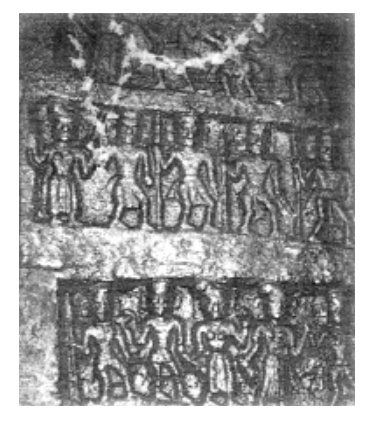
Look at the picture of a carved stone and answer the following questions.
Image
(a) Whom do these five figures shown in the picture represent ?
(b) In which part of India was this carved stone found ?
(c) How is this carved stone related to the tribal culture of that area ?
(d) What conclusion did the anthropologist K.S. Singh draw from such carved stones and the folklores ?
What is the primary sector? How is it different from the secondary sector? Give two examples.
Find following places in map.
(a) Sarnath
(b) Mathura
(c) Mahabalipuram
(d) Aihole
Look at the pictures given below and write about the picture.
Image
Image
Image
Image
How does the Municipal Corporation earn the money to do its work?
Match the following :
Narmada ValleyThe first big kingdom
MagadhaHunting and gathering
Garo hillsCities about 2500 years ago
Indus and its tributariesEarly agriculture
Ganga ValleyThe first cities
In the stories of Shalini and Tenzing, we see examples of joint families. What do you think are the aspects of modern living that make some couples opt for a nuclear family (i.e. living apart from older generations or other relatives)? What could be some advantages as well as disadvantages of the two kinds of families?
Read the following news item :
Nimone is a village on the Chauphula-Shirur Road. Like many others, this village has also been facing a severe water shortage for the last few months and villagers depend on tankers for all their needs. Bhagavan Mahadeo Lad (35) of this village was beaten with sticks, iron rods, and axes by a group of seven men. The incident came to light when some villagers brought a badly injured Lad to the hospital for treatment. In the FIR recorded by the police Lad said that he was attacked when he insisted that the water in the tanker must be emptied into the storage tanks constructed as part of the water supply scheme by Nimone Gram Panchayat so that there would be equal distribution of water. However, he alleged that the upper caste men were against this and told him that the tanker water was not meant for the lower castes.
1. Why was Bhagavan beaten ?
2. Do you think that the above is a case of discrimination? Why ?
Describe major landforms.
How can various sources help us understand history?