Question
Describe the methods of studying various first order reactions with examples.

Answer

self

Need a full question paper?

Generate a complete, print-ready paper with questions like this in minutes — across 16+ boards, with answer keys.

Start Generating Free

Similar questions

  1. Give three points of difference between lanthanoids and actinoids.
  2. Give reason and select one atom$/$ion which will exhibit asked property:
  1. $Sc^{3+}$ or $Cr^{3+} ($Exhibit diamagnetic behaviour$).$
  2. $Cr$ or $Cu ($High melting and boiling point$).$
Attempt any five of the following:
$(a)$ Deficiency of which vitamin causes night-blindness.
$(b)$ Give two examples of reducing sugars.
$(c)$ Define the following terms:
$i.$ Glycosidic linkage
$ii.$ Native protein
$(d)$ Write function of carbohydrates in plants.
$(e)$ Differentiate between:
$i.$ Peptide linkage and Glycosidic linkage
$ii.$ Nucleoside and Nucleotide
$(f)$ What type of linkage holds together the monomers of $\text{DNA}$?
$(g)$ Write the product obtained when $D-$glucose reacts with $H_2N-OH.$
  1. Define the following terms:
  1. Mole fraction.
  2. Ideal solution.
  1. $15.0\ g$ of an unknown molecular material is dissolved in $450\ g$ of water. The resulting solution freezes at $- 0.34^\circ C.$ What is the molar mass of the material?
$(K_f$ for water $= 1.86\ K \ kg\ mol^{–1}).$
$19.5 g$ of $\ce{CH2FCOOH}$ is dissolved in $500 g$ of water. The depression in the freezing point of water observed is $1.0^\circ C$. Calculate the van’t Hoff factor and dissociation constant of fluoroacetic acid.
Match the items of Column $I$ and Column $II.$
 
Column $I$
 
Column $II$
$i.$
Lead storage battery
$a.$
Maximum efficiency.
$ii.$
Mercury cell
$b.$
Prevented by galvanisation.
$iii.$
Fuel cell
$c.$
Gives steady potential.
$iv.$
Rusting
$d.$
$Pb$ is anode, $PbO_2$​​​​​​​ is cathode.
Write the rate law for a first order reaction. Justify the statement that half life for a first order reaction is independent of the initial concentration of the reactant.
After watching a programme on $TV$ about the presence of carcinogens $($cancer causing agents$)$ Potassium bromate and Potassium iodate in bread and other bakery products, Veena, a class $XII$ student, decided to make others aware about the adverse effects of these carcinogens in foods. She consulted the school principal and requested him to instruct the canteen contractor to stop selling sandwiches, pizzas, burgers and other bakery products to the students. The principal took an immediate action and instructed the canteen contractor to replace the bakery products with some proteins and vitamins$-$rich food like fruits, salads, sprouts, etc. The decision was welcomed by the parents and students.
After reading the above passage, answer the following questions:
  1. What are the values $($at least two$)$ displayed by Veena?
  2. Which polysaccharide component of carbohydrates is commonly present in bread?
  3. Write the two types of secondary structures of proteins.
  4. Give two examples of water soluble vitamins.
i. Write structures of different isomeric amines corresponding to the molecular formula$, \ce{C4H11N}$.
ii. Write $\text{IUPAC}$ names of all the isomers.
iii. What type of isomerism is exhibited by different pairs of amines?
  1. Complete the following chemical reaction equations:
i. $\text{MnO}_{4(aq)}^{-}+\text{C}_{2}\text{O}_{4(aq)}^{2-}+\text{H}^{+}_{(aq)}\rightarrow$
ii. $\text{Cr}_{2}\text{O}_{7(aq)}^{2-}+\text{Fe}^{2+}_{(aq)}+\text{H}_{(aq)}^{+}\rightarrow$
  1. Explain the following observations about the transition/inner transition elements:
  1. There is in general an increase in density of element from titanium (Z=22) to copper (Z=29).
  2. There occurs much more frequent metal-metal bonding in compounds of heavy transition elements (3rd series).
  3. The members in the actinoid series exhibit a larger number of oxidation states than the corresponding members in the lanthanoid series.
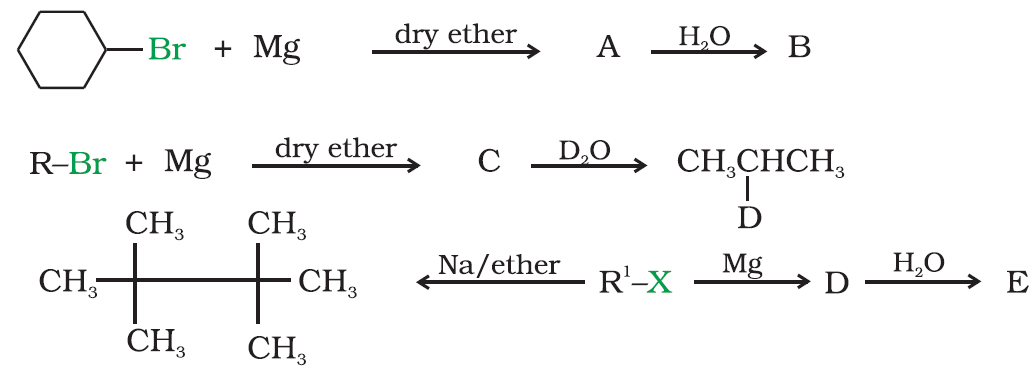
Identify $\text\{A, B, C, D, E, R\}$ and $R^1$ in the following: