Chloroplast: It was discovered by Schimper in 1864. Majority of the chloroplasts of the green plants are found in the mesophyll cells of the leaves. These are lens- shaped, oval, spherical, discoid or even ribbon-like organelles having variable length (5-10µm) and width (2-4µm). Their number varies from 1 per cell of the Chlamydomonas, a green alga to 20-40 per cell in the mesophyll. The chlorophyll is surrounded by two membranes. The space between these two membranes is called periplastidial space. There are two main parts inside the membranes:
(a) Stroma: This is a colourless part in which different types of enzymes are found, where the dark reaction of photosynthesis takes place.
(b) Grana: It is a structure like a pack of coins of thylakoid lamellae which is called grana. Light reaction of photosynthesis occurs in grana. Two adjacent grana are connected to each other by intergranal lamellae or stroma lamellae. There are 40 to 60 grana in a chloroplast.
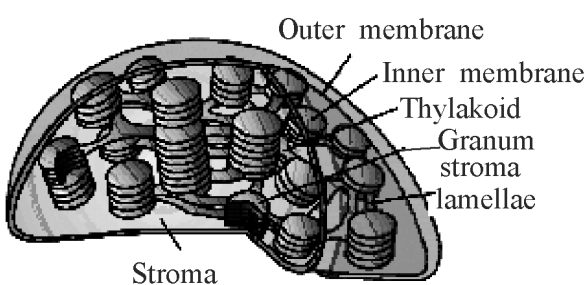
Many enzymes are found in the stroma of chlorophyll which are necessary for carbohydrate and protein synthesis. Small, double-stranded circular DNA molecules and ribosomes are found in these. The ribosome (70S) found in chlorophyll is smaller than the cytoplasmic ribosome (80S).
Functions: The main functions of chloroplast are as follows:
(i) To absorb light energy.
(ii) Formation of NADHP-H
2 by light reaction and release O
2 .
(iii) Making starch from CO
2 obtained from air.