Draw a labelled diagram of the human respiratory system.
Download our app for free and get started
Human Respiratory System: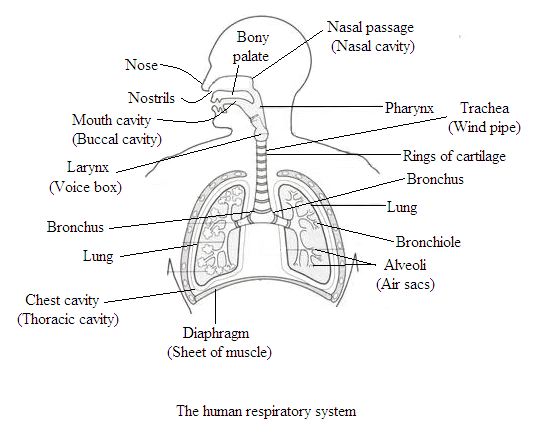

Download our appand get started for free
Experience the future of education. Simply download our apps or reach out to us for more information. Let's shape the future of learning together!No signup needed.*
Similar Questions
- 1View SolutionThe partially digested food coming from the stomach of a person enters a long and narrow organ A in his body. The organ A receives the secretion of two glands: liver and pancreas. Liver secretes a greenish - yellow liquid B which is normally stored in the organ C. Pancreas secretes pancreatic juice which contains three digestive enzymes D, E and F. The intestinal juice completes the process of digestion of food. The inner wall of organ A has millions of tiny finger - like projections G which help in the rapid absorption of digested food into blood stream. The undigested part of food then passes into wider tube H which absorbs most of the water from undigested food. The last part of tube H called I stores this undigested food (or waste) for some time. The undigested food is then passed out though opening J as faeces in the process known as K.
- Name the organ A.
- Name liquid B and organ C.
- What are the digestive enzymes D, E and F?
- Name the projections G present on the inner wall of organ A.
- Name Tube H, Part I, Opening J and Process K.
- 2View Solution‘Aerobic respiration produces more ATP than anaerobic respiration’. Justify this statement.
- 3View Solution
- Why is there a difference in the rate of breathing between aquatic organisms and terrestrial organisms? Explain.
- Draw a diagram of human respiratory system and label-pharynx, trachea, lungs, diaphragm and alveolar sac on it.
- 4View SolutionDraw a labelled diagram of the human digestive system. With the help of this diagram, describe the process of digestion of food in man (humans).
- 5View SolutionHow is double circulation different from single circulation?
- 6View SolutionWith a schematic diagram, explain the overall process of respiration.
- 7View SolutionName the conducting structures present in plants.
- 8View Solution
- Draw a diagram of human alimentary canal and label on it: Oesophagus, Gallbladder, Liver and Pancreas.
- Explain the statement, ‘Bile does not contain any enzyme but it is essential for digestion.’
- 9View SolutionA liquid X of colour Y circulates in the human body only in one direction: from body tissues to the heart. Among other things, liquid X contains germs from cells and dead cells. The liquid X is cleaned of germs and dead cells by a special type of white blood cells called Z. This cleaned liquid is then put into blood circulatory system in subclavian veins.
- What is (i) liquid X and (ii) colour Y?
- What are Z.
- The liquid X is somewhat similar to a component of blood. Name this component.
- Why is liquid X not red?
- 10View SolutionThe process of ultra-filtration is essential in urine formation, where does this step occur in nephron?