Question
Describe/Explain single slit diffraction using a simple day to day life example.
###
Describe a simple experiment (/activity) to see single slit diffraction.

Answer

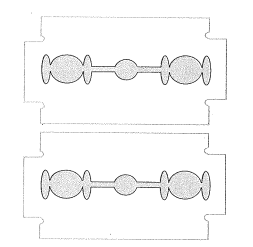
Image

It is very easy to see the single-slit diffraction pattern for oneself.
The equipment needed can be found in most homes-two razor blades and one clear glass electric bulb preferably with a straight filament.
One has to hold two blades so that the edges are parallel and have a narrow slit in between. This is easily done using the thumb and forefingers (fig.)
Keep the slit parallel to the filament, right in front of the eye. Use the spectacles if you normally do. With slight adjustment of the width of the slit and the parallelism of the edges, the pattern should be seen with its bright and dark bands.
Since the position of all the bands (except the central one) depends on wavelength, they will show some colours.
Using a filter for red or blue will make the fringes clearer. With both filters available, the wider fringes for red compared to blue can be seen.
→Another example :
In case of a dark room, where there is some light entering from outside, if the door is kept slightly open, the diffraction pattern can be seen on the tiles.
Need a full question paper?

Generate a complete, print-ready paper with questions like this in minutes — across 16+ boards, with answer keys.

Start Generating Free

Similar questions

Suppose the amplitude of a simple pendulum having a bob of mass m is $\theta_0.$ Find the tension in the string when the bob is at its extreme position.
Explain the difference between electric potential and electrical potential energy and explain the relationship between them.
If a compressed spring is dissolved in acid, what happened to the elastic potential energy of the spring?
Explain Magnetic flux with figure.
Answer the following questions regarding earth’s magnetism:
A vector needs three quantities for its specification. Name the three independent quantities conventionally used to specify the earth’s magnetic field.
What is paramagnetic substance?
A right-angled crown glass prism with critical angle 41° is placed before an object, PQ in two positions as shown in the figures (i) and (ii). Trace the paths of the rays from P and Q passing through the prisms in the two cases.
What is the acceleration due to gravity on the top of Mount Everest? Mount Everest is the highest mountain peak of the world at the height of 8848m. The value at sea level is $9.80m/s^2$.
The electric potential inside a charged spherical ball is given by $\phi=a r^2+b$. Where $r$ is the distance from the centre, $a$ and $b$ are constants. Calculate the charge density inside the ball.
In discussing Doppler effect, we use the word "apparent frequency". Does it mean that the frequency of the sound is still that of the source and it is some physiological phenomenon in the listener's ear that gives rise to Doppler effect? Think for the observer approaching the source and for the source approaching the observer.