Question
DETERMINANTS: A determinant is a square array of numbers (written within a pair of vertical lines) which represents a certain sum of We can solve a system of equations using determinants, but it becomes very tedious for large systems. We will only do 2 × 2 and 3 × 3 systems using determinants. Using the properties of determinants solve the problem given below and answer the questions that follow:
Three shopkeepers Ram Lal, Shyam Lal, and Ghansham are using polythene bags, handmade bags (prepared by prisoners), and newspaper's envelope as carry bags. It is found that the shopkeepers Ram Lal, Shyam Lal, and Ghansham are using (20, 30, 40), (30, 40, 20), and (40, 20, 30) polythene bags, handmade bags, and newspapers envelopes respectively. The shopkeepers Ram Lal, Shyam Lal, and Ghansham spent ₹250, ₹270, and ₹200 on these carry bags respectively.
  1. What is the cost of one polythene bag?
  1. ₹ 1
  2. ₹ 2
  3. ₹ 3
  4. ₹ 5
  1. What is the cost of one handmade bag?
  1. ₹1
  2. ₹2
  3. ₹3
  4. ₹5
  1. What is the cost of one newspaper bag?
  1. ₹1
  2. ₹2
  3. ₹3
  4. ₹5
  1. Keeping in mind the social conditions, which shopkeeper is better?
  1. Ram Lal
  2. Shyam Lal
  3. Ghansham
  4. None of these
  1. Keeping in mind the environmental conditions, which shopkeeper is better?
  1. Ram Lal
  2. Shyam Lal
  3. Ghansham
  4. None of these

Answer

  1. (a) ₹1
  2. (b) ₹2
  3. (d) ₹5
  4. (b) Shyam Lal
  5. (a) Ram Lal

Need a full question paper?

Generate a complete, print-ready paper with questions like this in minutes — across 16+ boards, with answer keys.

Start Generating Free

Similar questions

Let f(x) be a real valued function, then its
  • Left Hand Derivative (L.H.D.) : $\operatorname{Lf}^{\prime}(a)=\lim _{h \rightarrow 0} \frac{f(a-h)-f(a)}{-h}$
    Right Hand Derivative (R.H.D.) : $\operatorname{Rf}^{\prime}(a)=\lim _{h \rightarrow 0} \frac{f(a+h)-f(a)}{h}$
    Also, a function f(x) is said to be differentiable at x = a if its L.H.D. and R.H.D. at x = a exist and are equal.
    For the function $\text{f}(\text{x})=\begin{cases}|\text{x}-3|,\text{x}\geq1\\\\\frac{\text{x}^2}{4}-\frac{3\text{x}}{2}+\frac{13}{4},\text{x}<1\end{cases},$ answer the following questions.
    1. R.H.D. of f(x) at x = 1 is:
    1. 1
    2. -1
    3. 0
    4. 2
    1. L.H.D. of f(x) at x = 1 is:
    1. 1
    2. -1
    3. 0
    4. 2
    1. f(x) is non-differentiable at:
    1. x = 1
    2. x = 2
    3. x = 3
    4. x = 4
    1. Find the value of f'(2).
    1. 1
    2. 2
    3. 3
    4. -1
    1. The value of f'(-1) is:
    1. 2
    2. 1
    3. -2
    4. -1
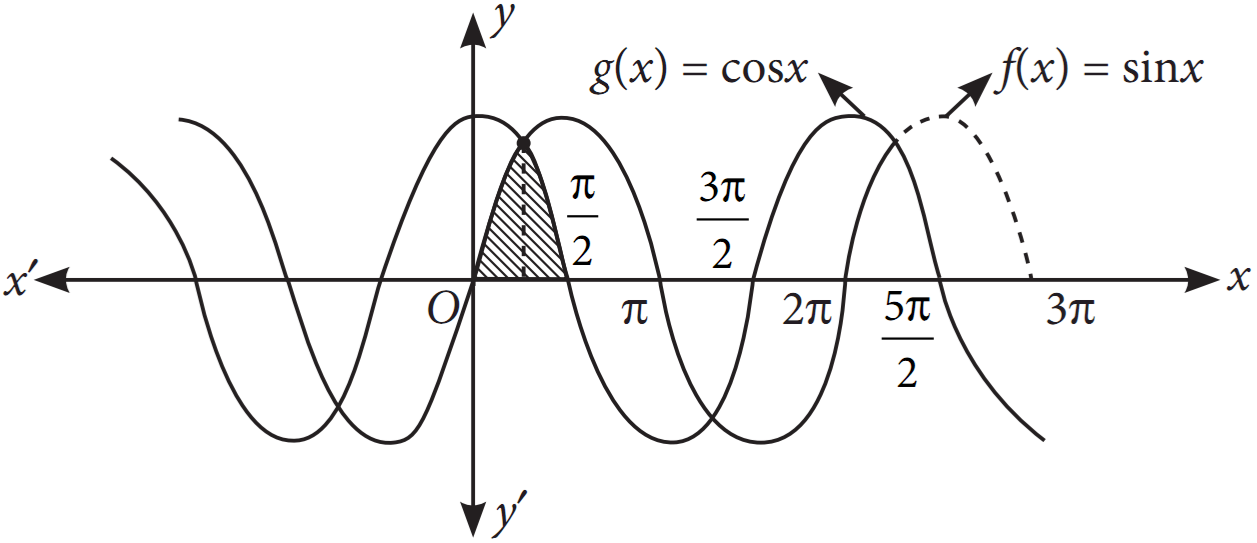
Graphs of two function $\text{f}(\text{x})=\text{sin}\text{ x}$ and $\text{(g)}\text{x}=\text{cos}\text{ x}$ is given below:

Based on the above information, answer the following questions.
  1. In $(0, \pi)$, the curves $\text{f}(\text{x})=\text{sin}\text{ x}$ and $\text{g}\text{ (x)}=\text{cos}\text{ x}$ at $\text{x}=$ 
    1. $\frac{\pi}{2}$
    2. $\frac{\pi}{3}$
    3. $\frac{\pi}{4}$
    4. ${\pi}$
  2. Value of $\int\limits_{0}^{\frac{\pi}{4}}\text{sin}\text{ x}\text{ dx}$ is.
    1. $1-\frac{1}{\sqrt{2}}$
    2. $1+\frac{1}{\sqrt{2}}$
    3. $2-\frac{1}{\sqrt{2}}$
    4. $2+\frac{1}{\sqrt{2}}$
  1. Value of $\int\limits_\frac{\pi}{4}^{\frac{\pi}{2}}\text{cos}\text{ x}\text{ dx}$ is.
    1. $1+\frac{1}{\sqrt{2}}$
    2. $1-\frac{1}{\sqrt{2}}$
    3. $2-\sqrt{2}$
    4. $2+\sqrt{2}$
  2. Value of $\int\limits_{0}^{\pi}\text{sin}\text{ x}\text{ dx}$ is.
  1. 0
  2. 1
  3. 2
  4. -2
  1. Value of $\int\limits_{0}^\frac{\pi}{2}\text{sin}\text{ x}\text{ dx}$ is.
  1. 0
  2. 1
  3. 3
  4. 4
Suppose a dealer in rural area wishes to purpose a number of sewing machines. He has only ₹ 5760 to invest and has space for at most 20 items for storage. An electronic sewing machine costs him ₹ 360 and a manually operated sewing machine ₹ 240. He can sell an electronic sewing machine at a profit of ₹ 22 and a manually operated sewing machine at a profit of ₹ 18.

Based on the above information, answer the following questions.

  1. Let x and y denotes the number of electronic sewing machines and manually operated sewing machines purchased by the dealer. If it is assume that the dealer purchased atleast one of the the given machines, then:
  1. $\text{x}+\text{y}\geq0$
  2. $\text{x}+\text{y}<0$
  3. $\text{x}+\text{y}>0$
  4. $\text{x}+\text{y}\leq0$
  1. Let the constraints in the given problem is represented by the following inequalities.

$\text{x}+\text{y}\leq20$

$360\text{x}+240\text{y}\leq5760$

$\text{x},\text{y}\geq0$

Then which of the following point lie in its feasible region.

  1. (0, 24)
  2. (8, 12)
  3. (20, 2)
  4. None of these
  1. If the objective function of the given problem is maximise z = 22x + 18y, then its optimal value occur at:
  1. (0, 0)
  2. (16, 0)
  3. (8, 12)
  4. (0, 20)
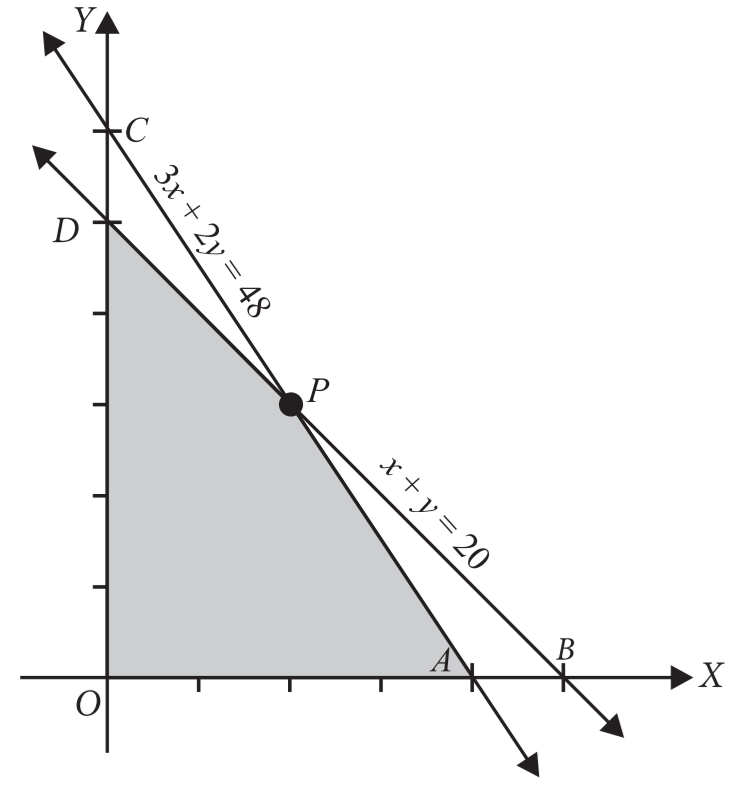
  1. Suppose the following shaded region APDO, represent the feasible region corresponding to mathematical formulation of given problem.

Then which of the following represent the coordinates of one of its corner points

  1. (0, 24)
  2. (12, 8)
  3. (8, 12)
  4. (6, 14)
  1. If an LPP admits optimal solution at two consecutive vertices of a feasible region, then:
  1. The required optimal solution is at the midpoint of the tine joining two points.
  2. The optimal solution occurs at every point on the tine joining these two points.
  3. The LPP under consideration is not solvable.
  4. The LPP under consideration must be reconstructed.
If there is a statement involving the natural number n such that:
  1. The statement is true for n = 1
  2. When the statement is true for n = k (where k is some positive integer), then the statement is also true for n = k + 1.
Then, the statement is true for all natural numbers n.
Also, if A is a square matrix of order n, then A2 is defined as AA. In general, Am = AA .... A (m times). where m is any positive integer.
Based on the above information, answer the following questions.
  1. If $\text{A}=\begin{bmatrix}3&-4\\1&-1\end{bmatrix},$ then for any positive integer n,
  1. $\text{A}^\text{n}=\begin{bmatrix}3\text{n}&-4\text{n}\\\text{n}&-\text{n}\end{bmatrix}$
  2. $\text{A}^\text{n}=\begin{bmatrix}1+2\text{n}&-4\text{n}\\\text{n}&1-2\text{n}\end{bmatrix}$
  3. $\text{A}^\text{n}=\begin{bmatrix}3\text{n}&-8\text{n}\\1&-\text{n}\end{bmatrix}$
  4. $\text{A}^\text{n}=\begin{bmatrix}1+3\text{n}&-4\text{n}\\\text{n}&1-3\text{n}\end{bmatrix}$
  1. If $\text{A}=\begin{bmatrix}1&2\\0&1\end{bmatrix},$ then |An|, where $\text{n}\in\text{ N},$ is equal to:
  1. 2n
  2. 3n
  3. n
  4. 1
  1. If $\text{A}=\begin{bmatrix}1&0\\1&1\end{bmatrix}$ and $\text{I}=\begin{bmatrix}1&0\\0&1\end{bmatrix}$ then which of the following holds for all natural numbers $\text{n}\geq1?$
  1. A= nA - (n - 1)I
  2. An = 2n-1 A - (n - 1)I
  3. A= nA + (n - 1)I
  4. An = 2n-1 A + (n - 1)I
  1. Let $\text{A}=\begin{bmatrix}\text{a}&0&0\\0&\text{a}&0\\0&0&\text{a}\end{bmatrix}$ and $\text{A}^\text{n}=[\text{a}_{\text{ij}}]_{3\times3}$ for some positive integer n, then the cofactor of a13 is:
  1. an
  2. -an
  3. 2an
  4. 0
  1. If A is a square matrix such that |A| = 2, then for any positive integer n, |An| is equal to:
  1. 0
  2. 2n
  3. 2n
  4. n2
In an office three employees Vinay, Sonia and Iqbal process incoming copies of a certain form. Vinay process 50% of the forms, Sonia processes 20% and Iqbal the remaining 30% of the forms. Vinay has an error rate of 0.06, Sonia has an error rate of 0.04 and Iqbal has an error rate of 0.03.

Based on the above information, answer the following questions.
  1. The conditional probability that an error is committed in processing given that Sonia processed the form is:
  1. 0.0210
  2. 0.04
  3. 0.47
  4. 0.06
  1. The probability that Sonia processed the form and committed an error is:
  1. 0.005
  2. 0.006
  3. 0.008
  4. 0.68
  1. The total probability of committing an error in processing the form is:
  1. 0
  2. 0.047
  3. 0.234
  4. 1
  1. The manager of the company wants to do a quality check. During inspection he selects a form at random from the days output of processed forms. If the form selected at random has an error, the probability that the form is NOT processed by Vinay is:
  1. $1$

  2. $\frac{30}{47}$

  3. $\frac{20}{47}$

  4. $\frac{17}{47}$

  1. Let A be the event of committing an error in processing the form and let E1, E2 and E3 be the events that Vinay, Sonia and Iqbal processed the form. The value of $\sum\limits^3_\text{i=1}\ \text{P}(\text{E}_\text{i}\ |\ \text{A})$ is:
  1. 0
  2. 0.03
  3. 0.06
  4. 1
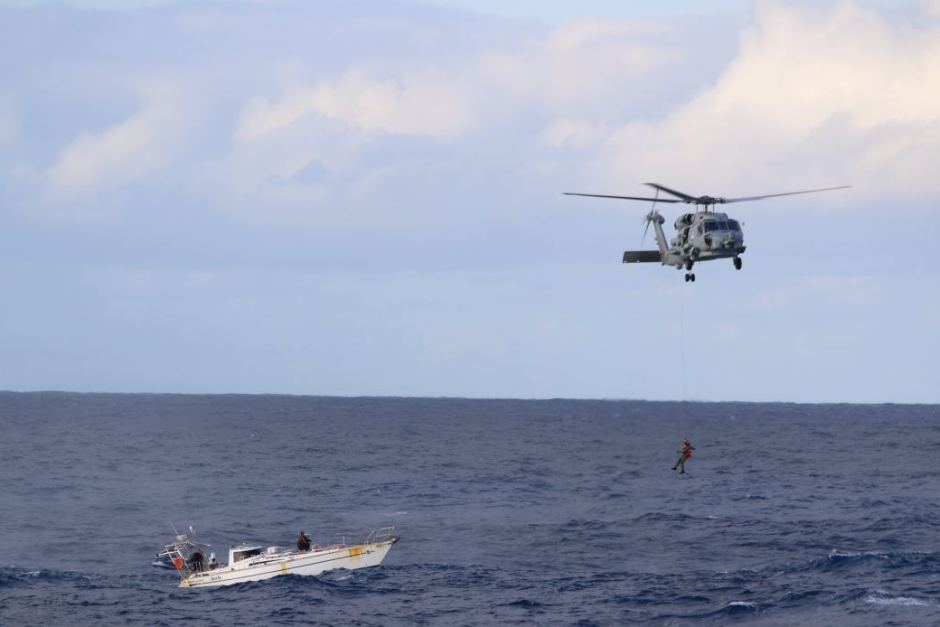
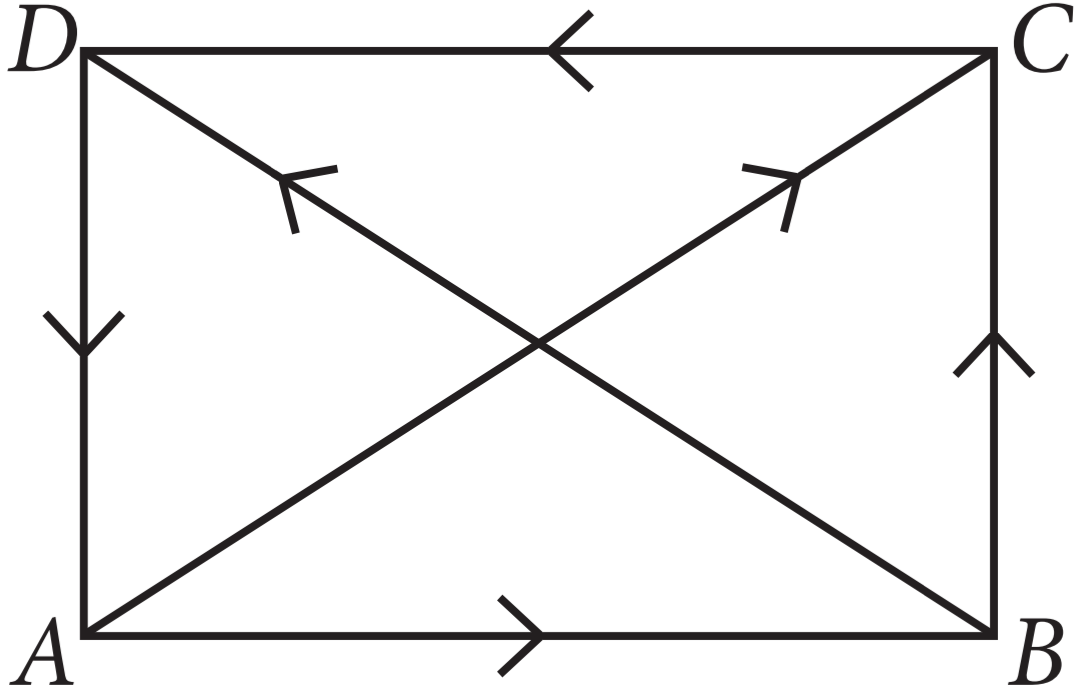
The Indian Coast Guard (ICG) while patrolling, saw a suspicious boat with four men. They were nowhere looking like fishermen. The soldiers were closely observing the movement of the boat for an opportunity to seize the boat. They observe that the boat is moving along a planar surface. At an instant of time, the coordinates of the position of coast guard helicopter and boat are (2, 3, 5) and (1, 4, 2) respectively.

Based on the above information, answer the following questions.
  1. If the line joining the positions of the helicopter and boat is perpendicular to the plane in which boat moves, then equation of plane is:
  1. x - y + 3z = 2
  2. x + y  + 3z = 2
  3. x - y + 3z = 3
  4. x + y + 3z = 3
  1. If the soldier decides to shoot the boat at given instant of time, where the distance measured in metres then what is the distance that bullet has to travel?
  1. $\sqrt{5}\text{m}$

  2. $\sqrt{8}\text{m}$

  3. $\sqrt{10}\text{m}$

  4. $\sqrt{11}\text{m}$

  1. If the speed of bullet is 30m/ sec, then how much time will the bullet take to hit the boat after the shot is fired?
  1. 30 seconds
  2. 1 second
  3. $\frac{1}{2}\text{second}$

  4. $\frac{\sqrt{11}}{30}\text{seconds}$

  1. At the given instant of time, the equation of line passing through the positions of helicopter and boat is:
  1. $\frac{\text{x}}{1}=\frac{\text{y}}{-1}=\frac{\text{z}}{3}$

  2. $\frac{\text{x}-1}{1}=\frac{\text{y}-4}{-1}=\frac{\text{z}-2}{3}$

  3. $\frac{\text{x}}{1}=\frac{\text{y}}{1}=\frac{\text{z}}{-3}$

  4. $\frac{\text{x}-1}{1}=\frac{\text{y}-4}{1}=\frac{\text{z}-2}{-3}$

  1. At a different instant of time, the boat moves to a different position along the planar surface. What should be the coordinates of the location of the boat for the bullet to hit the boat if soldier shoots the bullet along the line whose equation is $\frac{\text{x}-1}{1}=\frac{\text{y}-1}{-2}=\frac{\text{z}-2}{3}?$
  1. $\Big(\frac{1}{2},\frac{1}{2},\frac{1}{2}\Big)$

  2. $\Big(\frac{3}{4},\frac{3}{2},\frac{5}{4}\Big)$

  3. $\Big(\frac{1}{3},\frac{1}{4},\frac{1}{5}\Big)$

  4. None of these
Two farmers Shyam and Balwan Singh cultivate only three varieties of pulses namely Urad, Masoor and Mung. The sale (in ₹) of these varieties of pulses by both the farmers in the month of September and October are given by the following matrices A and B.

September sales (in ₹)
$\begin{matrix}\ \ \ \ \ \ \ \ \ \ \text{Urad}&\text{Masoor}&\text{Mung}\end{matrix}\\\text{A}=\begin{bmatrix}10000&20000&30000\\50000&30000&10000\end{bmatrix}\begin{matrix}\text{Shayam}\\\text{Balwan singh}\end{matrix}$
October sales (in ₹)
$\begin{matrix}\ \ \ \ \ \ \ \ \ \ \text{Urad}&\text{Masoor}&\text{Mung}\end{matrix}\\\text{B}=\begin{bmatrix}10000&20000&30000\\50000&30000&10000\end{bmatrix}\begin{matrix}\text{Shayam}\\\text{Balwan singh}\end{matrix}$
Using algebra of matrices, answer the following questions.
  1. The combined sales of Masoor in September and October, for farmer Balwan Singh, is:
  1. ₹ 80000
  2. ₹ 90000
  3. ₹ 40000
  4. ₹ 135000
  1. The combined sales of Urad in September and October, for farmer Shyam is:
  1. ₹ 20000
  2. ₹ 30000
  3. ₹ 36000
  4. ₹ 15000
  1. Find the decrease in sales of Mung from September to October, for the farmer Shyam.
  1. ₹ 24000
  2. ₹ 10000
  3. ₹ 30000
  4. No change
  1. If both farmers receive 2% profit on gross sales, compute the profit for each farmer and for each variety sold in October.
  1. $\begin{matrix} \ \text{Urad}&\text{Masoor}&\text{Mung}\end{matrix}\\\begin{bmatrix}100&\ \ \ \ \ \ 200&\ \ \ \ \ 220\\400&\ \ \ \ \ \ 300&\ \ \ \ \ 200\end{bmatrix}\begin{matrix}\text{Shayam}\\\text{Balwan singh}\end{matrix}$
  2. $\begin{matrix} \ \text{Urad}&\text{Masoor}&\text{Mung}\end{matrix}\\\begin{bmatrix}100&\ \ \ \ \ \ 200&\ \ \ \ \ 120\\400&\ \ \ \ \ \ 200&\ \ \ \ \ 200\end{bmatrix}\begin{matrix}\text{Shayam}\\\text{Balwan singh}\end{matrix}$
  3. $\begin{matrix} \ \text{Urad}&\text{Masoor}&\text{Mung}\end{matrix}\\\begin{bmatrix}150&\ \ \ \ \ \ 200&\ \ \ \ \ 220\\400&\ \ \ \ \ \ 200&\ \ \ \ \ 280\end{bmatrix}\begin{matrix}\text{Shayam}\\\text{Balwan singh}\end{matrix}$
  4. $\begin{matrix} \ \text{Urad}&\text{Masoor}&\text{Mung}\end{matrix}\\\begin{bmatrix}100&\ \ \ \ \ \ 200&\ \ \ \ \ 120\\250&\ \ \ \ \ \ 200&\ \ \ \ \ 220\end{bmatrix}\begin{matrix}\text{Shayam}\\\text{Balwan singh}\end{matrix}$
  1. Which variety of pulse has the highest selling value in the month of September for the farmer Balwan Singh?
  1. Urad
  2. Masoor
  3. Mung
  4. All of these have the same price
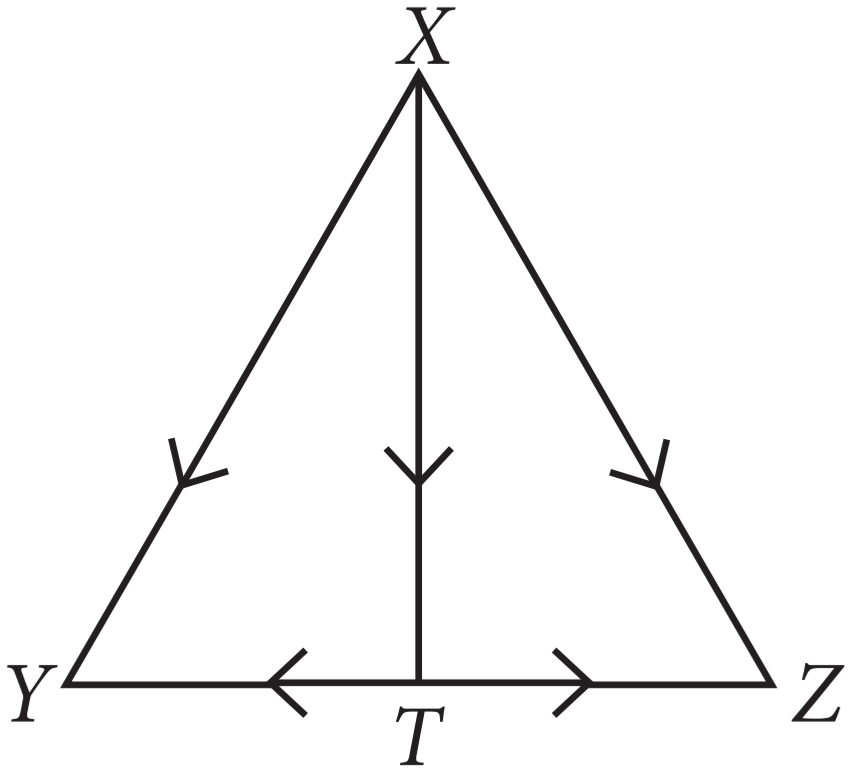
If two vectors are represented by the two sides of a triangle taken in order, then their sum is represented by the third side of the triangle taken in opposite order and this is known as triangle law of vector addition. Based on the above information, answer the following questions.
  1. If $\vec{\text{p}},\vec{\text{q}},\vec{\text{r}}$ are the vectors represented by the sides of a triangle taken in order, then $\vec{\text{q}},+\vec{\text{r}}=$
  1. $\vec{\text{p}}$

  2. $2\vec{\text{p}}$

  3. $-\vec{\text{p}}$

  4. None of these
  1. If ABCD is a parallelogram and AC and BD are its diagonals, then $\overline{\text{AC}}+\overline{\text{BD}}=$
  1. $2\overline{\text{DA}}$

  2. $2\overline{\text{AB}}$

  3. $2\overline{\text{BC}}$

  4. $2\overline{\text{BD}}$

  1. If ABCD is a parallelogram, where $\overline{\text{AB}}=2\vec{\text{a}}$ and $\overline{\text{BC}}=2\vec{\text{b}},$ then $\overline{\text{AC}}-\overline{\text{BD}}=$
  1. $3\vec{\text{a}}$

  2. $4\vec{\text{a}}$

  3. $2\vec{\text{b}}$

  4. $4\vec{\text{b}}$

  1. If ABCD is a quadrilateral whose diagonals are $\overline{\text{AC}}$ and $\overline{\text{BD}},$ then $\overline{\text{BA}}+\overline{\text{DC}}=$

  1. $\overline{\text{AC}}+\overline{\text{DB}}$

  2.  $\overline{\text{AC}}+\overline{\text{BD}}$

  3. $\overline{\text{BC}}+\overline{\text{AD}}$

  4. $\overline{\text{BD}}+\overline{\text{CA}}$

  1. If T is the mid point of side YZ of $\triangle\text{XYZ},$ then $\overline{\text{XY}}+\overline{\text{XZ}}=$

  1. $2\overline{\text{YT}}$

  2. $2\overline{\text{XT}}$

  3. $2\overline{\text{TZ}}$

  4. None of these
 In a wedding ceremony, consists of father, mother, daughter and son line up at random for a family photograph, as shown in figure.

Based on the above information, answer the following questions.

  1. Find the probability that daughter is at one end, given that father and mother are in the middle.
  1. $1$

  2. $\frac{1}{2}$

  3. $\frac{1}{3}$

  4. $\frac{2}{3}$
  1. Find the probability that mother is at right end, given that son and daughter are together.
  1. $\frac{1}{2}$

  2. $\frac{1}{3}$

  3. $\frac{1}{4}$

  4. $0$
  1. Find the probability that father and mother are in the middle, given that son is at right end.
  1. $\frac{1}{4}$

  2. $\frac{1}{2}$

  3. $\frac{1}{3}$

  4. $\frac{2}{3}$

  1. Find the probability that father and son are standing together, given that mother and daughter are standing together.
  1. $0$

  2. $1$

  3. $\frac{1}{2}$

  4. $\frac{2}{3}$

  1. Find the probability that father and mother are on either of the ends, given that son is at second position from the right end.
  1. $\frac{1}{3}$

  2. $\frac{2}{3}$

  3. $\frac{1}{4}$

  4. $\frac{2}{5}$  

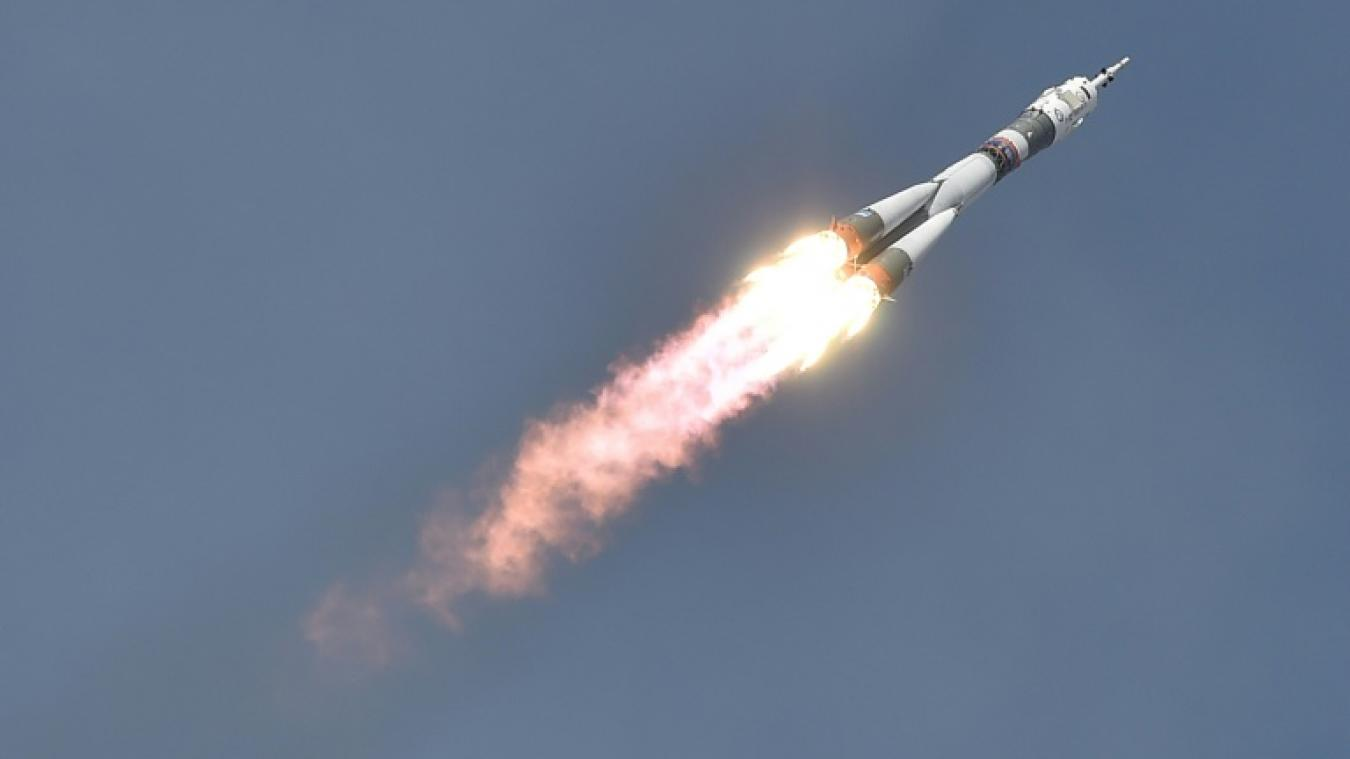
The upward speed v(I) of a rocket at time I is approximated by $\text{v}(\text{t})=\text{at}^2+\text{bt}+\text{c},0\leq\text{t}\leq100,$ here a, b and c are constants. It has been found that the speed at times t = 3, t = 6 and t = 9 seconds are respectively 64, 133 and 208 miles per second..

If $\begin{bmatrix}9&3&1\\36&6&1\\81&9&1\end{bmatrix}^{-1}=\frac{1}{18}\begin{bmatrix}1&-2&1\\-15&24&-9\\54&-54&18\end{bmatrix},$ then answer the following questions.
  1. The value of b + c is:
  1. 20
  2. 21
  3. $\frac{3}{4}$
  4. $\frac{4}{3}$
  1. The value of a + c is:
  1. 1
  2. 20
  3. $\frac{4}{3}$
  4. None of these.
  1. v(t) is given by:
  1. $\text{t}^2+20\text{t}+1$
  2. $\frac{1}{3}\text{t}^2+20\text{t}+1$
  3. $\text{t}^2+\frac{1}{3}\text{t}+20$
  4. $\text{t}^2+\text{t}+1$
  1. The speed at time 1 = 15 seconds is:
  1. 346 miles/ sec
  2. 356 miles/ sec
  3. 366 miles/ sec
  4. 376 miles/ sec
  1. The time at which the speed of rocket is 784 miles/ sec is:
  1. 20 seconds
  2. 30 seconds
  3. 25 seconds
  4. 27 seconds