Answer

Get the step-by-step solution for this question inside the Vidyadip app.

Get the answer in the app

Need a full question paper?

Generate a complete, print-ready paper with questions like this in minutes — across 16+ boards, with answer keys.
Start Generating Free

Similar questions

(a) (i) Write the disproportionation reaction of $H _3 PO _3$.
(ii) Draw the structure of $XeF _4$.
(b) Account for the following:
(i) Although fluorine has less negative electron gain enthalpy yet $F_2$ is a strong oxidizing agent.
(ii) Acidic character decreases from $N _2 O _3$ to $Bi _2 O _3$ in group 15.
(c) Write a chemical reaction to test Sulphur dioxide gas. Write the chemical equation involved.
Describe a method for the identification of primary, secondary and tertiary amines. Also write chemical equations of the reaction involved.
What do you mean by elevation of boiling point and molal elevation constant? Give the formula or equation to determine the molar mass from elevation of boiling point.
  1. What may be the possible oxidation states of the transition metals with the following d electronic configurations in the ground state of their atoms:
  1. $3d^34s^2, 3d^54s^2$ and $3d^6 4s^3$. Indicate relative stability of oxidation states in each case.
  2. Write steps involved in the preparation of $(i) Na_2CrO_4$ from chromite ore and $(ii) K_2MnO_4$ from pyrolusite ore.
Explain the methods of preparation alcohol from the following compounds:
(a) From carbonyl compound
(b) From carboxylic acid
(c) From esters
(d) From Grignard reagent
  1. Define the following terms:
  1. Molarity.
  2. Molal elevation constant$(Kb).$
  1. A solution containing $15\ g$ urea $($molar mass $= 60\ g\ mol^{–1})$ per litre of solution in water has the same osmotic pressure $($isotonic$)$ as a solution of glucose $($molar mass $= 180\ g\ mol^{–1})$ in water. Calculate the mass of glucose present in one litre of its solution.
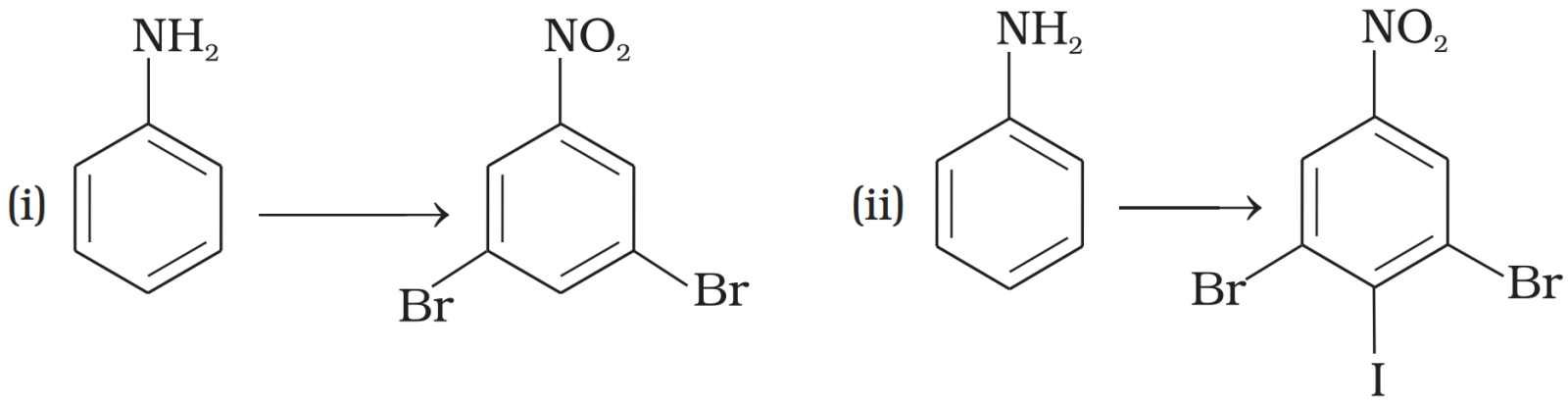
How are different aromatic compounds synthesized by benzene diazonium chloride? Explain with examples.
After watching a programme on $TV$ about the presence of carcinogens $($cancer causing agents$)$ Potassium bromate and Potassium iodate in bread and other bakery products, Veena, a class $XII$ student, decided to make others aware about the adverse effects of these carcinogens in foods. She consulted the school principal and requested him to instruct the canteen contractor to stop selling sandwiches, pizzas, burgers and other bakery products to the students. The principal took an immediate action and instructed the canteen contractor to replace the bakery products with some proteins and vitamins$-$rich food like fruits, salads, sprouts, etc. The decision was welcomed by the parents and students.
After reading the above passage, answer the following questions:
  1. What are the values $($at least two$)$ displayed by Veena?
  2. Which polysaccharide component of carbohydrates is commonly present in bread?
  3. Write the two types of secondary structures of proteins.
  4. Give two examples of water soluble vitamins.
Complete the following reactions :
(i) $C _6 H _5 NH _2+ CHCl _3+$ alc. $KOH \longrightarrow$
(ii) $C _6 H _5 N_2 Cl + H _3 PO _2+ H _2 O \longrightarrow$
(iii) $C _6 H _5 NH _2+ H _2 SO _4$ (conc.) ⟶
(iv) $C _6 H _5 N_2 Cl + C _2 H _5 OH \longrightarrow$
(v) $C _6 H _5 NH _2+ Br _2(a q) \longrightarrow$
i. Tert$-$Butylamine cannot be prepared by the action of $NH_3$ on tert$-$butyl bromic. Explain why?
ii. Suggest a convenient method for the preparation of tert$-$butylamine.