Question
  1. Differentiate between molarity and molality for a solution. How does a change in temperature influence their values?
  2. Calculate the freezing point of an aqueous solution containing $10.50\ g$ of $MgBr_2$ in $200\ g$ of water. (Molar mass of $MgBr_2 = 184 g$)
$(K_f$ for water $= 1.86\ K\ kg\ mol^{–1})$

Answer

  1. Molality (m) is the number of moles of the solute per kilogram (kg) of the solvent whereas Molarity is the number of moles of solute present in one litre (or one cubic decimeter) of solution at a particular temperature.
Molality is independent of temperature whereas Molarity is function. of temperature because volume depends on temperature and the mass does not or Molarity decreases with increase of temperature.
  1. $\Delta\text{T}_{f}=7.5^{o}C$
$\Delta\text{T}_{f}=\text{iK}_{f}\text{m}$
$\text{T}_{f}^{0}-\text{T}_{f}=3\times1.86^0\text{C kg mol}^{-1}\times\frac{10.50g}{\text{184 gmol}^{-1}}\times\frac{\text{1000}}{\text{200 kg}}$
$0^oC-T_f = 1.59^oC$
$T_f = –1.59^oC$ or $271.41\ K.$

Need a full question paper?

Generate a complete, print-ready paper with questions like this in minutes — across 16+ boards, with answer keys.

Start Generating Free

Similar questions

(a) What type of protein is present in keratin?
(b) Write the reactions showing the presence of following in the open structure of glucose:
   i. an aldehyde group
  ii. a primary alcohol
(c) What products would be formed when a nucleotide from DNA containing thymine is hydrolysed?
(d) Amino acids show amphoteric behaviour. Why?
(e) What are a Amino Acids? Give examples.
(f) a. How can you explain the absence of an aldehyde group in the pentaacetate of D-glucose?
    b. Name the bases present in RNA. Which one of these is not present in DNA?
(g) Which monosaccharide units are present in starch, cellulose and glycogen and which linkages link these units?
Attempt any five of the following$:$
$(a)$ Deficiency of which vitamin causes night$-$blindness.
$(b)$ Give two examples of reducing sugars.
$(c$) Define the following terms$:$
$i.$ Glycosidic linkage
$ii.$ Native protein
$(d)$ Write function of carbohydrates in plants.
$(e)$ Differentiate between$:$
$i.$ Peptide linkage and Glycosidic linkage
$ii.$ Nucleoside and Nucleotide
$(f)$ What type of linkage holds together the monomers of $ \text{DNA}?$
$(g$) Write the product obtained when $D-$glucose reacts with $H_2N-OH.$
i. Write one chemical reaction for each
a. Carbylamine reaction
b. Acetylation reaction
ii. Write structure of N,N-ethylmethylethanamide
Describe the reactions of carboxylic acids in which C-OH bond is broken.

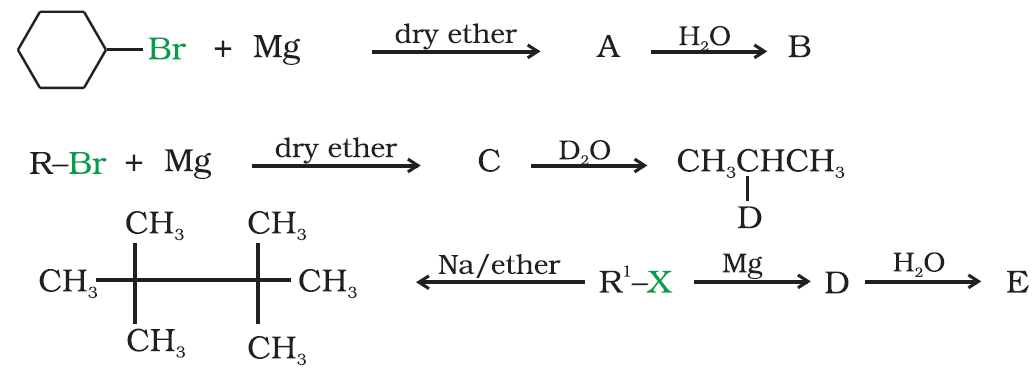
Identify A, B, C, D, E, R and $R^1$ in the following:
  1. Draw the structures of the following:
  1. $H_2S_2O_8$.
  2. $HClO_4$.
  1. How would you account for the following:
  1. $NH_3$​​​​​​​ is a stronger base than $PH_3$​​​​​​​.
  2. Sulphur, has a greater tendency for ‘catenation than oxygen'.
  3. $F_2$​​​​​​​ is a stronger oxidising agent than $Cl_2​​​​​​​$​​​​​​​.
  1. Complete the following chemical reaction equations:
i. $\text{MnO}_{4(aq)}^{-}+\text{C}_{2}\text{O}_{4(aq)}^{2-}+\text{H}^{+}_{(aq)}\rightarrow$

ii. $\text{Cr}_{2}\text{O}_{7(aq)}^{2-}+\text{Fe}^{2+}_{(aq)}+\text{H}_{(aq)}^{+}\rightarrow$
  1. Explain the following observations about the transition/inner transition elements:
  1. There is in general an increase in density of element from titanium (Z=22) to copper (Z=29).
  2. There occurs much more frequent metal-metal bonding in compounds of heavy transition elements (3rd series).
  3. The members in the actinoid series exhibit a larger number of oxidation states than the corresponding members in the lanthanoid series.
Describe the structure of a fuel cell. Draw labelled diagram of a structure of fuel cell?
All energetically effective collisions do not result in a chemical change. Explain with the help of an example.
  1. Account for the following:
  1. $BiH_3$ is the strongest reducing agent in Group $15$ elements hydrides.
  2. $Cl_2​​​​​​​$​​​​​​​ acts as a bleaching agent.
  3. Noble gases have very low boiling points.
  1. Draw the structures of the following:
  1. $H_4P_2O_7$
  2. $XeOF_4$​​​​​​​