Question
Differentiate between primary rainbow and secondary rainbow.

Answer

Primary rainbowSecondary rainbow
1. It forms between about 40° and 42° from the antisolar point.It is about 10° further out from the antisolar point than the primary rainbow.
2. Width of primary rainbow is 1/2 as secondary rainbow.It is turice as wide than primary rainbow.

Need a full question paper?

Generate a complete, print-ready paper with questions like this in minutes — across 16+ boards, with answer keys.
Start Generating Free

Similar questions

A $15.0 \mu F$ capacitor is connected to a $220 V , 50 Hz$ source. Find the capacitive reactance and the current (rms and peak) in the circuit. If the frequency is doubled, what happens to the capacitive reactance and the current?
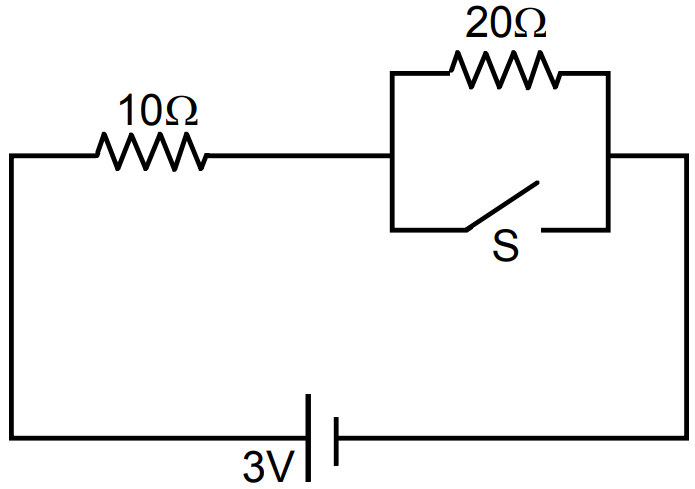
Consider the circuit shown in figure. Find the current through the $10\Omega$ resistor when the switch S is (a) Open (b) Closed.
Provide the classification of solids on the basis of the relative values of electrical conductivity $(\sigma)$ or resistivity $(\rho).$
The frequency of incident radiation $v$ in a photo-electric cell is greater than threshold frequency $v_0$. If frequency $v$ is increased, then how stopping potential will vary keeping other factors constant?
A single lens is mounted in a tube. A parallel beam enters the tube and emerges out of the tube as a divergent beam. Can you say with certainty that there is a diverging lens in the tube?
Explain the excited states for the hydrogen atom.
In a Quincke's experiment the sound detected is changed from a maximum to a minimum when the sliding tube is moved through a distance of 2.50cm. Find the frequency of sound if the speed of sound in air is 340m/s.
Two point charges $4Q, Q$ are separated by $1\ m$ in air. At what point on the line joining the charges is the electric field intensity zero?
Also calculate the electrostatic potential energy of the system of charges, taking the value of charge, $Q = 2 \times 10^{–7} C.$
  1. Can two equipotential surfaces intersect each other? Give reasons.
  2. Two charges – q and +q are located at points A (0, 0, –a) and B (0, 0, +a) respectively. How much work is done in moving a test charge from point P (7, 0, 0) to Q (-3, 0, 0)?
Write two differences between charge and mass.