Question
Differentiate between the following:
Plasma and Serum

Answer

PLASMASERUM
Plasma is a pale-yellow (straw-coloured) alkaline
liquid.
Serum is a yellow-coloured blood plasma.
It contains several salts, glucose, amino acid, fats,
enzymes, hormones, antibodies, and digested and
excreted products of food.
It is the blood plasma from which fibrinogen, the
blood clotting protein has been removed.
 It absorbs, transports and release heat.It is used in the treatment or prevention of certain
infections.

Need a full question paper?

Generate a complete, print-ready paper with questions like this in minutes — across 16+ boards, with answer keys.
Start Generating Free

Similar questions

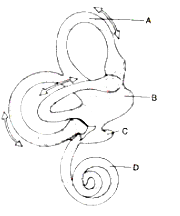
The diagram alongside represents the structure found in the inner ear. Study the same and then answer the questions that follow:
(i) Name the parts labelled A, B, C and D.
(ii) Name the parts of the ear responsible for transmitting impulses to the brain.
(iii) Name the part labelled above which is responsible for:
1. Static equilibrium. 2. Dynamic equilibrium. 3. Hearing
(iv) Name the audio receptor cells which pick up vibrations.
(v) Name the fluid present in the inner ear.
Briefly explain how the rate of transpiration is affected by
Intensity of light
Differentiate between the following:Plasmolysis and deplasmolysis
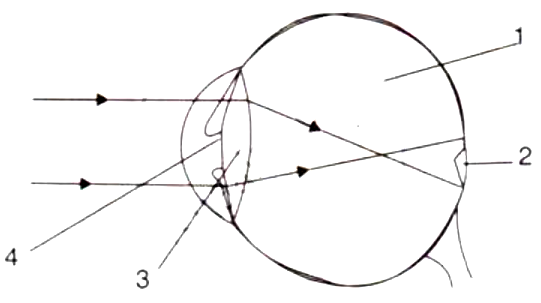
Given below is a diagram depicting a defect of the human eye? Study the same and answer the question that follow:

Draw a labeled diagram to show how the above mentioned defect is rectified using the lens named above.
Complete the following table:
 
Components Origin Function Approx. No. $(mm^3)$ Life span
RBCs        
WBCs        
Platelets        
(i) Draw a neat and well-labelled diagram of the Chloroplast.
(ii) List the events taking place in the photo-chemical phase of Photosynthesis.
(iii) If you are planning an experiment to show the effect of light on photosynthesis :
(a) Will you select white light or green light? Justify your answer.
(b) Why would you select a destarched plant?
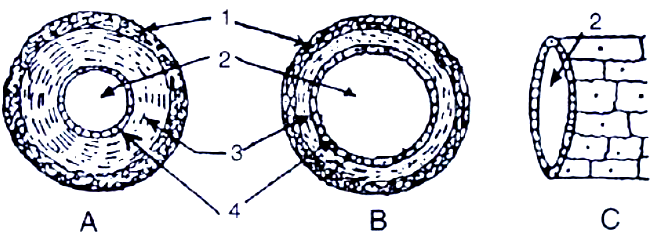
The figures given below show diagrammatic cross-sections of three kinds of blood vessels.

(a) Identify the blood vessels A, B and C
(b) Name the parts labelled 1-4
(c) Mention two structural differences between A and B.
(d) Name the kinds of blood that flow through A and through B respectively.
(e) In which one of the above vessels referred to in (a) above does the exchange of gases actually take place?
Which one or more of the expressions in column II are appropriate for the items listed in column I? write the correct matching pairs-
Column IColumn II
(i) The blind spot(a) colour of the eye
(ii) the yellow spot(b) shape of the lens
(iii) Ciliary muscle(c) protective covering of the brain
(iv) Iris(d) basic unit of brain
(v) Meninges(e) free of rod cells
(f) vitreous humour
(g) centre of the retina
(h) no sensory cells
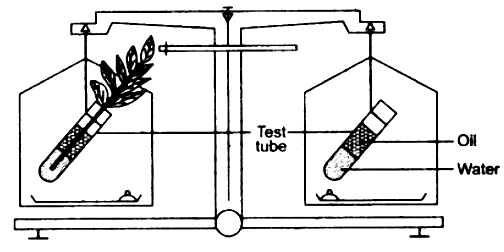
The figure given below represents an experimental set up with a weighing machine to demonstrate a particular process in plants. The experimental set up was placed in bright sunlight. Study the diagram and answer the following questions:

(i) Name the process intended for the study.
(ii) Define the above-mentioned process.
(iii) When the weight of the test tube (A & B) is taken before and after the experiment, what is observed ? Give reasons to justify your observation in A & B.
(iv) What is the purpose of keeping the test tube B in the experimental setup?
What is meant by positive and negative tropic movements in plants? Explain them by giving suitable examples.