Questions

[3 marks Question Answer]

🎯

Test yourself on this topic

11 questions · timed · auto-graded

Question 13 Marks
Differentiate between the following:
Systole and Diastole
Answer
SYSTOLEDIASTOLE
This is the phase during which the heart contracts.This is the phase of rest or relaxation of the heart muscles.
During systole, the atria send blood into the
ventricles to be ejected from the ventricles to the
corresponding vessels.
During diastole, the heart chambers fill with blood and the supply of the cardiac muscle is improved.
Time taken for atrial systole is 0.1 to 0.16 seconds
and ventricular systole is 0.3 seconds.
Atrial diastole lasts 0.7 to 0.76 seconds and
ventricular diastole lasts 0.5 to 0.56 seconds.
View full question & answer
Question 23 Marks
Differentiate between the following:
Pulmonary artery and pulmonary vein
Answer
PULMONARY ARTERYPULMONARY VEIN
It conveys the deoxygenated blood from the
right ventricle of the heart to the lungs.
It conveys oxygenated blood from the lungs to
the left atrium of the heart.
There are pulmonary semilunar valves at the
opening of the pulmonary artery.
There are no such valves in pulmonary vein.
View full question & answer
Question 33 Marks
Differentiate between the following:
Lymphocytes and Monocytes
Answer
LYMPHOCYTESMONOCYTES
These are small blood cells with large nucleus.They are large cells with kidney-shaped
nucleus.
Their normal count is 1800-3000 per ml. of blood,
about 30-35% of the total WBC count.
Their number varies from 200-700 per ml. of
 blood about 3-7% of total WBC count and measure 9-12 microns in diameter.
They produce antibodies and provide immunity
to the body and contribute in wound healing
and show immunological reactions during
transplantations.
They ingest microbes and other foreign bodies. They also act as scavengers, as they remove dead cells.
View full question & answer
Question 43 Marks
Differentiate between the following:
Eosinophil and Basophil
Answer
EOSINOPHILBASOPHIL
These cells have bilobed nucleus, where each lobe
is connected by a thin strand.
A basophil has two or more lobes in the nucleus.
The cytoplasmic granules stain orange-red with
acid dyes (eosin). Because of this affinity for
acidic dyes, they are also called acidophils.
Basophil has an affinity for basic dyes and stains blue-black with them.
Their normal count is 60-300 per ml. of blood,
about 2 to 5% of the total WBCs count.
Their number ranges from 35 to 100 per ml of blood, about 0.5 to 1% of the total WBC count.
Increase in the number of eosinophils in blood is
called eosinophilia. It is mainly due to parasitic
infection.
It produces a chemical (histamine) which dilates blood vessels making their wall leaky for other leucocytes to fight germs.
Eosinophils engulf particles formed by antigen-
antibody reaction.
t prevents clotting of blood in the blood vessels, and seratonins, which constrict blood vessels.
View full question & answer
Question 53 Marks
Differentiate between the following:
Blood and lymph
Answer
BLOODLYMPH
It is a red-coloured tissue fluid.Lymph is a yellow-coloured fluid.
Blood flow starts from heart and after flowing
through arteries, capillaries and veins it is
returned back to the heart.
Lymph starts from tissue spaces and after flowing
through lymph capillaries and lymphatic vessels enters the blood.
It contains more proteins.It contains fewer proteins.
It contains RBCs with haemoglobin, hence, red
in colour.
Only leucocytes present; RBCs are absent.
Platelets are present.Platelets are absent.
Flows rapidly.Flows slowly.
View full question & answer
Question 63 Marks
Differentiate between the following:
Plasma and Serum
Answer
PLASMASERUM
Plasma is a pale-yellow (straw-coloured) alkaline
liquid.
Serum is a yellow-coloured blood plasma.
It contains several salts, glucose, amino acid, fats,
enzymes, hormones, antibodies, and digested and
excreted products of food.
It is the blood plasma from which fibrinogen, the
blood clotting protein has been removed.
 It absorbs, transports and release heat.It is used in the treatment or prevention of certain
infections.
View full question & answer
Question 73 Marks
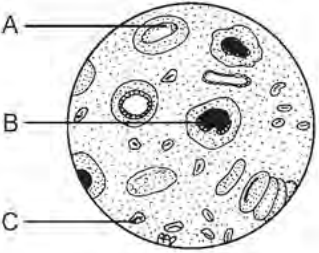
The diagram given alongside represents a blood smear. Answer the questions given below:
(i) Identify A, B and C.
(ii) State an important function of each.
(iii) State two important characteristics of B that enable it to carry out its function.

Image
Answer
(i) 1. Red Blood Cells (RBCs)
2. White Blood Cells (WBCs)
3. Platelet
(ii) RBCs contain haemoglobin which has an affinity for oxygen. So, RBCs transport the oxygen from lungs to the tissues.
WBCs form antibodies hence, defend the body against germs.
Platelets help in clotting of blood.
(iii) • Amoeboid movement of leucocytes (WBCs) help them to engulf the bacteria or germs.
• Lymphocytes (a type of WBCs) help in resisting the infections. So, these are a major constituent of the immune system.
View full question & answer
Question 83 Marks
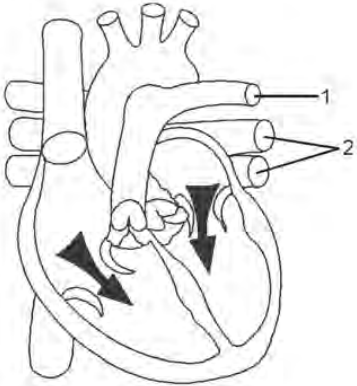
The diagram given below represents a section of the human heart. Answer the questions that follow:

Image
(i) Which parts of heart are in the diastolic phase? Give a reason to support your answer.
(ii) Label the parts numbered as 1 and 2 in the diagram. What type of blood flows through them?
(iii) What causes the heart sounds 'LUBB' and 'DUBB'?
Answer
(i) Ventricles are in the diastolic (relax) phase. The blood from atria is flowing to the ventricles.
(ii) Part 1 - Pulmonary artery
Part 2 - Pulmonary veins
(iii) The first heart sound (lubb) is associated with the closure of the tricuspid and bicuspid valves whereas the second heart sound (dubb) is associated with the closure of the semilunar valves.
View full question & answer
Question 103 Marks
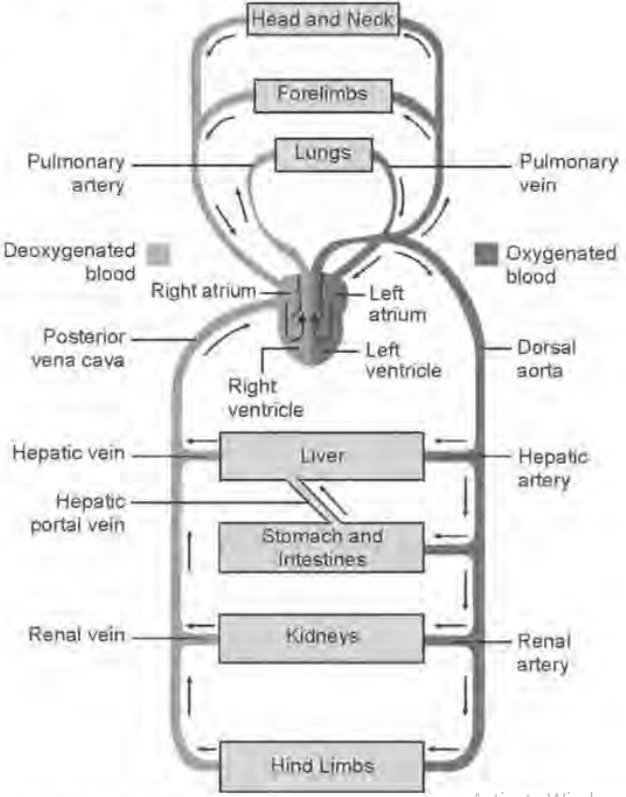
Give a diagramatic representation of circulatory system in humans.
Answer
Diagramatic representation of circulatory system

Image
View full question & answer
Question 113 Marks
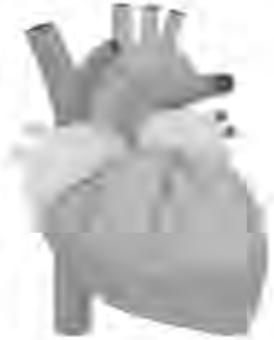
Given below is the diagram showing external view of human heart. Read the information and fill in the blanks:
The human heart, a vital organ, pumps blood throughout the body. It is conical in shape, encased in the pericardium. Made of cardiac muscle tissue, it contracts rhythmically to circulate blood. Valves inside regulate blood flow, ensuring unidirectional movement.
The heart is a muscular organ located slightly towards the (i) __________ side of the chest cavity. It is divided into four chambers: two upper chambers and two lower chambers called as $\qquad$ (ii) __________ . The right atrium receives deoxygenated blood from the body through the (iii) __________ The left atrium receives axygenated blood from the lungs through the (iv) __________ . Blood is pumped from the right ventricle to the lungs through the (v) __________ -

Image
Answer
(i) left
(ii) atria, ventricles
(iii) vena cava
(iv) pulmonary veins
(v) pulmonary artery
View full question & answer
[3 marks Question Answer] - Biology STD 10 Questions - Vidyadip