Question
Differentiate between
Nervous control and Hormonal control

Answer

Nervous ControlHormonal Control
 The information is sent in the form of electric
 signals.
 The information is sent in the form of chemical
 signals.
 The signals travel through nerve fibres to specific
 target cells like muscle fibres and glands.
 The signals travel through bloodstream to cells in
 different organs.
 The nervous system causes muscles to contract or
 relax, glands to secrete more or less. But it cannot
 bring about growth.
 Endocrine system brings about changes in   metabolic activities of all body tissues. It affects   growth.
 Action is immediate (within few milliseconds). Action is slow (can take hours or days to produce
 response).
 Effect lasts for a short time. Effect is more lasting and permanent.

Need a full question paper?

Generate a complete, print-ready paper with questions like this in minutes — across 16+ boards, with answer keys.
Start Generating Free

Similar questions

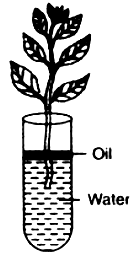
Study the diagram given below and answer the questions that follow:

(i) Name the process being studied in the above experiment.
(ii) Explain the process mentioned in (i) above.
(iii) Why is oil placed over water?
What is the direct cell division? Explain with an example.
Name the stimulus which causes the following movements in plants.
phototropism,thigmotropism, hydrotropism and geotropism
State any five functions of blood.
What is the significance of the testes being located in scrotal sacs outside the abdomen. Can there be any abnormal situation regarding their locations? If so, what is that and what is the harm caused due to it?
Give Reasons
A large number of sperms are required for fertilizing one egg.
What is the difference between stratospheric and ground level ozone?
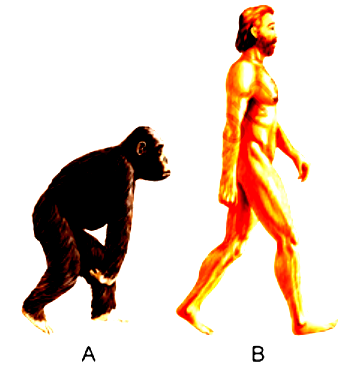
Given alongside are two figures (A and B) representing the two stages of evolution of human beings. Answer the following:

Mention any two contrasting characters between the two stages.
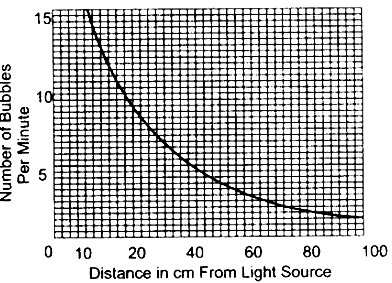
The diagram alongside refers to an experiment in which the apparatus was set up with the light source 10 cm away from the plant. After 15 minutes the number of bubbles evolved per minute from the cut stem was recorded. The light source was moved to 20 cm away from the plant, left for 15 minutes and the number of bubbles evolved per minute was again recorded. The experiment was repeated with the light source at distances of 40, 60, 80 and 100 cm away from the plant. Plot a graph for the results obtained and answer the following questions.

(i) From the graph it seems likely that the rate of bubbling per minute at 50 cm would have been
(a) 2.0 (b) 2.5 (c) 3.0 (d) 3.5
(ii) The gas produced by the plant during the experiment was
(a) air (b) oxygen (c) carbon dioxide (d) nitrogen (e) hydrogen
(iii) The gas collected comes due to the breakdown of
(a) glucose (b) starch (c) water (d) air (e) ATP
(iv) If ice cubes were added to the water, the rate of bubble formation would
(a) Stay the same.
(b) Increase because more water is added.
(c) Decrease because the temperature drops.
(d) Decrease because water freezes.
(e) Cannot tell from the information given.
(v) If some sodium bicarbonate is added to the water the rate of bubble formation
(a) Increases because more respiration occurs.
(b) Increases because more photosynthesis occurs.
(c) Increases because the gas becomes less soluble.
(d) Decreases because carbon dioxide acts as a limiting factor.
(e) Decreases because respiration decreases.
Give a labeled structure of ovum.