MCQ
Diffusion current in a p-n junction is greater than the drift current in magnitude:
- AIf the junction is forward-biased.
- BIf the junction is reverse-biased.
- CIf the junction is unbiased.
- DIn no case.
Explanation:
In the forward biassing of a p−n junction, the positive terminal of the battery is connected to the p side of the p−n junction and the negative terminal of the battery is connected to the n side of the p−n junction. As a result, electrons in the n side of the p−n junction are repelled by the negative terminal of the battery and move to the p side, where the positive terminal of the battery attracts the electrons. Similarly, holes from the p side of the p−n junction are repelled by the positive terminal of the battery and move to the nside, where the negative terminal of the battery attracts the holes. Thus, they give diffusion current across the p−n junction.
In case of reverse biassing, no conduction takes place across the junction because of the diffusion of majority carriers. Hence, there is no diffusion current.
If the junction is unbiased, then diffusion current is initially maximum. But at equilibrium, diffusion current becomes equal to drift current.
Generate a complete, print-ready paper with questions like this in minutes — across 16+ boards, with answer keys.
Assertion : At a point in space, the electric field points towards north. In the region, surrounding this point the rate of change of potential will be zero along the east and west.
Reason : Electric field due to a charge is the space around the charge.
|
(a) If both assertion and reason are true and the reason is the correct explanation of the assertion. |
|
(b) If both assertion and reason are true but reason is not the correct explanation of the assertion. |
|
(c) If assertion is true but reason is false. |
|
(d) If the assertion and reason both are false. |
Curie temperature is the temperature above which
|
(a) A paramagnetic material becomes ferromagnetic |
|
(b) A ferromagnetic material becomes paramagnetic |
| (c) A paramagnetic material becomes diamagnetic |
|
(d) A ferromagnetic material becomes diamagnetic |
The diagram shows-the energy levels for an electron in a certain atom. Which transition shown represents the emission of a photon with the most energy
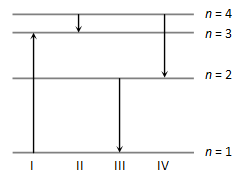
| (a) I | (b) II | (c) III | (d) IV |
A magnet is suspended in such a way that it oscillates in the horizontal plane. It makes 20 oscillations per minute at a place where dip angle is 30o and 15 oscillations per minute at a place where dip angle is 60o. The ratio of total earth's magnetic field at the two places is
(a) 3
|
(b) 16 : 9
|
(c) 4 : 9 |
(d) 2
|